

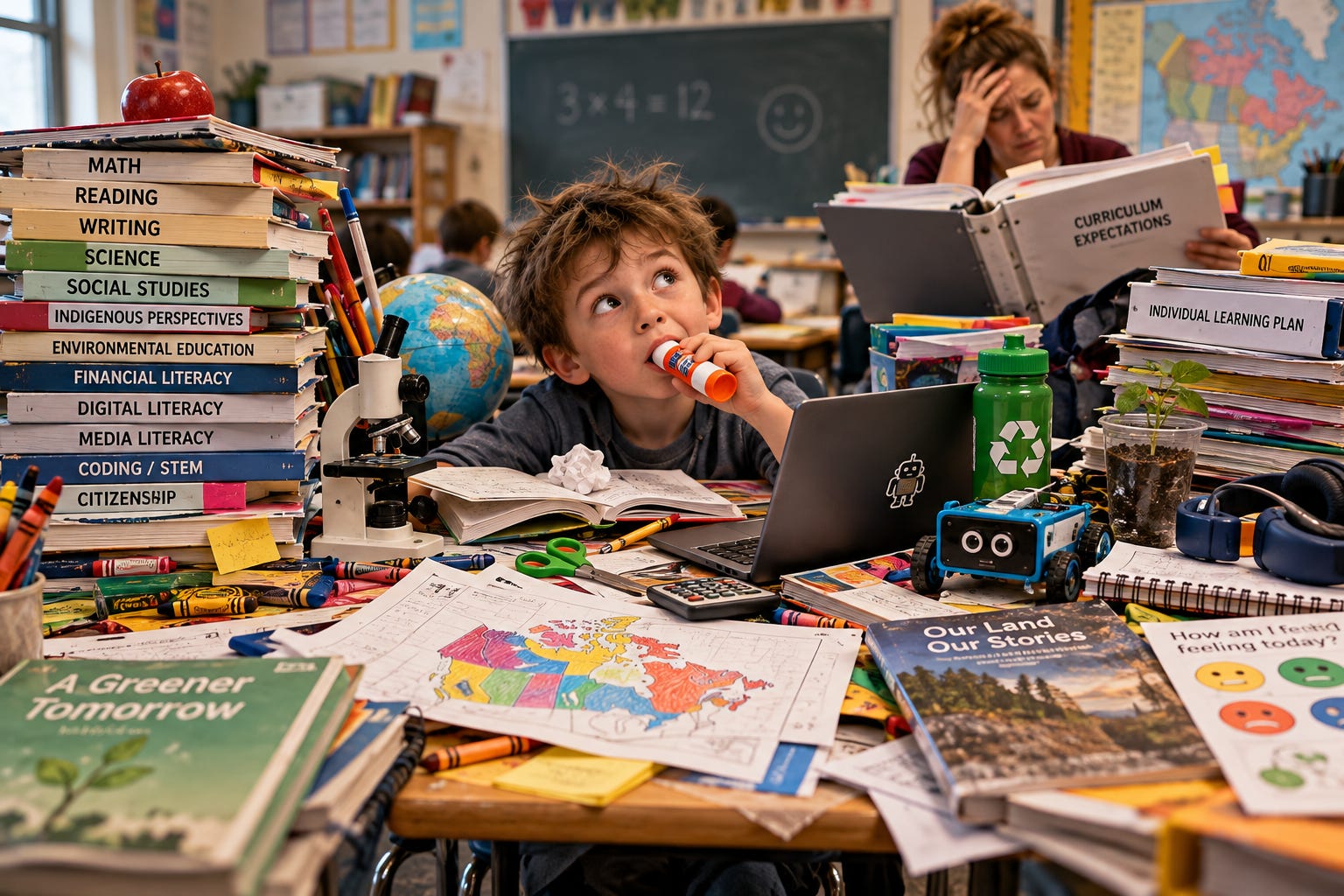
If you refer to your school memories as “back in the day,” you probably wouldn’t recognize what’s going on in a modern-day classroom.
Education has evolved, and that’s a good thing. Could you imagine if it didn’t?
“You won’t always have a calculator in your pocket” would still be considered great career advice. Computer class would start with typing C:\ and figuring out where the floppy disk goes. Our maps would still have places like the USSR and Czechoslovakia on them.
So yeah, education needed to evolve.
But did it need to evolve this much?
We can argue all day about what needs to be included and what doesn’t, but am I the only one overwhelmed by the sheer volume of what we expect from kids and teachers today?
When I was a kid, I remember a curriculum that seemed to revolve around reading, writing, math and recess. I’m sure we planted seeds in Dixie cups and kept them next to the window, probably to give us some science or fill time. I’m still not sure.
There was that map of Canada we got every year where we had to label the provinces and capitals and colour them in. Every. Fucking. Year.
If you were lucky enough to have a teacher who was so inclined, you’d get taken down to the gym and play basketball, volleyball or floor hockey. If you weren’t, they’d throw a bunch of dodgeballs at you and let natural selection take its course.
This was physical education.
As I start preparing myself for a return to the classroom, albeit standing in front of it, I keep asking myself the same question:
When the hell did we decide kids and teachers had to do all this stuff?
And look, I’m not asking whether school was better then or now. I’m certainly not falling into the nostalgia trap. I’m not crying for the return of cursive. I stopped using it the second my teachers stopped making me.
Frankly, I’m more concerned that kids today can’t type with all their fingers. I can type faster than I could ever write, and I can change a document to cursive with the click of a button.
Assuming anyone can still read it.
I’m also not pretending we didn’t have science or social studies or any of that when I was growing up. We did.
But put the Grade 3 curriculum from the 1980s beside the Grade 3 curriculum today and you start to understand what I’m talking about.
In 1975, Ontario’s provincial curriculum policy for Grades 1 through 6, The Formative Years, was all of 26 pages.
Twenty-six.
For six grades.
I dare you to try printing the equivalent curriculum today. You’d go through toner faster than quarters at a 1980’s arcade.
If you had a time machine and could drop today’s curriculum expectations into a smoke-filled staff room in nineteen-eighty-something, every teacher in the room would be fighting over the nearest rotary phone to call their union rep.
Great. So we expanded what our kids were supposed to learn to keep up with an advancing world.
Makes sense.
But did anyone stop for a second and think that maybe the system we use to deliver all of this needed to change too?
Back in the day, lesson planning could consist of turning the page in the textbook, writing something on the blackboard, assigning questions from that same textbook and then smoking a cigarette while sneaking whiskey into a coffee cup from a flask buried in the back of the desk while everyone got to work.
Okay, I may not have evidence for the whiskey.
But you know that guy existed.
Compare that with what we expect from teachers today.
They have to build units across multiple subjects they themselves might not be experts in. Tie themes together across those subjects. Differentiate instruction. Support accommodations and individual learning needs. Incorporate rapidly changing technology, digital literacy, media literacy and financial literacy.
Then somehow get coding, STEM, environmental education, citizenship, Indigenous histories and perspectives in there while supporting the social and emotional well-being of as many as thirty kids at once.
And here’s the problem:
Those are all good things.
That’s what makes this difficult.
We kept adding good things.
We just never seemed to stop and ask where the hell we were going to put them.
Sometimes I ask myself why I’m even trying to get back into a classroom.
The answer is that there’s a subset of society compelled towards teaching no matter how difficult we make it. I’m not trying to make it sound noble. We do it because watching the light bulb go off in someone else’s head is euphoric. It’s a high that can’t compare to any drug.
Unfortunately, before you can get to that moment, apparently you have to teach financial literacy, coding and environmental sustainability while simultaneously getting Brayden to stop licking a glue stick.
The problem isn’t that the curriculum has bad intentions.
It’s that we keep loading good intentions onto an antiquated system and then wondering why teachers are struggling to carry them.
And teachers aren’t the only ones drowning.
Students are struggling too.
Because we didn’t just add more things to the curriculum. Somewhere along the way, we also changed what it means to learn something.
Today’s students aren’t just expected to know something. Increasingly, they’re expected to understand it, explain it, apply it, investigate it, communicate it, make connections, solve problems, collaborate, demonstrate their understanding in different ways and then reflect on their learning.
Again, these are good things.
I want a kid to understand something rather than memorize it long enough to pass a test and immediately forget it.
But somewhere in our rush to improve education, I wonder if we started undervaluing the one thing that nearly comprised the entirety of the old system:
Repetition.
A kid gets better at reading by reading.
Writing by writing.
Arithmetic by doing arithmetic.
Spelling by spelling.
Sometimes learning really is that boring.
There are still only so many hours in a school day and so many school days in a year. And more often than not, there is still one teacher standing in front of the room.
I’m never going to advocate for burying kids under worksheets, but at some point we have to look at falling scores in math and literacy and ask ourselves what “getting back to basics” is actually supposed to mean.
Because something has got to give.
Do we scale back the expectations or scale up the resources?
How deeply do certain subjects need to be taught?
Where is exposure enough?
Do we need more educators in the classroom?
And here’s one I don’t think we ask enough:
Do we really need to grade all of it?
I’m not arguing that we get rid of science, stop teaching Indigenous history or throw computers out of classrooms.
I’m asking something much simpler.
What does a kid in Grade 3 really need to be able to do?
What would we like them to know?
How do we effectively get them there?
And maybe most importantly, if we’re going to keep adding things to the list, what are we willing to take off?
Because there are still only so many hours in the day.
And only so many times that poor kid needs to colour in the fucking map.