

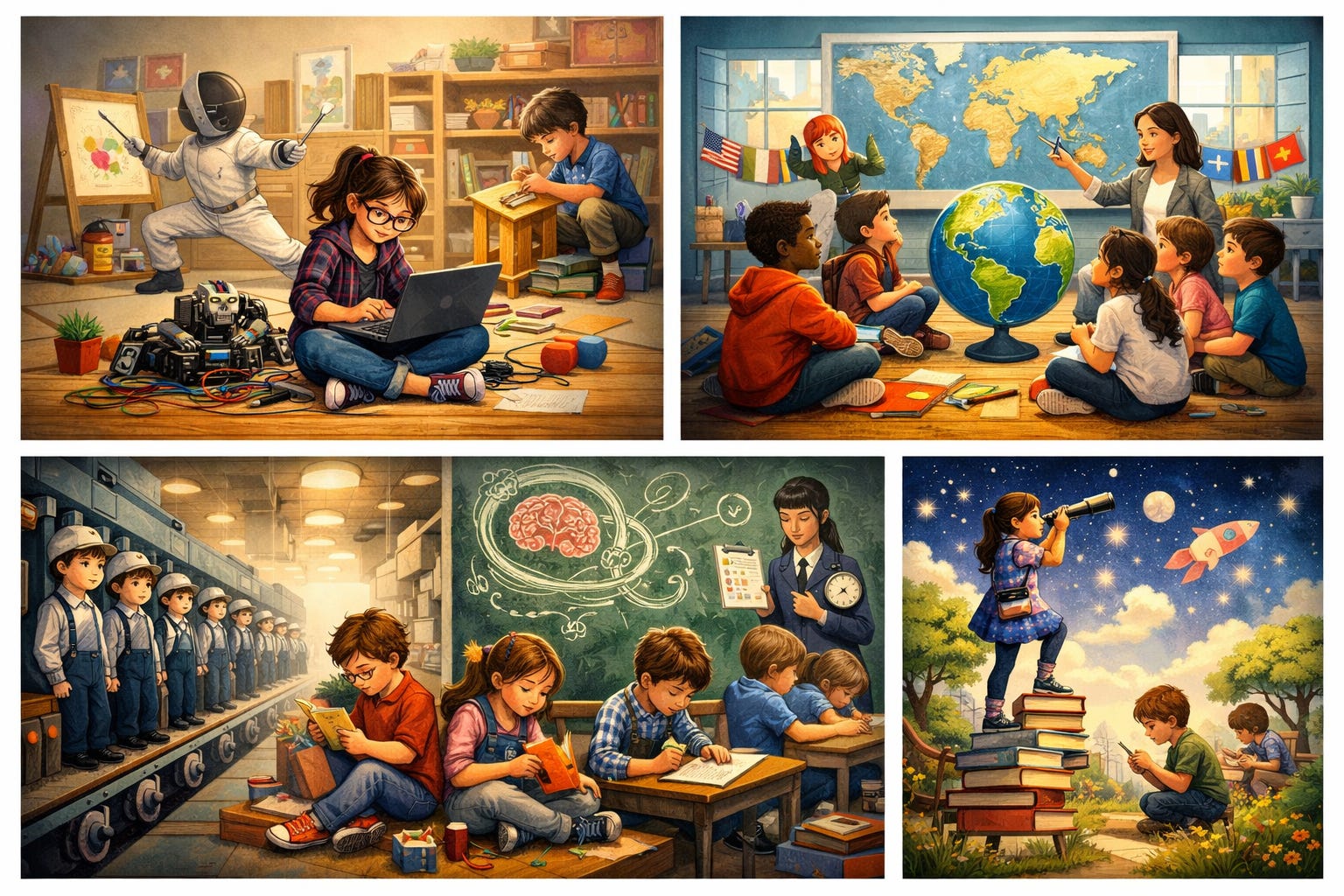
The one thing I wish most in this world is that we finally get education right.
That parents and families don’t have to spend years watching how much better other countries do it, wondering why we can’t do the same here.
Instead, we’re stuck inside an outdated system where *school* and *education* are treated as the same thing—when they aren’t.
One is about knowledge, curiosity, and understanding.
The other is about schedules, compliance, and systems.
We keep confusing structure for learning.
And then we act surprised when kids disengage, teachers burn out, and families feel like something is deeply off—but can’t quite name it.
Education should be alive.
What we have is a machine.
And just make it universal.
It’s getting absurd trying to teach history and geography from narrow, nationalized points of view when we all have access to the same information now.
Borders don’t change facts.
Perspective shouldn’t rewrite reality.
We’re still teaching like knowledge is scarce,
like books are rare,
like curiosity has to be rationed.
But the truth is, all you need today is enough curiosity to knock.
The door is already open.
Kids don’t need watered-down versions of the world.
They need context.
They need honesty.
They need to understand how everything connects—cultures, economies, mistakes, victories, consequences.
A shared foundation of truth wouldn’t erase identity.
It would strengthen it.
You don’t become less *you* by understanding the world.
You become harder to manipulate by anyone trying to lie about it.
And cohorts?
We’ve decided everyone is supposed to learn the same things,
at the same time,
in the same order,
at the same speed—
as if human development were an assembly line.
Fall behind and you’re labeled.
Get ahead and you’re bored.
Move differently and you’re “a problem.”
There’s no room to focus on different things at different times.
No permission to take knowledge in your own way, in your own rhythm.
So what—you can’t read fluently until you’re nine?
Fine.
You can fence.
You can build.
You can draw.
You can code.
You can move your body, train your mind, sharpen discipline somewhere else.
Learning isn’t linear.
Curiosity isn’t synchronized.
And intelligence sure as hell isn’t standardized.
And here’s the part we refuse to say out loud.
Some minds don’t move in straight lines.
They surge, loop, stall, sprint, obsess, drift, and suddenly lock in.
They don’t fail at learning—
they fail at waiting.
We keep punishing kids whose brains won’t sit still,
won’t absorb on command,
won’t care about the thing we’ve decided matters *right now*.
So they get labeled.
Managed.
Slowed down.
Or ignored.
But the truth is, those minds are often miles ahead—
just not on the path we paved.
You don’t need every child reading at six.
You need every child *engaged* somewhere.
Let them master something.
Anything.
Momentum creates momentum.
Cohorts were built for factories.
Curiosity was not.
Education shouldn’t be about control, sorting, or compliance.
It should be about exposure, pathways, and trust.
Give kids a shared foundation of truth.
Give them freedom in how they build on it.
And stop pretending that learning only counts
if it happens on schedule.
We don’t need better schools.
We need a better idea of what education actually is.
You're right Eric. Take Zinn's People's History of the United States. Great book, full of wonderful material, loaded with facts. But control of information, shaping a narrative, still occurs. Oh, the margins have been nibbled; colonization, exploitation, marginalized groups, all have received some attention. The spotlight has been shifted from the traditional stars, but what's changed? None of what Zinn said can really be disputed, but it's not the narrative I was fed in school, and certainly no teacher of mine cited him, save for my Vietnam vet high school Government teacher. He likely would be restricted from doing that nowadays, or fired