

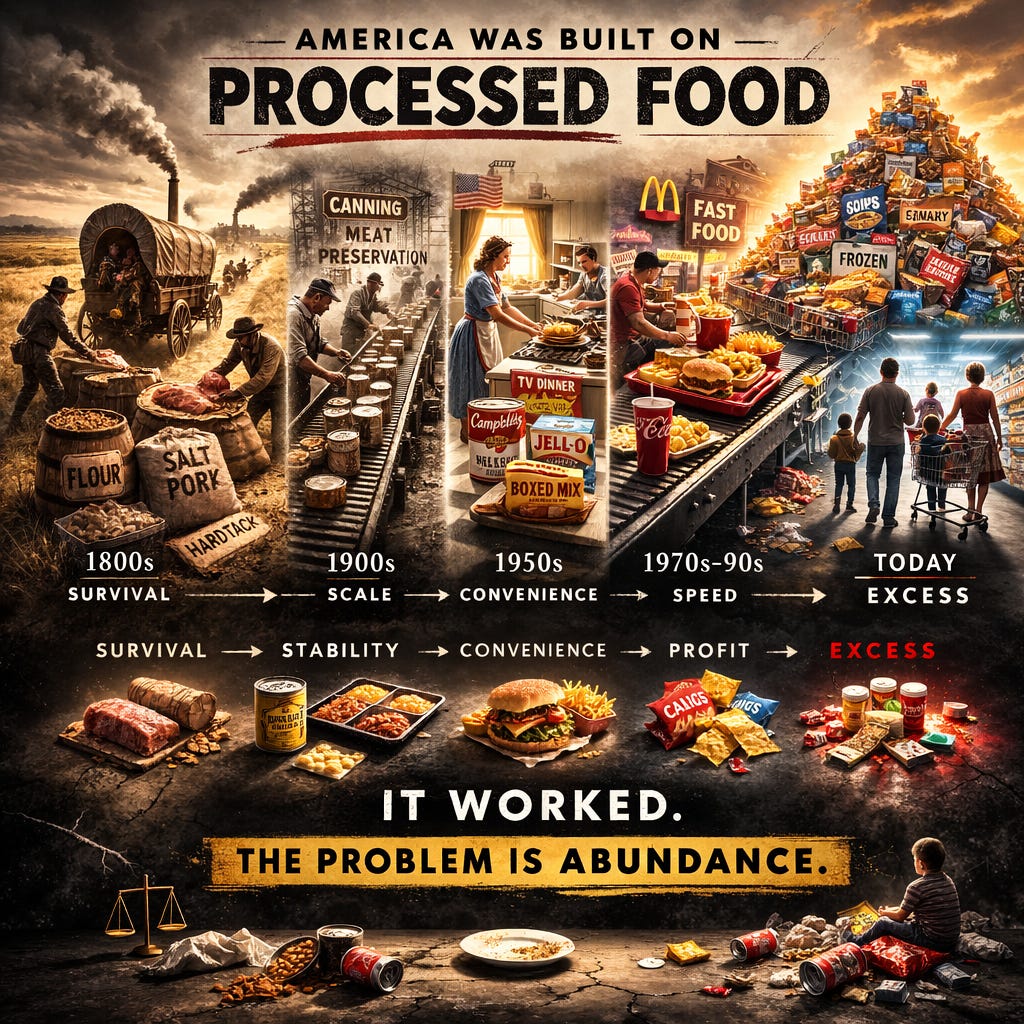
Everyone wonders why America has a problem with processed food.
The answer is simple.
America was built on processed food.
You think they had fresh fruit and vegetables waiting on the Oregon Trail? People crossing a continent packed flour, salt pork, dried beans, coffee, and whatever would survive months in a wagon. Food had to travel. It had to last. It had to endure heat, dust, rain, and time.
Processing wasn’t indulgence. It was survival.
Salting. Drying. Smoking. Fermenting. Canning. These weren’t corporate tricks. They were tools of expansion. If you wanted settlers to move west, they needed calories that wouldn’t rot halfway there.
And once they arrived? Harsh winters. Drought. Crop failures. Isolation. Food still had to last.
Fast forward to the first half of the 20th century. The coasts industrialized. Cities boomed. But large parts of the interior stayed rural, spread out, infrastructure thin. Refrigerated logistics weren’t what they are today. Thirty or fifty years ago, you couldn’t move fresh produce across the globe overnight. Even rail refrigeration took time to standardize and spread.
Processed food solved problems:
It lowered cost per calorie.
It extended shelf life.
It reduced foodborne illness.
It simplified preparation.
It fed factory workers who didn’t have two hours to cook after a 12-hour shift.
When you worked all day, you didn’t come home to knead bread and braise vegetables. You opened a can, heated something up, filled your belly, and went to sleep so you could do it again tomorrow.
That wasn’t decadence. That was industrial life.
By the 1950s, life got easier—but the diet didn’t reset. The mythology of the scratch-made suburban kitchen ignores what was actually on the stove: canned green beans, boxed mixes, frozen dinners, steak from the icebox. Thanksgiving cranberry sauce still sliding out of the can, ridges intact.
Look at Midwest casseroles—cream-of-whatever soup, packaged seasonings, Jell-O, marshmallows on yams, hot dogs mixed with whatever binds it together. Dump casseroles weren’t culinary accidents. They were cultural artifacts. Shelf-stable cuisine for a country built on distance, winter, and work.
Processed food did its job too well.
It solved scarcity. It solved safety. It solved labor in the kitchen. It became normal. It became tradition. It became American cuisine.
And now we pretend the word “processed” means poison.
Unless you pick an apple straight from the tree and eat it whole, you are eating processed food. Grind peanuts into butter? Processed. Chop fruit and bake it into a pie? Processed. Canned chickpeas for hummus? Processed. Peaches in a jar instead of rotting in the fridge? Processed.
Processing is not the villain. It’s the reason cities function and populations grow.
A granola bar isn’t killing you. A bag of chips isn’t a moral failure. You can overeat “clean” food just as easily as packaged food. Macros matter. Total calories matter. Activity matters.
Processed food didn’t weaken America.
It built it.
The problem isn’t processing.
The problem is abundance.