

The news doesn’t tell stories anymore.
It skims them.
Just enough information to make you angry,
not enough to make you understand why you should be angry in the first place.
Everything gets flattened into outrage bait.
A headline.
A number.
A villain.
Then on to the next thing before anyone has time to ask deeper questions.
Take the World Cup coming to North America.
The outrage is already predictable:
“Canada is spending over a billion dollars to host a handful of games.”
And sure — there’s an argument there.
You can absolutely ask whether the economic output justifies the cost.
But honestly?
That’s still not the real story.
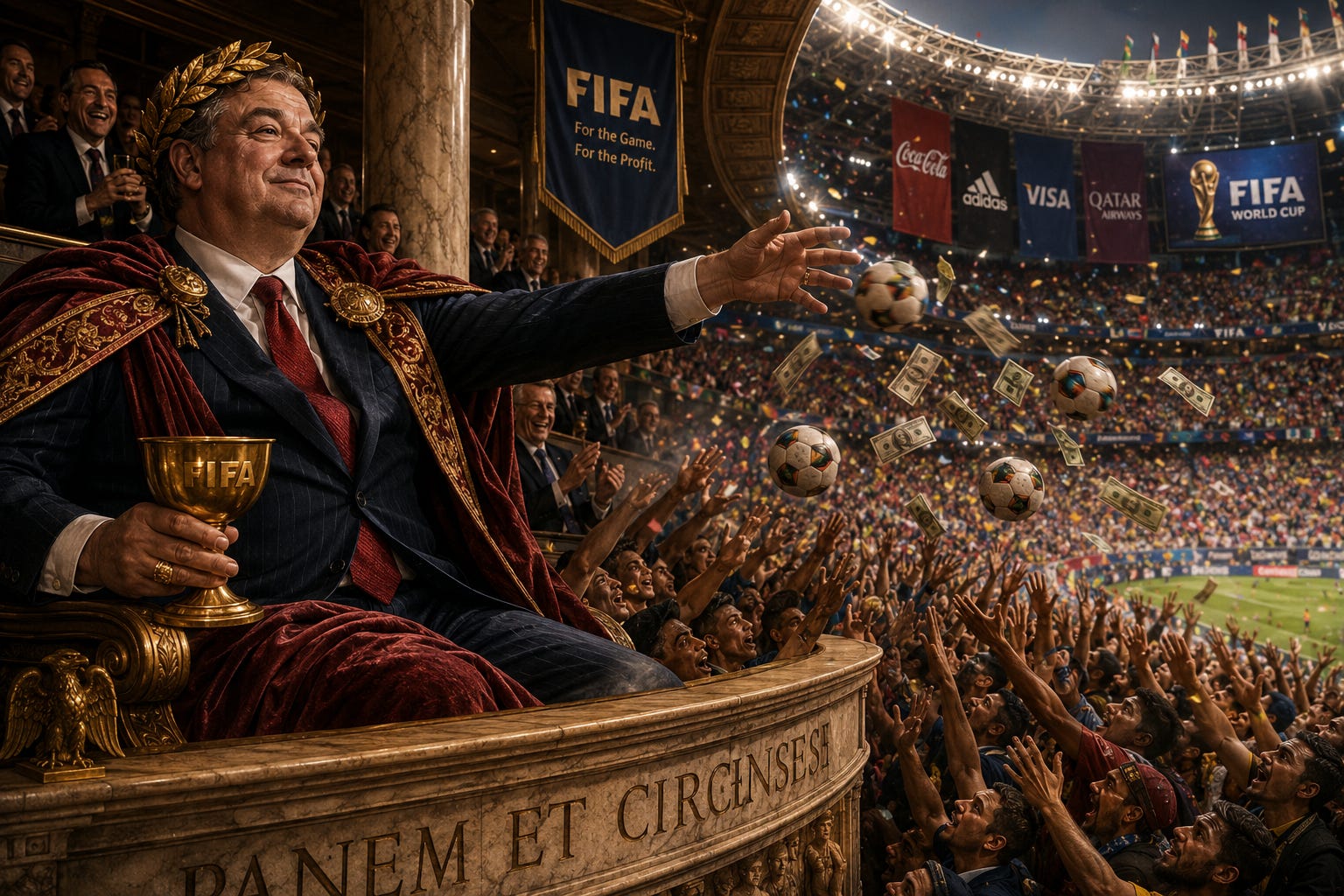
The real story is that organizations like FIFA and the International Olympic Committee have become so powerful, so normalized, that we barely react anymore to the ethical rot surrounding them.
And it’s not hidden corruption.
It’s open.
Documented.
Repeated.
Countries bend over backwards for these organizations.
Laws get rewritten.
Public money gets redirected.
Communities get displaced.
Workers get exploited.
Citizens get sold “legacy projects” that somehow never seem to benefit them the way promised.
And then, once the cameras leave, the people are expected to quietly carry the bill and move on.
That’s the pattern.
Every host country eventually discovers the same thing:
these organizations arrive speaking the language of unity, culture, and humanity —
while operating like corporations chasing leverage.
And somehow we’re supposed to separate the beauty of sport from the ugliness surrounding the institutions controlling it.
That’s getting harder to do.
Because the corruption isn’t just financial.
It’s moral.
You can’t spend years talking about human dignity, inclusion, and global togetherness while shaking hands with dictators, laundering reputations for authoritarian governments, and pretending politics magically disappears once a ball hits the pitch.
Sport has always been political because human beings are political.
And these organizations know it.
That’s why authoritarian governments love hosting these events.
It’s branding.
Image management.
A giant televised message to the world saying:
“Look how modern. Look how respected. Look how legitimate we are.”
And the governing bodies go along with it because the money keeps flowing.
That’s the part the news never really digs into.
Instead we get:
“Should taxpayers pay for stadiums?”
Sure. Fine. Ask that question.
But ask the bigger one too:
Why have we accepted that massively profitable global organizations can demand public obedience while operating with less accountability than the governments funding them?
Why do we treat these organizations like noble cultural institutions when they often behave more like untouchable corporate empires?
And look — I love football.
A road trip this summer to catch a couple games will probably be my annual vacation.
The games themselves aren’t the problem.
Sport matters.
Shared moments matter.
Joy matters.
But loving something also means being honest about what’s wrapped around it.
Because right now, ordinary people subsidize events they often can’t afford to attend, while the organizations behind them posture as guardians of humanity despite corruption scandals following them decade after decade.
And the media keeps missing the story.
Not because the information isn’t there.
Because outrage is easier to sell than understanding.