

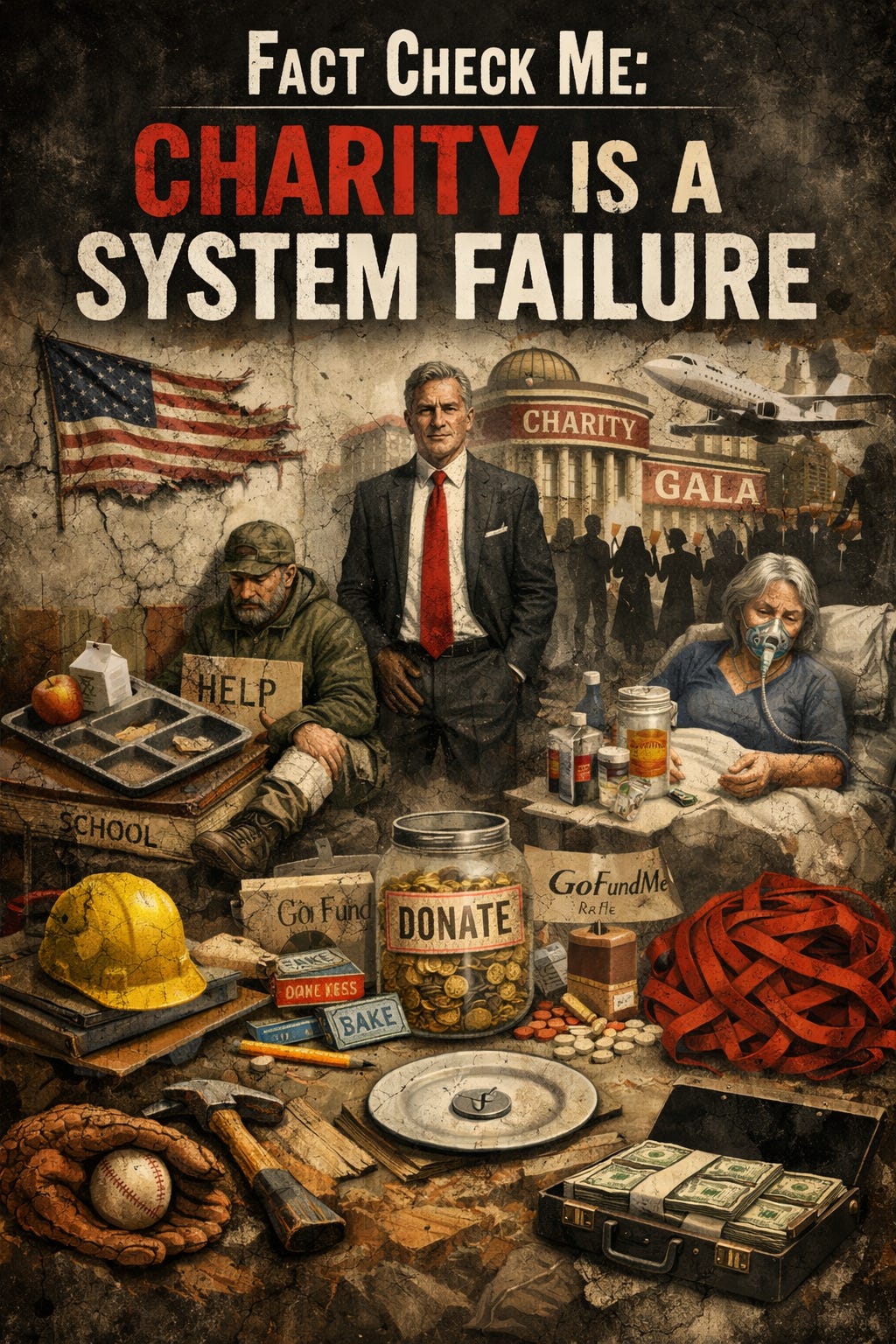
I hate charity.
Not because I hate helping people —
but because we shouldn’t need it.
We pay something like 60% of our wages by the time income tax, sales tax, property tax, fuel tax, fees, and hidden costs are done with us. And then we’re told there’s no money to feed kids at school, care for wounded veterans, or provide basic medicine to the sick.
Bullshit.
Charity is treated like virtue, but most of the time it’s just a confession of systemic failure. It’s the applause at the end of a bad play — everyone clapping so we don’t have to admit the whole thing was broken.
If we need bake sales to feed children, the problem isn’t generosity.
If we need fundraisers for veterans, the problem isn’t gratitude.
If we need GoFundMe for insulin, the problem isn’t compassion.
The problem is priorities.
The problem is misallocation.
The problem is that the money exists — it’s just pointed upward instead of outward.
And then charities themselves became businesses.
Why does a charity need a CEO?
Why does “helping people” require executive compensation packages, branding departments, consultants, and marketing teams?
Why does compassion need a boardroom?
We’re asked to give more money.
More time.
More labor.
Because the system “doesn’t have enough.”
And when we question that, we’re told we’re not working hard enough.
Not doing our part.
Not being good citizens.
Bullshit again.
We’ve never been more productive.
We’ve never generated more wealth.
So where is it going?
Because when only ten cents on the dollar ends up as food, medicine, clean water, or actual help, this isn’t charity — it’s laundering guilt through bureaucracy.
Most modern charities don’t solve problems.
They manage them.
They professionalize suffering.
They turn crises into careers and emergencies into permanent revenue streams.
And then there’s the red tape.
When a community says, “Let’s build a playground for our kids,” why can’t it just be a few dads on a weekend, some power tools, and a case of beer?
Why does it require approved contractors, permits, insurance reviews, consultants, and a committee nobody can name?
On my street alone, we have every kind of tradesperson imaginable — carpenters, electricians, plumbers, engineers — people who could build it safely tomorrow.
But we’re told no.
It has to go through the system.
Through forms.
Through approvals.
Through people who don’t live here and won’t use it.
We stripped communities of agency and then blamed them for not helping themselves.
And here’s the part that actually matters:
We know it’s bullshit.
And we still give.
We buy raffle tickets for prizes we don’t even want so kids at school can have pencils.
Pencils.
Number 2s.
In a country that can track a package across the globe in real time, we don’t have money for fucking pencils?
But we buy the ticket anyway.
Because most people want to do good.
Human nature isn’t broken.
It’s generous.
It’s empathetic.
And the system knows this.
So it leans on fundraisers, raffles, fun runs, and moral theater — not because they work, but because they shift responsibility.
If kids don’t have supplies, it’s not a budget failure.
It’s because you didn’t buy enough tickets.
And before you pull out your credit card —
before you set up that monthly donation for the sad-eyed children, the injured pets, or the wounded veterans on TV —
ask one question:
Who paid for this commercial?
Because that airtime wasn’t free.
That production wasn’t volunteer-based.
Someone paid a lot of money to ask you for a little.
Then ask the harder question:
Where is my money actually going?
Charity was never meant for the poor.
It was meant for the rich.
It was supposed to be how excess was returned to society.
How hoarded wealth acknowledged responsibility.
Instead, the rich hoard it —
and the rest of us are told to fend for ourselves.
Modern charities became mechanisms for hiding money, dodging taxes, building prestige projects, and carving donor names into stone.
They don’t exist for us.
They exist for themselves.
Real charity would make itself obsolete.
Real charity would reduce inequality.
Real charity wouldn’t need your credit card every thirty days to survive.
So what if our taxes actually paid for what they were meant to?
Education.
Food.
Healthcare.
What if weekends were for resting?
For coaching little league.
For playing with our kids.
For being human again.
And let charity — real charity — be left to the rich.
Let them build hospitals and libraries.
Let them fund opera houses and concert halls.
Put their names on the walls if they need to.
Just make the tickets affordable.
So the people who laid the bricks can sit inside and hear the music.
Until that happens, it will be working people who continue to shoulder the burden.
Because that’s what humanity actually is —
each of us catching the person who falls.
But it’s time to look up.
It’s time to stop quietly compensating for those who refuse to carry their share.
Where the fuck are you?
You built the systems.
You took the wealth.
You claimed the credit.
Now it’s time you showed up.
Well said