

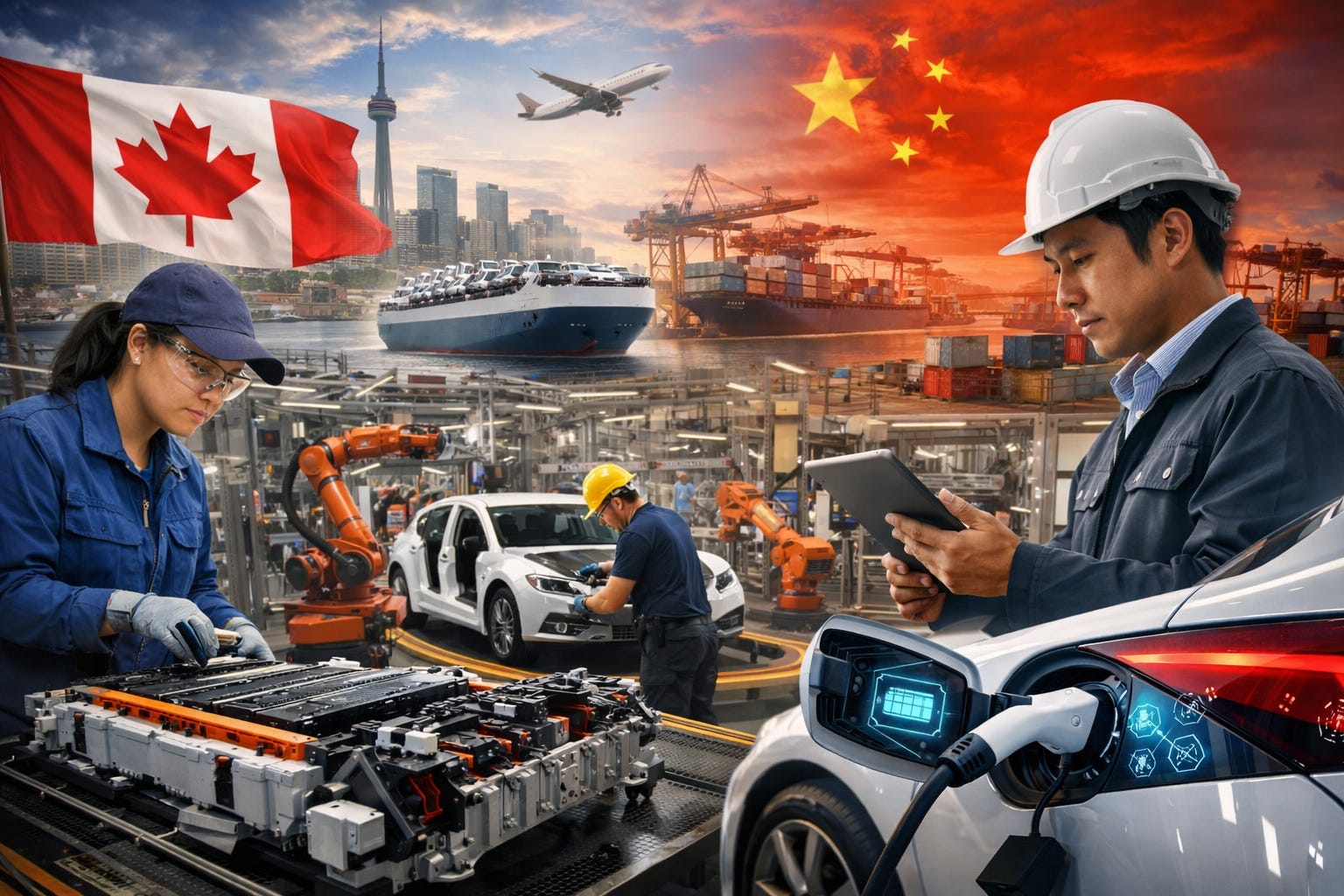
Canada says we’re going to allow some Chinese cars into the country.
People hear that and immediately reach for the panic button.
Like the moment a BYD rolls off a ship, we’re all going to wake up speaking Mandarin and paying rent in yuan.
But walk the logic out for five seconds and you realize something:
This might actually be the only outcome that makes sense.
---
Step one: Canada opens the door a crack.
Not a flood. Not a surrender. Just an opening.
A market test.
And Canadians do what Canadians do when something is good and reasonably priced:
We buy it.
We tell our friends.
We ask for more.
Then the next thing happens—quietly, predictably, like gravity.
China says, “We’d love to sell you more, but we’re at capacity.”
Because when a country is supplying the world, “more exports” isn’t just a decision—it’s a physical limit.
Factories fill.
Ports bottleneck.
Wages rise.
Shipping costs climb.
Politics gets messy.
People love to imagine exports are infinite, like a faucet you can just open wider.
They’re not.
You run out of workers.
You run out of factory space.
You run out of patience from the countries you’re shipping into.
So eventually, any serious manufacturer asks the only grown-up question left:
“Can we build them there?”
And if Canada wants more cars built in Canada, the answer shouldn’t be outrage.
It should be: “Under what conditions?”
---
Here’s the part that melts people’s brains:
If the goal is Canadian jobs, Canadian factories, and Canadian industrial strength,
China might be the solution, not the problem.
Because the alternative isn’t some patriotic fantasy where Canadian companies magically scale overnight and flood the world with perfect EVs.
The alternative is being at the mercy of American politics.
American companies and American policy swing with elections.
Trade deals get rewritten.
Tariffs appear out of nowhere.
“America First” isn’t a slogan—it’s a permanent instinct.
So Canada keeps doing what we always do:
we build our economy on the assumption that the U.S. will be stable and loyal,
even though the last decade has screamed the opposite.
They’ll partner with us when it’s convenient,
and drop us when it’s useful.
That isn’t evil.
It’s incentives.
---
China plays a different game.
They’re not perfect. They’re not saints.
But they plan long.
They build in decades.
They invest in things that take years to pay off.
Once they commit to a factory, they don’t want drama—they want predictability.
And manufacturing loves predictability.
So if China says, “We’d like to build EVs in Canada for the Canadian market,”
Canada shouldn’t respond with fear.
Canada should respond with a spine.
We don’t have to “trust” anyone.
We just have to structure the deal properly.
Canadian labour laws.
Canadian inspections.
Canadian courts.
Canadian environmental standards.
Data rules.
Privacy rules.
Exit clauses.
Local sourcing targets.
Training pipelines.
No special zones.
No “exceptions.”
A factory in Canada is not a colony.
It’s a building sitting on Canadian land under Canadian rule.
And once that capital is sunk—once it’s real bricks, real equipment, real workers—Canada’s leverage grows every year.
Factories don’t pack up overnight.
That’s the point.
---
And here’s the part nobody talks about because it’s harder to tweet:
EVs aren’t just cars.
They’re tech.
They’re software.
They’re batteries.
They’re materials science.
They’re robotics.
They’re data.
They’re rolling computers.
Canada has the schools.
Canada has the engineers.
Canada has the research capacity.
Canada has the chops to grow real intellectual property.
What we’ve lacked isn’t talent.
It’s gravity.
We train brilliant people, then we watch them leave because the ecosystem—the industrial pull—is somewhere else.
If we build EV manufacturing here, the gravity shifts.
Talent stays.
Startups form.
Suppliers cluster.
Patents get filed.
Immigration brings in more skill instead of more brain drain.
And if we’re smart, we write the deal so that the derivative innovation—the stuff built here—stays here.
That’s not naïve.
That’s how industrial nations are made.
---
Now, the moral people will say:
“But what about the issues we don’t agree on?”
Good.
That’s the whole point.
Because dialogue doesn’t open because atrocities are called out.
Dialogue opens because interests align.
When you have shared projects—shared factories, shared jobs, shared reputational risk—suddenly you have something to lose.
And when both sides have something to lose, both sides start talking like adults.
You build the bridge first.
Then you walk across it together.
Then you talk about what needs fixing.
---
So no—China building cars in Canada isn’t “giving up.”
It’s Canada remembering we have power.
We don’t need to pick sides.
We need to pick outcomes.
Canadian factories.
Canadian jobs.
Canadian tech.
Canadian IP.
Canadian leverage.
If we want more cars built in Canada, this might be the most realistic path we’ve got.
Not because China is benevolent.
Because supply chains obey physics,
and grown-up countries use that physics to their advantage.
About those 49,000 BYD electric cars. We'll see how they behave in our climate with extreme temperature differences and our long distances.
Russia has BYD electric cars for a couple of years now. Apparently, the satisfaction rate is not very high. There's numerous videos of BYDs immobilized on the side of the road, or literally on fire. Taxi drivers in Moscow complain that they are dead and useless after 115,000 to 125,000 km. Which often is just a couple of years in Canada.
Russians seem to despise them and prefer their Ladas. Maybe some people remember Russian Lada cars in Canada, they were terrible and didn't sell for long. If Russians prefers them to BYDs, that tells a lot. We don't need another avoidable problem. Hopefully China will be sending us an improved build.
Why Canada bought a-Lada Soviet lemons - Hagerty Media https://share.google/Xq0PCwSFUvBbAmgIR