

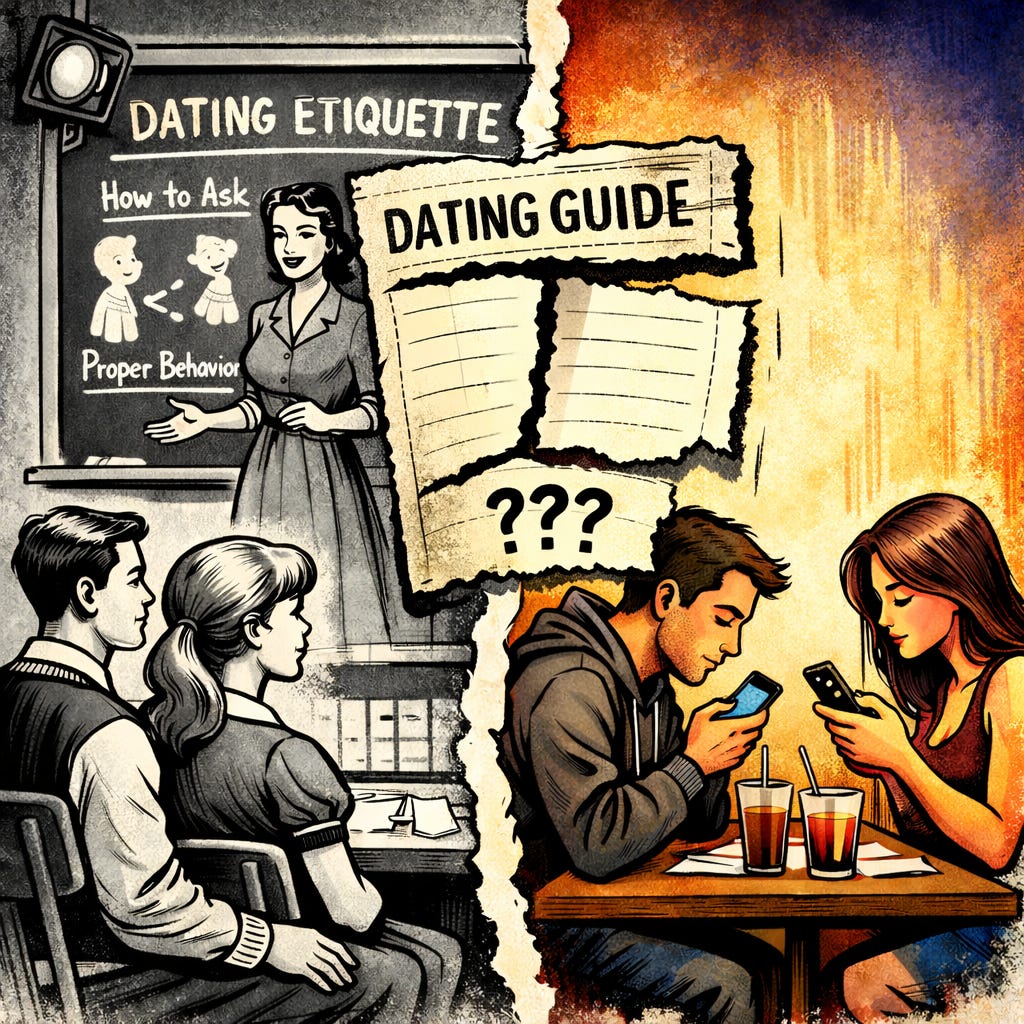
If you do a lazy search online, you’ll find old instructional films from the 1950s and 60s teaching teenagers how to date.
They’ll show you how to ask someone out.
How to read signals.
How to sit, talk, smile, and leave.
We laugh at them now.
They’re stiff.
Awkward.
Completely out of touch with modern life.
But here’s the question no one asks:
What replaced them?
Because as ridiculous as those videos were, they did something we don’t do anymore.
They taught people how to engage with each other.
They gave young people a shared understanding of what was happening when two people showed interest in one another.
A script.
A starting point.
And we threw it out.
Not because it didn’t serve a purpose—but because it didn’t reflect the world we wanted anymore.
Fair enough.
But we never replaced it.
---
Now we’ve got a generation learning how to date from:
social media highlight reels,
porn,
equally confused friends,
and trial and error.
No consistency.
No shared language.
No clear expectations.
And somehow we’re surprised that everything feels awkward.
---
Take initiation.
We talk about equality all the time.
We say men and women are equals in relationships.
But when it comes to actually starting one?
We’re still running the same old play.
Men approach.
Women respond.
Only now, men have been told to be more careful, more respectful, more aware—which is good—but no one handed them a new model to replace the old one.
So they hesitate.
Overthink.
Or say nothing at all.
Meanwhile, women are still largely expected to wait.
Not because they can’t act—but because the system never really invited them to.
And that’s where things quietly break.
Because if one side carries the risk of rejection, and the other side carries the expectation of being chosen, you don’t have equality.
You have imbalance with better branding.
---
And then we get to the date itself.
Dinner and a movie.
The gold standard.
Except now, that “low-stakes” date can cost a day’s wages.
So before you even know if you like the person sitting across from you, you’re already invested—financially, socially, emotionally.
You’re locked into a conversation you can’t easily exit, sitting face-to-face like it’s some kind of interview.
It’s not a connection.
It’s a performance.
We turned dating into something you buy instead of something you build.
---
Meanwhile, the simplest versions of dating—the ones that actually make sense—are treated like afterthoughts.
A walk.
A coffee.
A casual meet-up.
Low cost.
Low pressure.
Easy to leave.
Easy to repeat.
You’re not interrogating each other.
You’re just seeing if you enjoy being in the same space.
Which is the whole point.
---
Even historically, dating didn’t look like what we do now.
People walked together.
Visited each other’s homes.
Sat with families.
Spent time in shared environments.
It wasn’t about compressing compatibility into ninety minutes and a bill.
It was about proximity.
Familiarity.
Gradual connection.
---
We laugh at the old rules.
But at least they were rules.
Now we’ve replaced them with nothing—and we expect people to just figure it out.
And when they don’t?
We blame men for not approaching properly.
We blame women for being unclear.
We blame the apps.
We blame the culture.
We blame everything except the obvious:
We removed the structure and never built a new one.
---
If we actually believe in equality, then both people should be equally responsible for starting connections—not just maintaining them.
If we actually want better relationships, then maybe first dates shouldn’t feel like investments—they should feel like test runs.
Low risk.
Low pressure.
Honest.
Because the goal isn’t to impress someone.
It’s to find out if you like them.
---
Dating didn’t get more complicated because people got worse.
It got more complicated because we stopped teaching people how to do it—and replaced it with a system built on pressure, confusion, and guesswork.
And then we called that progress.