

The problem with our education system isn’t that the standards aren’t tight enough.
The problem is we keep everyone together too long.
We lump learning into one giant group and pretend there’s one path, one pace, one definition of “smart,” and one timeline that everyone has to follow. Same subjects. Same order. Same expectations. Same deadlines. Same damn pressure.
And if you don’t fit?
We treat it like a character flaw.
So learning becomes a chore. Not because learning is naturally miserable — but because we force it to happen when you’re interested in other things, when your energy is somewhere else, when you don’t feel free, when you can’t see the point, and when you’re trapped in a system that doesn’t care what moves you.
We don’t need to tighten education to get better outcomes.
We need to loosen it.
Because it’s ridiculous to think every student has to perform at the same level in the same subjects.
Top marks in English and science? For everyone? Are you kidding?
We don’t do this past high school. We don’t demand adults be perfect in everything. We let people specialize. We let people choose. We accept lopsided excellence all the time.
But in school we act like a kid is broken if they’re brilliant in one area and weak in another.
That’s not education. That’s compliance training.
---
HERE’S THE FIX: END GENERAL EDUCATION EARLIER
Middle school should be the end of general education.
That’s the exposure phase.
That’s where you learn the basics.
That’s where you get the foundational skills you need to function.
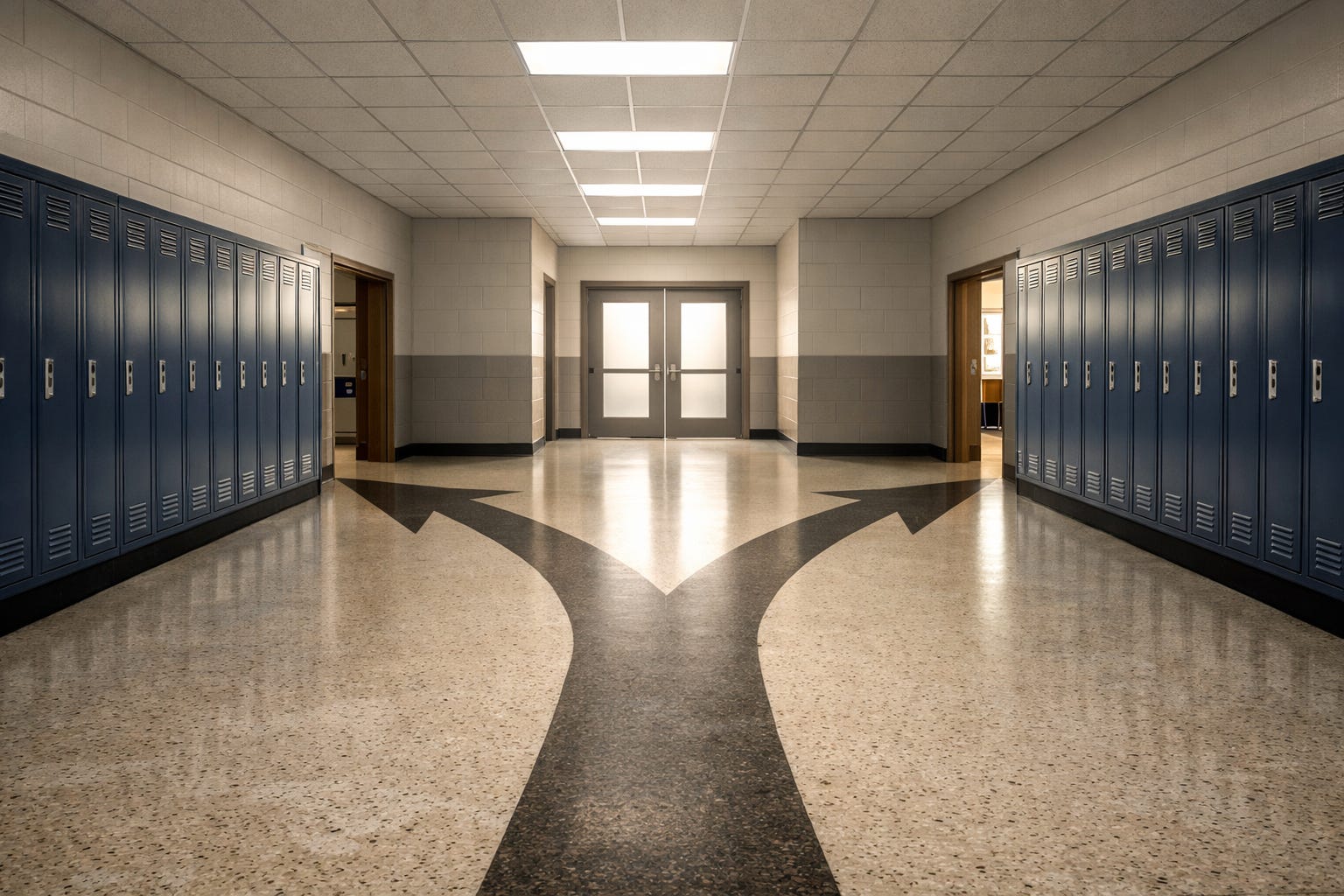
After that, high school should stop being one hallway everybody has to walk down.
High school should become a set of paths.
And who chooses the path?
The student.
Let them try.
Let them fail.
Let them switch.
Let them bump around.
Let them find what they actually enjoy and what they’re actually good at.
Science, math, philosophy, trades, art, writing — whatever moves you.
Get your Level 4s where you’re alive.
Take Level 1s where you’re not.
And stop acting like a Level 1 is shameful.
Maybe someone takes Level 1 English four times to fill a quota.
Good.
They’ll come out with something — words, rhythm, meaning, Shakespeare in their bones — and isn’t that the point? To leave school with something real inside you?
Not everybody needs to be an academic.
Not everybody needs to love every subject.
Not everybody is built for the same kind of thinking.
So stop forcing it.
---
THE PATHS HAVE TO BE FLUID
This isn’t a system where you get labeled at 12 and locked in a box forever.
The paths are fluid.
Everyone needs a minimum baseline — Level 1 across the board to graduate — because society needs citizens who can read, write, do basic math, and understand the world they live in.
But beyond that? Let students go deep where they care.
Let them graduate at 15 or 16 if they want.
Some kids don’t need school the way we’ve designed it.
Some have family businesses to step into.
Some want to work.
Some want to build.
Some want to apprentice.
Some need to leave, live a little, and come back later with hunger.
And here’s the part adults don’t like to admit:
They should be allowed to bump around while they’re young.
Because bumping around at 16 is safer than bumping around at 26.
At 16 you can still rely on parents.
You still have a safety net.
You can fail without it defining your life.
You can try things with low stakes and high learning.
That’s the best time to start.
So you create a citizenry that’s ready to contribute earlier — while they’re excited, while they’re willing, while the future still feels like something you get to build instead of something you survive.
---
NOW WE MOVE TO UNIVERSITY
Right now, first-year university is a joke for a lot of students.
They show up and say, “I already know all this.”
And they’re right.
We’re paying twice for the same year.
So here’s what happens in the better system:
First year is already done.
If you have Level 4s — real Level 4s, earned through depth and work — you already have the credits.
University starts where university should start: at higher-level thinking, not slow-motion review.
So university gets:
- faster
- easier to navigate
- cheaper
You cut undergrad by about 25% because you removed a duplicated year.
And then people ask the obvious question:
“How’s that going to get paid for?”
It doesn’t have to be paid for.
It saves money.
We already subsidize students through a bloated system that repeats itself.
We already spend the public money.
We’re just spending it inefficiently.
So when degrees cost less and take less time, the same subsidy goes further.
Students carry less debt.
Government money stretches farther.
Universities don’t have to scream about funding because the public system already did the foundational job properly.
We stop paying twice.
We stop wasting time.
We stop building a system that only works if students bleed for it.
---
THE END STATE: EDUCATION CAN BE FREE
Eventually, if the whole thing becomes efficient enough, education becomes free across the board.
Not as a fantasy.
As a math result.
When you remove duplication, delay, and credential theater, the cost per outcome drops.
And when money stops being a barrier, you stop filtering brilliance by income.
You start breeding top thinkers in every field — not because you forced them, but because you finally gave them room.
And yes:
We should be paying for those philosophy degrees.
Because philosophy isn’t “impractical.”
Philosophy is the operating system for ethics, meaning, reasoning, leadership, and long-term thinking.
We don’t have a technology problem in society.
We have a thinking problem.
We have an incentives problem.
We have a moral outsourcing problem.
Philosophy helps fix that.
So fund it.
On purpose.
Without shame.
A society that makes education free isn’t giving people a luxury.
It’s investing in its own ability to think.
---
THIS ISN’T SECRET KNOWLEDGE
None of this is hidden.
The reason it doesn’t happen is because systems don’t like admitting the obvious:
Most of what we call “education” is just administration.
We keep kids together too long because it’s easier to manage.
We force uniformity because it’s easier to measure.
We pretend everyone needs the same path because it’s easier to justify.
But easier isn’t better.
Better is alignment.
Better is choice.
Better is letting people become useful sooner.
Better is letting students learn like humans actually learn — when they care, when they’re ready, when it fits.
We don’t need higher standards.
We need fewer universal ones.
We don’t need more years.
We need less repetition.
We don’t need to gatekeep education with money.
We need to treat thinking like infrastructure.
And once you do that?
Education stops being a prison sentence.
It becomes a tool.
A ladder.
A launch.
A public good.
And that’s what it should’ve been the whole time.
Wow that’s a lot to unpack there! As an educator, I agree- the system is most definitely broken. The way our government is heading, I’m afraid it won’t be heading in the right direction anytime soon. You’re right, a one size fits all curriculum will serve no one but unfortunately it isn’t about the kids. It’s about the bottom line. Destreaming and Universal Design for learning will have kids falling through the cracks at both ends of the performance spectrum. Cutting funding for special education and passion subjects like music and art will lose more students. Some schools are getting rid of tech subjects like shop and culinary in order to appear more academically advanced. They are creating boring sheep and if the kids don’t fit the mould than too bad for them . Don’t even get me started on standardized testing! Rant finished.
That’s exactly it — the system optimizes for manageability, not learning.
What I’m trying to work through is how to redesign it so fewer kids fall through the cracks on either end.
More choice earlier actually reduces damage later.
I’ll be expanding these ideas, and I really appreciate you engaging with it from the classroom side.