

There is this idea in karate that to master it, you have to master all of it.
Every kata.
Every application.
Every stance, every strike, every concept.
Be able to perform it, explain it, apply it, and fight with it.
It sounds noble.
It’s also complete nonsense.
---
Imagine if a physicist had to master all of physics before earning a PhD.
No specialization. No focus. Just everything.
There would be no experts.
No progress.
No expansion of knowledge.
The field would collapse under its own weight.
And yet in karate, we pretend that’s exactly what mastery looks like.
---
Karate isn’t one system.
It’s a collection of systems stacked on top of each other and presented as one clean path.
Kihon.
Kata.
Bunkai.
Kumite.
Self-defense.
Weapons tied to Okinawan kobudo.
And even within just kata, you’re expected to understand:
the shape,
the application,
the competitive version,
the history,
the philosophy.
And somehow… also be able to step into a ring and fight.
---
These aren’t levels of the same skill.
They’re different disciplines that share a common ancestry.
And instead of admitting that, we pretend they all naturally come together if you train long enough.
They don’t.
---
The best kata competitors don’t always fight well.
The best fighters don’t always care about kata.
The best self-defense practitioners often ignore both.
That’s not failure.
That’s reality.
That’s specialization.
---
We also pretend karate is frozen in time.
Like everything meaningful was already discovered by the old masters — and our job is just to preserve it.
But those men weren’t preserving anything.
They were building.
They were working with less information, fewer tools, and a much smaller pool of knowledge than we have today.
A modern practitioner with ten serious years of training — access to video, cross-training, sports science — can understand fighting in ways those masters never had access to.
That’s not disrespect.
That’s progress.
---
And then there’s the part nobody wants to say out loud:
There isn’t just one karate anymore.
There’s what came out of Okinawa.
And there’s what grew in North America.
A full sport system.
A competitive culture.
A different way of training and testing skill.
And it doesn’t get the same respect, because it’s seen as “not traditional.”
But if millions of people practice something, refine it, compete in it, and build systems around it…
…it’s real.
---
Some of the people who helped shape that version don’t get the same reverence.
But they should at least be part of the conversation.
They didn’t just copy karate.
They translated it.
Stress-tested it.
Spread it.
So if we hang pictures on the wall to honor contribution…
maybe the wall isn’t complete yet.
---
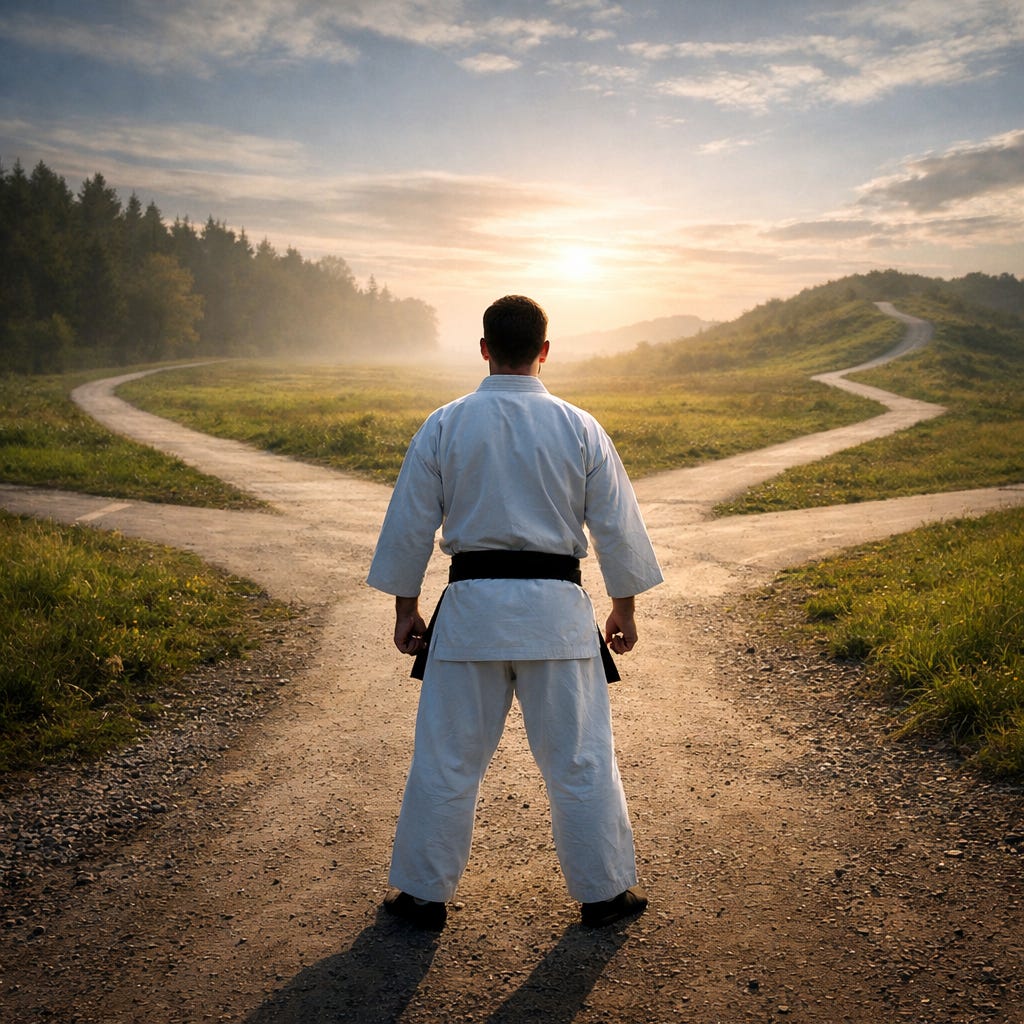
Karate isn’t one thing you climb.
It’s a crossroads.
And the problem isn’t that students can’t master everything.
The problem is they’re told they’re supposed to.
---
And maybe the solution is simpler than we think.
Instead of forcing everyone to carry the entire system, we give them a foundation first — a level where they understand the art as a whole.
And after that?
They choose.
They specialize.
One student goes deep into kata.
Another into fighting.
Another into teaching.
Another into application.
They earn depth, not just time.
Because the dojo is bigger than any one person.
And maybe the best teacher isn’t the one who knows everything…
but the one who mastered the thing you came to learn.
---
If the old masters were great because they pushed karate forward…
then maybe the real question is this:
Are we honoring them by preserving what they left behind?
Or by doing what they did?