

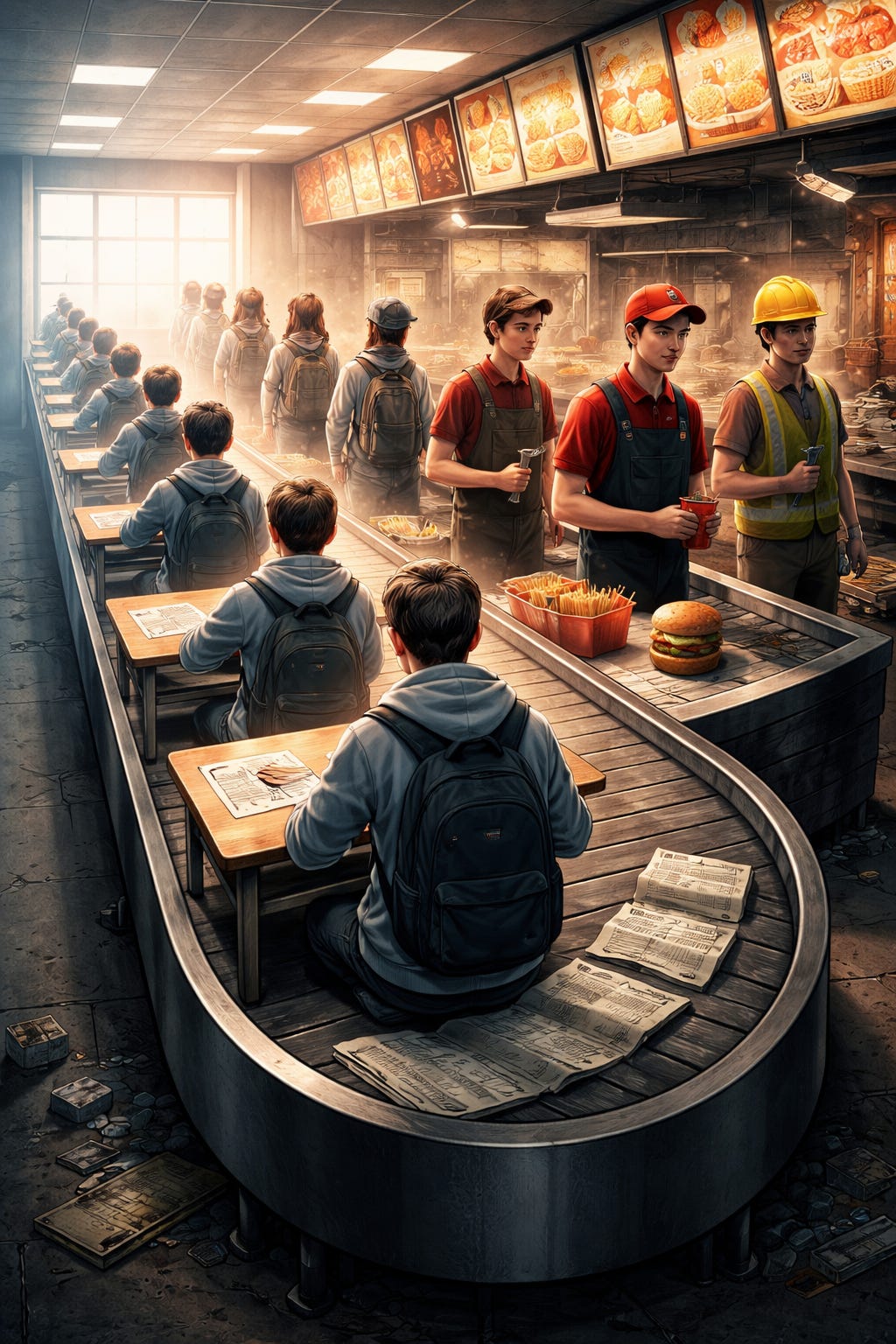
We spend our whole lives working.
Grinding.
Chasing.
Trading time for money like it’s the only deal on the table.
And somehow, we’ve decided that the best way to prepare young people for that life…
is to start them early.
Put them behind a counter.
Hand them a mop.
Stick them on a fryer.
Let them close up shop at 11pm on a Wednesday
with a math quiz waiting first period Thursday morning.
And we call that character building.
---
We say it teaches responsibility.
Time management.
Work ethic.
But let’s be honest about what it really teaches.
It teaches exhaustion.
It teaches compliance.
It teaches kids how to endure a system
before they’ve even had a chance to question it.
We confuse endurance with development.
---
And here’s the part nobody wants to say out loud:
In a lot of places around the world,
this wouldn’t be framed as “opportunity.”
It would be a red flag.
Call it what you want—
early work experience, life skills, earning your own money—
but when a kid is sacrificing sleep, school performance, and social development
to keep a business running…
you’re not building character.
You’re borrowing from their future.
---
Because those years?
They’re not supposed to be about productivity.
They’re supposed to be about discovery.
Who am I?
What do I like?
Where do I fit?
How do I relate to people?
You don’t learn that
while rushing through homework at midnight
or giving up your weekends to a shift schedule.
You learn that by living.
By being around your peers.
By making mistakes that don’t come with a time clock.
---
And let’s not pretend this system exists in a vacuum.
Those “starter jobs” were never meant to carry weight.
They were designed for pocket money.
For temporary work.
Now they’re propping up entire industries.
So we keep wages low,
expectations high,
and quietly plug teenagers into the gaps
because they’re the only ones who will accept the terms.
---
And how many kids get trapped in these jobs?
That’s the part we don’t measure.
We talk about the ones who “learned responsibility,”
the ones who “worked their way up,”
the success stories that justify the system.
But what about the ones who never leave?
The ones who get caught early—
not because they chose a path,
but because the path was there…
easy to step onto,
hard to step off.
---
Because here’s the truth:
When you start working young,
you don’t just learn how to work.
You learn how to stay.
You get used to the pay.
Used to the routine.
Used to being told what to do and when to do it.
And before you know it,
you’re not building a future—
you’re maintaining a position.
---
We tell ourselves there’s opportunity in these systems.
And sometimes there is.
But you have to ask:
Are they being lifted…
or contained?
Because there’s a difference between growth
and just moving up inside the same box.
---
What’s often worse?
When the money is good.
Because now leaving costs something.
Now staying feels smart.
Now the short-term win
becomes a long-term ceiling.
---
I’ve seen it in my own culture.
Young men pulled out of school
into construction.
Not because they love the trades.
Not because it’s their calling.
But because:
- the pay is good
- the work is there
- and someone they know can get them in tomorrow
An uncle.
A father.
A connection.
And just like that—
school becomes optional.
---
Then one day they’re 30.
No diploma.
No direction.
Just years of labour behind them.
They can lay shingles.
Pour concrete.
Work harder than most people ever will.
But ask them to pivot?
To build something of their own?
To step outside what they know?
That’s a different fight.
Because confidence doesn’t just come from working hard.
It comes from believing you had options.
---
And if we’re being honest about it—
these environments aren’t always healthy.
Long days.
Hard labour.
Repetitive work.
It wears on you.
Physically.
Mentally.
And yeah—sometimes people cope the way people cope:
- caffeine
- substances
- anything that gets you through the next shift
That’s not an indictment of the people.
It’s a reflection of the conditions.
---
And let’s be clear:
This isn’t about attacking trades.
Or saying construction workers are anything less than skilled, valuable, essential people.
It’s about asking a harder question:
Who chose this path—
and who just ended up on it?
---
Because when a kid steps into a job too early,
before they’ve explored who they are,
what they want,
what they’re capable of—
that job doesn’t just give them experience.
It can quietly define their limits.
---
We’ve normalized something strange.
We’ve taken childhood—
one of the shortest, most important windows in a person’s life—
and turned part of it into labour supply.
---
This isn’t about saying young people should never work.
It’s about asking:
Why are we so comfortable asking them to?
Why are we in such a rush
to introduce them to a system
most adults are trying to escape?
---
Because maybe the goal
shouldn’t be to prepare kids for the grind.
Maybe the goal
should be to give them enough space
to build a life worth grinding for.
The goal of Capitalism is more money and power for the Capitalists.