

Socialism didn’t start as an evil idea.
It became one.
Not because of what it was—but because of who it threatened.
At its core, socialism is almost boring in its simplicity. People working together for a common good. Neighbors helping neighbors. The belief that people should come first, that dignity shouldn’t be conditional, and that money and power should rise from the bottom instead of being hoarded at the top.
That’s it. That’s the whole monster.
But you were never taught to see it that way.
You were taught to fear the word.
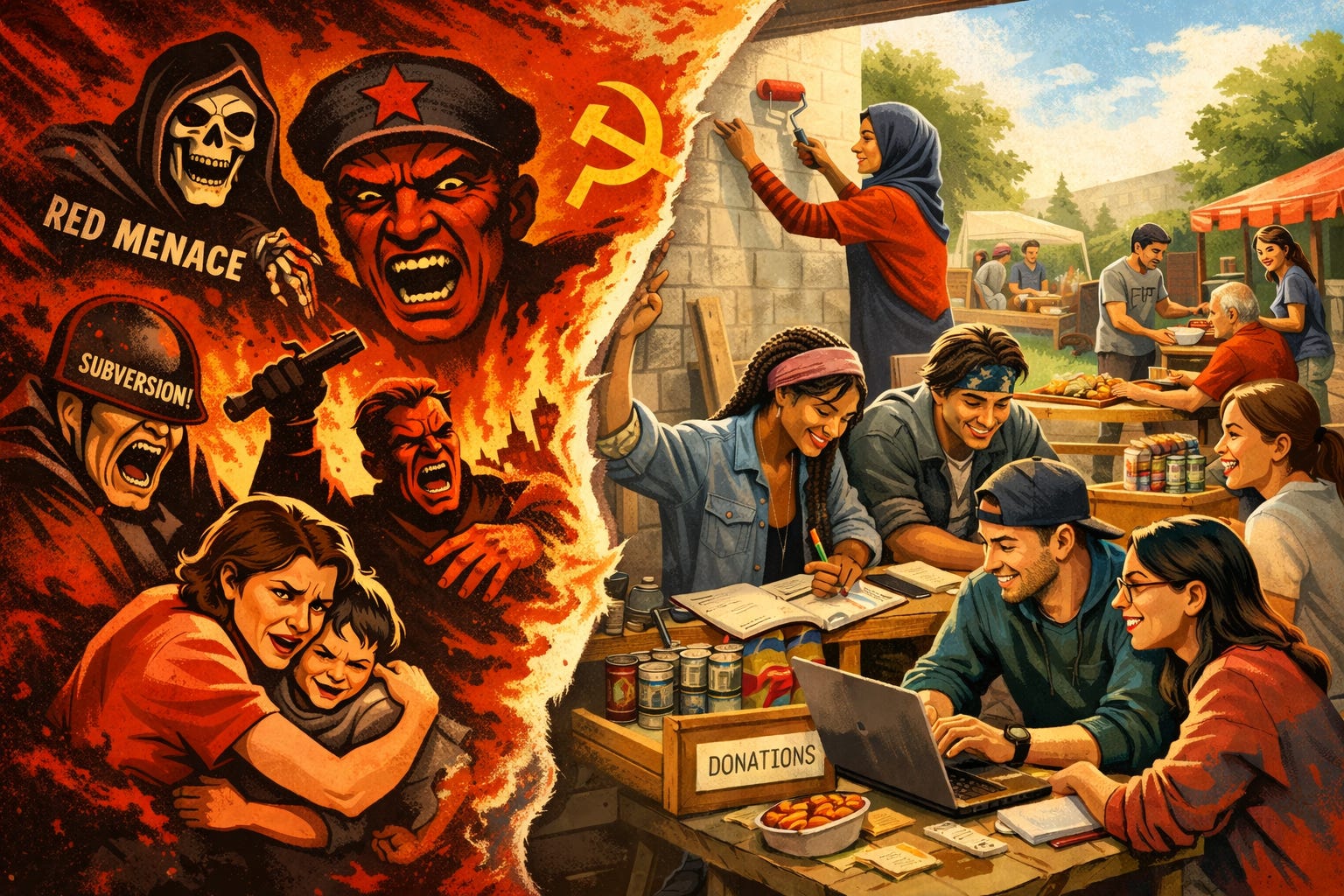
Movies. TV. Books. Cold War propaganda. Grainy footage. Accents. Flags. Villains. A thousand images that had nothing to do with your street, your school, your family, or your community. Socialism was dragged out of the neighborhood and dropped onto a geopolitical stage where it could be framed as foreign, extreme, and dangerous.
And it worked—because for a long time, it was easy to control the message.
Ideas moved slowly. Information was scarce. Authority told the story, and social pressure enforced it. Even when freedom of thought existed on paper, falling in line was still safer than questioning out loud.
Socialism was born in a time of rigid class tyranny—systems held in place by violence, hunger, and inheritance. When it pushed back, it didn’t do so politely. It fought. Sometimes with words. Sometimes with guns. Not because violence was the goal, but because power doesn’t submit. It only yields when it’s torn down—or when it erodes slowly enough to pretend it chose to move.
When socialism became too big to destroy outright, those with money and influence did what they always do: they infiltrated it. They adopted the language without surrendering control. They hollowed it out, bent it, diluted it, or turned it into something it was never meant to be.
In some places, socialism became a scarecrow—the enemy of “freedom,” the thing you point at and say that is wrong.
In other places, it became a cage—the justification for oppression, obedience, and new elites wearing old crowns.
Both outcomes served power just fine.
So socialism became a slur.
Its advocates became villains.
Its faces were chosen—not by people, but by those who wanted to freeze the image in time. While the ideas evolved academically and politically, the public narrative stayed locked in black-and-white fear. A word stripped of meaning and loaded with emotion.
And here’s the irony: the same people who recoil at the word will help a neighbor shovel a driveway, donate to a GoFundMe, coach kids for free, support public schools, libraries, fire departments, and healthcare—and never see the contradiction.
Because the fear was never about the behavior.
It was about the label.
Now enter young people.
The Cold War doesn’t belong to them. It’s not in their bones. It’s a chapter they read about, not a trauma they inherited. Their world is smaller in distance and bigger in connection. They grew up watching markets crash, pandemics spread, climate disasters hit everyone, and wealth concentrate openly and unapologetically.
They have the internet in their pockets.
You can’t tell them something is evil just because you say so. You can’t bullshit them with ghosts. You can’t decide who their enemies should be—because they don’t see enemies. They see people. Friends. Family. Cultures they already live inside, from the clothes they wear to the media they consume to the food they eat.
Fear needs distance.
They live in overlap.
So when you call a young person a Radical Socialist, it doesn’t scare them.
They’ll put it on a T-shirt.
They’ll wear it with pride.
And then they’ll tell you to go fuck yourself.
Not because they’re dangerous.
Not because they’re naive.
But because the word doesn’t own them anymore.
And once a slur loses its power, all it really does is tell on the person still trying to use it.