

Let's talk about manufacturing jobs for a second.
You hear it in Canada and the United States all the time: "We need to bring back manufacturing jobs."
Look, don't get me wrong. If you work in manufacturing, I respect the hell out of you. You work hard, long hours, often doing physically demanding jobs that produce the things the rest of us rely on every day.
But let's be real. These are not good jobs. Let's stop romanticizing them.
The nostalgia comes from remembering your grandfather raising a family fastening rivets at the plant eight hours a day. It paid well. It was unionized. It provided security.
But mark my words: your grandfather probably hated that job.
He did it because it paid the bills. Because it was the best opportunity available with the education he had. He didn't spend forty years on an assembly line hoping his kids would one day pack frozen chickens into cardboard boxes beside him. He did it hoping they'd have the chance to do something else.
My father spent his life in the trades repairing collision damage on cars. His work demanded skill, patience, training, and incredible attention to detail. He was a master of his craft.
Many people would love to have those skills as a hobby.
As a career?
Nine hours a day repairing mangled Fords after Hondas after Kias, one wreck rolling in as soon as the last one rolled out. Day after day. Year after year. Losing his hearing after decades of shop noise. Breathing dust and chemicals. Tennis elbow from swinging a body hammer—not from afternoons at the country club.
He took pride in his work.
He also wanted his kids nowhere near it.
Manufacturing is even harder to romanticize. The work is repetitive. The shifts are long. Your body pays the price.
So when politicians stand in front of cameras and tell us that the future of wealthy countries like Canada or the United States is bringing back more assembly-line jobs, I can't help but think we've set the bar embarrassingly low.
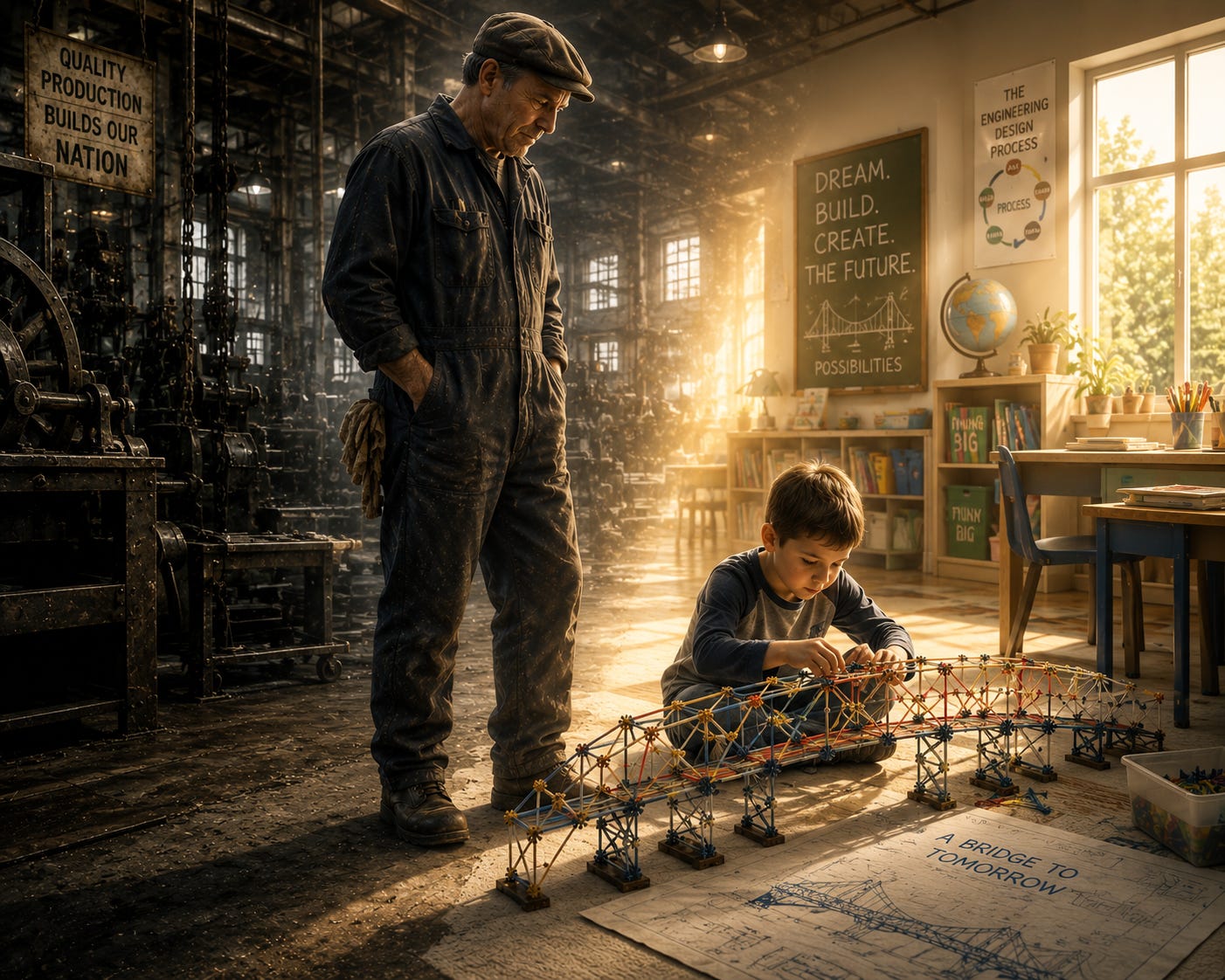
Our goal shouldn't be to recreate the economy of 1955.
It should be to build the economy of 2055.
We should be investing in skilled trades, advanced manufacturing, engineering, healthcare, research, software, robotics, education, and the industries that create value with knowledge as much as muscle.
A knowledge-based economy doesn't just make us wealthier. It gives more people the chance to do meaningful, creative, skilled work instead of work that wears down their bodies before their time.
The promise of Canada—or America—was never that your children could inherit your shift.
It was that they wouldn't have to.
That's not disrespect for manufacturing workers.
It's respect for what they sacrificed to give the next generation more choices than they had.
Honestly, when I hear "We need to bring back manufacturing jobs" it translates in my head to "We fucked over our trades people and now we've run out."
Trades can be great fun, but not when you're paid shit and taken advantage of. Greedy fuckers lost/losing their peons.