

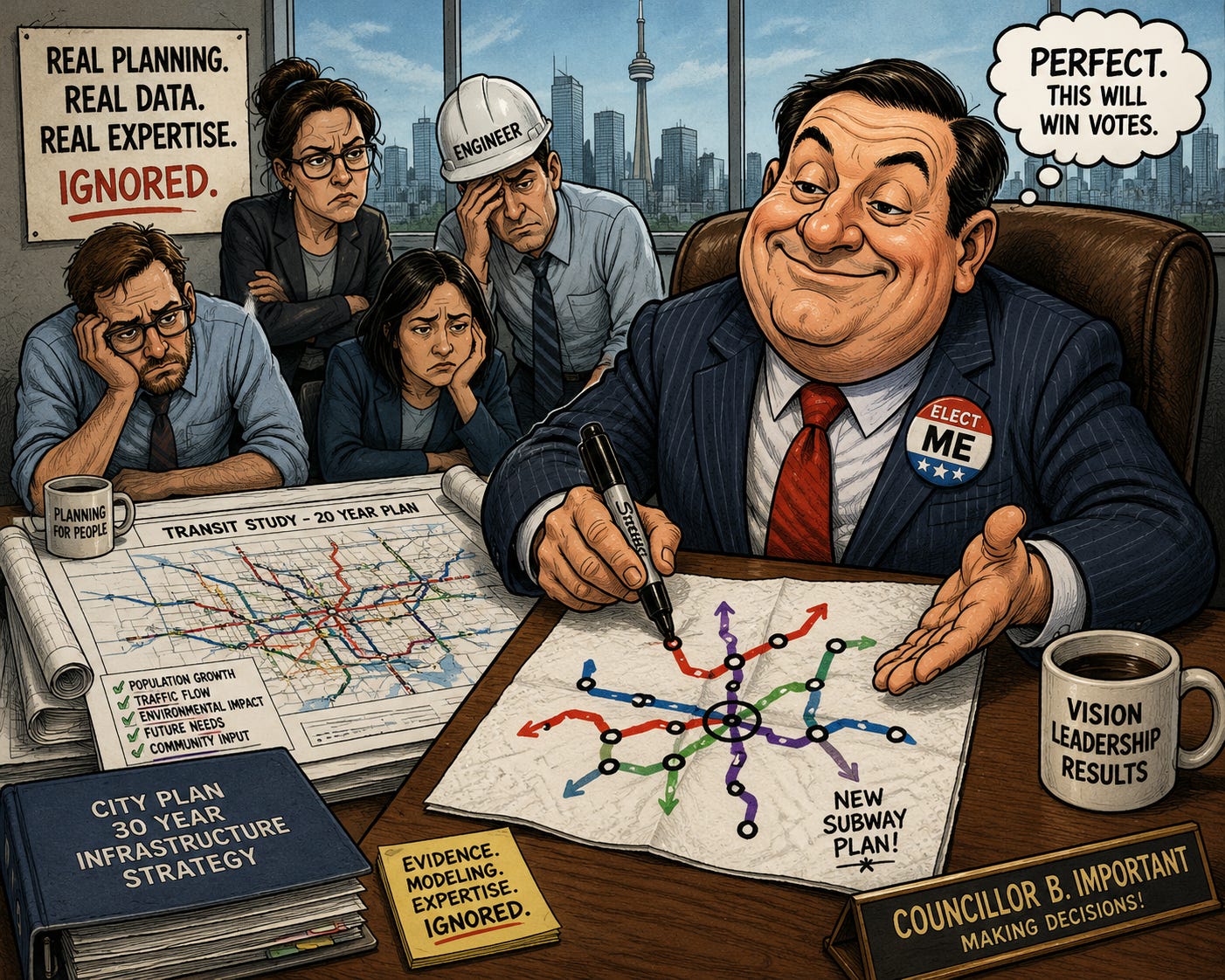
We let temporary people make permanent decisions.
That’s the whole problem.
Politicians come and go.
Four years. Maybe eight if they’re lucky.
But the decisions they make?
We live with those for decades.
Transit lines. Road layouts. Zoning. Entire neighborhoods.
These aren’t short-term choices.
They shape how a city moves, breathes, and survives.
And yet somehow, they get decided like they’re campaign promises.
A new government comes in and suddenly we’re building bike lanes everywhere.
Another one takes power and rips them all out.
Millions spent putting them in.
Millions more spent tearing them out.
Not because the data changed.
Not because the city changed.
Because the politics changed.
Meanwhile, you’ve got planners, engineers, and people who actually understand how cities function sitting there watching it happen.
People who studied this.
Who model traffic flows.
Who understand density, transit, and how humans actually move through space.
And they get overruled by someone chasing a headline.
Let’s talk about growth.
Look at Markham.
One of the fastest-growing cities in the country.
Houses everywhere.
Townhomes. Condos. Developments popping up like weeds.
Great.
So where do these people go?
Where do they shop?
Where do they live their lives outside their front door?
Because nobody’s building grocery stores.
And before someone jumps in with, “That comes later”—
that’s exactly the problem.
We don’t build communities.
We build inventory.
Homes first.
Life second.
Maybe.
Grocery stores don’t just appear because people exist.
They follow density.
They follow patterns.
They follow certainty.
But we approve housing like the rest will magically sort itself out.
So now you’ve got thousands of people moving into neighborhoods that don’t function yet.
Which means they drive.
Everywhere.
Now traffic gets worse.
Now we need more roads.
Now we’re “fixing” problems we created on purpose.
And the bike lane debate?
We treat it like it’s ideological.
Like you’re either for them or against them.
But nobody stops to ask a simple question:
Was this ever part of a coherent plan?
Because if it wasn’t, then yeah—of course it fails.
You can’t copy-paste Amsterdam into a place that wasn’t designed for it and expect the same result.
Amsterdam didn’t wake up one day and decide to be a bike city.
They committed to it.
For decades.
They built around it.
Here?
We experiment with infrastructure like it’s a trend.
Try it. Scrap it. Rebrand it. Repeat.
All while the bill keeps growing.
This isn’t about being pro-bike or anti-car.
It’s about consistency.
It’s about having a plan—and sticking to it long enough to see if it actually works.
Because once you’ve paid for something?
You should at least have the courage to let it succeed or fail properly.
But that requires something our system isn’t built for:
Long-term thinking.
Right now, politicians are judged on what they can show before the next election.
Not what the city looks like in 20 years.
So they optimize for visibility.
Quick wins.
Big announcements.
Shiny projects.
Even if they don’t connect to anything.
And the people who actually know how to build cities?
They advise.
They recommend.
They get ignored.
We’ve built a system where expertise is optional,
but optics are mandatory.
Where long-term consequences don’t matter
as long as the short-term narrative works.
So yeah—watching it happen is frustrating.
Because you can see the outcome coming a mile away.
More traffic.
More congestion.
More money wasted fixing what didn’t need to be broken in the first place.
We don’t have a planning problem.
We have a time horizon problem.
Until the people making the decisions are forced to think beyond their own shelf life,
we’re going to keep building cities that don’t work—
and then arguing about why.
We don’t suffer the consequences of bad planning—
we inherit them.