

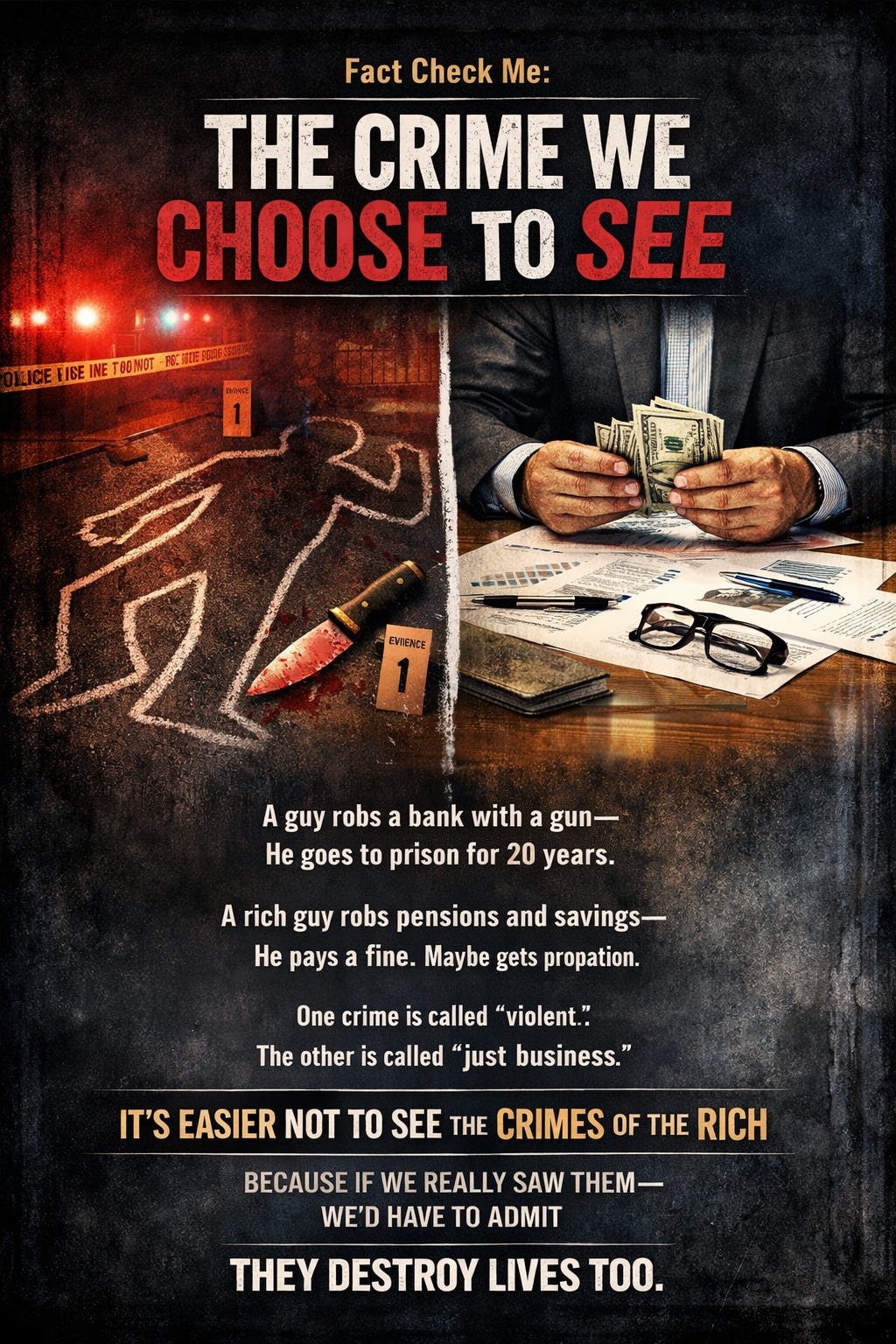
We’ve decided—somewhere along the way—that violent crime is the worst kind of crime.
It’s the one we fear.
The one we punish the hardest.
The one we point to and say,
“That’s what’s wrong with the world.”
And sure—violence is brutal.
A punch, a stabbing, a robbery—
it’s immediate, it’s visible, it leaves a mark.
You can see the damage.
But what about the crimes you can’t see?
The ones done in boardrooms instead of back alleys.
The ones written in spreadsheets instead of blood.
White collar crime.
We treat it differently.
Like it’s not really crime at all.
Like it’s just… business.
A guy robs a bank with a gun,
and we call him dangerous.
We lock him away and throw away the key.
Another guy robs thousands of people with a pen—
pensions, savings, livelihoods—
and we call it fraud.
He pays a fine.
He makes a statement.
Maybe he does a little time, maybe he doesn’t.
And we move on.
Why?
Because there’s no bruised face.
No chalk outline.
No ambulance lights.
Just numbers.
But those numbers are people.
They’re retirements that disappear.
Families that have to start over at 60.
Stress that turns into illness.
Lives quietly unraveling behind closed doors.
No headlines.
No outrage.
No urgency.
We say violent crime is worse because it feels worse.
But white collar crime?
It’s cleaner.
Quieter.
Easier to ignore.
And here’s the truth we don’t like to admit:
We don’t just fear violence—
we understand it.
Desperation.
Anger.
A moment where someone snaps.
We can picture it.
But calculated harm?
Systematic exploitation?
People gaming systems already built in their favor?
That makes us uncomfortable in a different way.
Because it’s not chaos.
It’s control.
It’s not someone losing everything.
It’s someone who already has everything—
deciding it still isn’t enough.
And maybe that’s the real reason we soften it.
Because if we called it what it is—
if we treated it like the destruction it causes—
we’d have to admit something we don’t want to say out loud:
That the crimes of the powerful
are protected by the systems they helped build.
And the crimes of the desperate
are punished by those same systems.
So we keep telling ourselves
that the worst crime is the one we can see.
Because it’s easier than facing the ones we’ve learned to accept.