

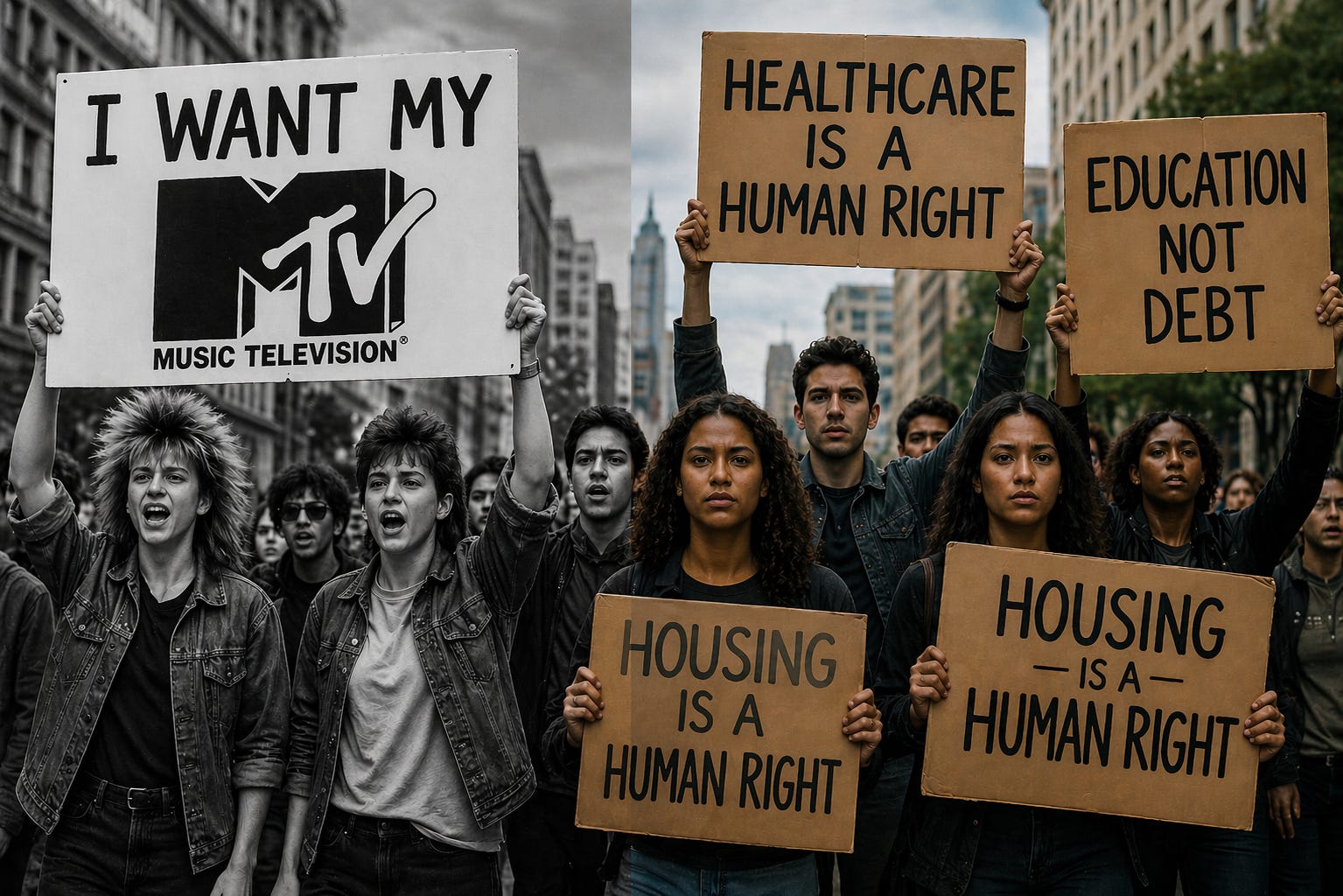
I am part of the MTV generation.
A generation raised on a steady diet of glamour, aspiration, ambition, and wealth in excess — all beamed into our homes through network and cable TV.
“I want my MTV” was more than a marketing slogan. It was a campaign. A ploy designed to get kids to write their cable providers and demand MTV be added to the lineup. But the brilliance was in the wording. The phrase carried entitlement. It was bold. The “I” and the “my” gave teenagers ownership over the demand.
MTV wasn’t being sold as just a new channel — it was being sold as identity.
And once teens started lapping it up, once MTV was left on 24/7 like a radio in the background, we got more than the latest hits. We got access. We didn’t just hear music — we saw the artists. The clothes. The jewelry. The adoring fans. The lifestyle.
It was, in many ways, the first real form of social media.
It allowed celebrities to engrain themselves into the daily lives of their fans. An artist wasn’t just a voice on the airwaves anymore — they were a person you could follow. You got to go backstage, peek into their lives, hear their stories, and absorb the mythology of who they were supposed to be.
And MTV wasn’t the only machine pressing on the ambitions of a generation.
We also had shows like *Lifestyles of the Rich and Famous*. Robin Leach walked us through mansions, yachts, and ridiculous displays of luxury, narrating excess to kids sitting in modest living rooms with wood-paneled walls. Television that once focused on suburban or working-class life began shifting toward wealth and power. We grew up on *Dallas*, *Dynasty*, and *Designing Women*.
Suddenly, a normal life wasn’t enough.
Or more accurately — it was made to feel like it wasn’t enough.
For the first time in history, the working class didn’t just look up at the ruling class — they started to see it as aspirational.
Not distant. Not untouchable.
Possible.
We were made to believe that if we worked hard enough — or got lucky enough — we too could cross that line. That we could step out of ordinary life and into something bigger, brighter, richer.
And the stories we were fed reinforced it.
The adoption theme was everywhere.
Not just in obvious ways like *Different Strokes*, where kids were literally lifted out of one world and placed into another — but in subtler fantasies too. *Magnum P.I.* living in a Hawaiian estate he didn’t earn, driving a Ferrari that wasn’t his, moving freely through luxury because someone had chosen him.
That was the quiet promise.
You might not be born into it…
but you could be picked.
Discovered. Selected. Elevated out of obscurity.
It’s a powerful idea — because it removes the burden of structure and replaces it with the hope of exception. You don’t need the system to change if you believe you might one day escape it.
And that belief rewires how you see your place in the world.
Instead of questioning the gap between classes, you imagine yourself crossing it.
Instead of challenging the system, you invest in the fantasy of winning it.
Because when enough people believe they might become rich, fewer people ask why they’re not.
And I know how this sounds.
A little absurd. A little conspiratorial.
That’s not what I’m saying.
But timing matters.
Because right around the same time a generation was being taught to dream — to rise above their station — the rules of the game started to shift.
We got trickle-down economics.
We got steadily lowering tax rates for the wealthiest.
We got deregulation, privatization, and a cultural push toward individualism.
And none of it was sold as control.
It was sold as freedom.
Freedom to succeed.
Freedom to build.
Freedom to become.
But underneath that messaging, something else took hold.
We started building a society that quietly accepted a simple premise:
if there are winners, there must be losers.
And if you didn’t win?
Well, that was on you.
You didn’t work hard enough.
You didn’t want it badly enough.
You didn’t take the right risks.
It couldn’t be the system — because the system was built on opportunity. That’s what we were told.
So failure stopped being structural.
It became personal.
And once people internalize failure, they stop questioning the conditions that produce it.
They stop asking why the ladder is so hard to climb.
They just blame themselves for not climbing it fast enough.
That’s how you maintain a system without needing to defend it.
You don’t have to convince people it’s fair.
You just have to convince them that any outcome within it is their responsibility.
But here’s the thing.
Today’s generation can see it.
They have the benefit of hindsight. They can connect the dots — not just through experience, but through access to information and each other in ways we never could.
And they’re different.
They grew up watching their parents struggle just to keep up. They watched people do everything “right” and still fall behind. They weren’t promised fame, fortune, or even stability.
So they adjusted.
This isn’t a generation obsessed with owning things.
It’s a generation trying to live a balanced life.
They hear what previous generations were able to achieve — homes, families, stability — and they see how far out of reach that feels now. Not because they lack ambition, but because the math doesn’t work.
Rising costs.
Stagnant wages.
Systems stretched past their limits.
So they’re not asking for MTV.
They’re not chasing endless possessions.
They’re asking for something far more basic.
Education.
Healthcare.
Housing.
The necessities required to live a stable life.
And when they hear the old lines —
“pull yourself up by your bootstraps,”
“work harder,”
“stop complaining” —
it doesn’t land the same way anymore.
Because they’ve already seen what that effort produces.
They see the imbalance.
They see the trade-offs.
They see what it costs — not just individually, but socially.
And they’re not seduced by it.
Because you can’t sell the dream to people who’ve already watched it fail in real time.
They don’t want to win the game.
They’re starting to question why the game looks like this at all.