

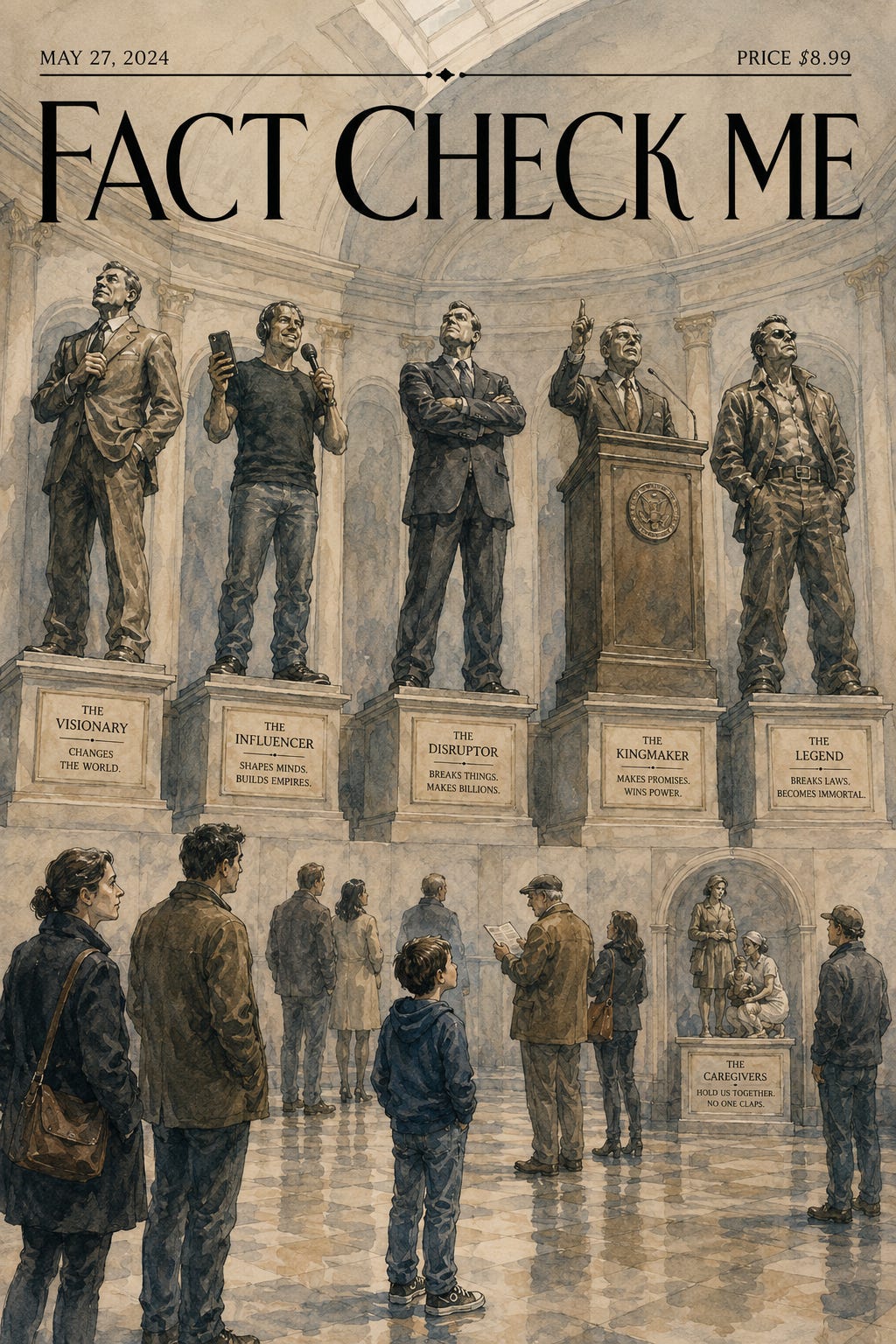
Why do we demand integrity from our children but excuse its absence in our heroes?
As children, we're taught a simple moral code.
Share.
Play fair.
Tell the truth.
Treat others the way you'd want to be treated.
We're told that character matters, that integrity is everything, and that how you win is just as important as whether you win at all.
Then we grow up.
Suddenly, we're taught an entirely different set of rules.
"Business is business."
"You don't get rich by being nice."
"Love him or hate him, you have to respect what he built."
Really?
Do we?
Somewhere along the way, we've accepted the idea that success justifies almost anything. That to make it to the top you have to be ruthless. You have to bend the rules, exploit every advantage, crush your competition, and do whatever it takes. We don't celebrate these traits despite them being morally questionable—we celebrate them because we've been taught they're necessary.
It's a strange contradiction.
We raise our children to value kindness, honesty, and empathy, then applaud adults who seem to succeed by abandoning those very principles.
Take someone like Dana White.
People often tell me, "Love him or hate him, you have to admire what he's done for mixed martial arts."
Do I?
I can acknowledge that under his leadership the UFC became a global phenomenon. That's undeniable.
But why does building something successful automatically make the builder admirable?
The athletes who step into that cage put their brains, bones, and futures on the line. Many fighters have long argued they deserve a larger share of the wealth they create, while those at the top continue to prosper. Whether you think fighter pay is fair or not isn't really the point.
The point is this:
Success answers one question.
Did it grow?
It doesn't answer the more important one.
Was it built in a way worthy of admiration?
Those aren't the same thing.
The same pattern appears everywhere.
We romanticize billionaires as visionaries before we ask how they accumulated their wealth.
We celebrate politicians because they won elections, as though victory itself proves virtue.
We even idolize criminals. The mafia has become entertainment. Gangsters become antiheroes. We quote them, dress like them, and call them legends while forgetting the violence, fear, and exploitation that made their empires possible.
We have an odd habit of confusing power with greatness.
Then there's influence.
How can someone like Joe Rogan speak to millions of people every week and be told he bears virtually no responsibility for the ideas he amplifies?
Many of his listeners are young men looking for direction, purpose, or simply someone who seems to understand the frustrations they feel. Whether you agree with him or not, that kind of reach carries weight.
We expect teachers, journalists, doctors, and coaches to understand the influence they have over others.
Why should people with audiences hundreds of times larger be held to a lower standard?
Freedom of speech has never meant freedom from criticism.
Influence carries responsibility whether you asked for it or not.
What concerns me most isn't any one billionaire, podcast host, politician, or sports executive.
It's the story we're constantly being sold.
Be bold.
Break the rules.
Don't apologize.
Do whatever it takes.
The people who benefit most from that message are often the same people with the largest platforms and the greatest ability to shape our culture. Through podcasts, documentaries, business books, social media, and endless interviews, they teach us that this is simply what success looks like.
Maybe that's why I had such a hard time watching The Audacity.
Not because it's unfair.
Because it feels plausible.
It's a satire about Silicon Valley and tech billionaires, but it could just as easily be about politics, professional sports, entertainment, or Wall Street. Strip away the industry and the message is the same: once someone convinces themselves they're changing the world, the rules somehow stop applying to them.
The frightening part isn't that these characters exist.
It's that we recognize them.
We've seen them before. We reward them. We defend them. We buy their products, consume their content, vote for them, and tell ourselves that their brilliance excuses behaviour we'd never tolerate from anyone else.
Apparently integrity is mandatory—unless you're successful enough that it becomes optional.
So what's the alternative?
Do we simply accept that the world is dog eat dog?
Even that expression falls apart under scrutiny.
Dogs survive because they work in packs.
Human beings have never advanced because one ruthless individual conquered everyone else. We advanced because we cooperated. We shared knowledge. We built communities. We trusted one another enough to create civilizations.
Today we possess something our ancestors could scarcely imagine.
The printing press changed the world by making information harder to control.
The internet changed it again by allowing almost anyone to create information, challenge institutions, expose corruption, organize communities, and support ideas they believe in.
The powerful still have advantages. They always will.
But they no longer have a monopoly on the conversation.
The rest of us have voices too.
Power isn't just something that's taken.
It's something that's given.
Every ticket we buy.
Every subscription we keep.
Every dollar we spend.
Every vote we cast.
Every post we share.
Every public figure we excuse.
Those are all tiny acts of consent.
Individually they feel meaningless.
Collectively, they're how cultures change.
Maybe the question was never whether we should admire success.
Maybe the question is whether success, on its own, deserves our admiration.
Because if we continue to mistake winning for wisdom, wealth for virtue, and influence for righteousness, we shouldn't be surprised when the people at the top keep teaching us that the only thing worth measuring is who got there first.
I think we can do better than that.
Fact check me.
🎶Every move you make
And every vow you break
Every smile you fake
Every claim you stake 🎶