

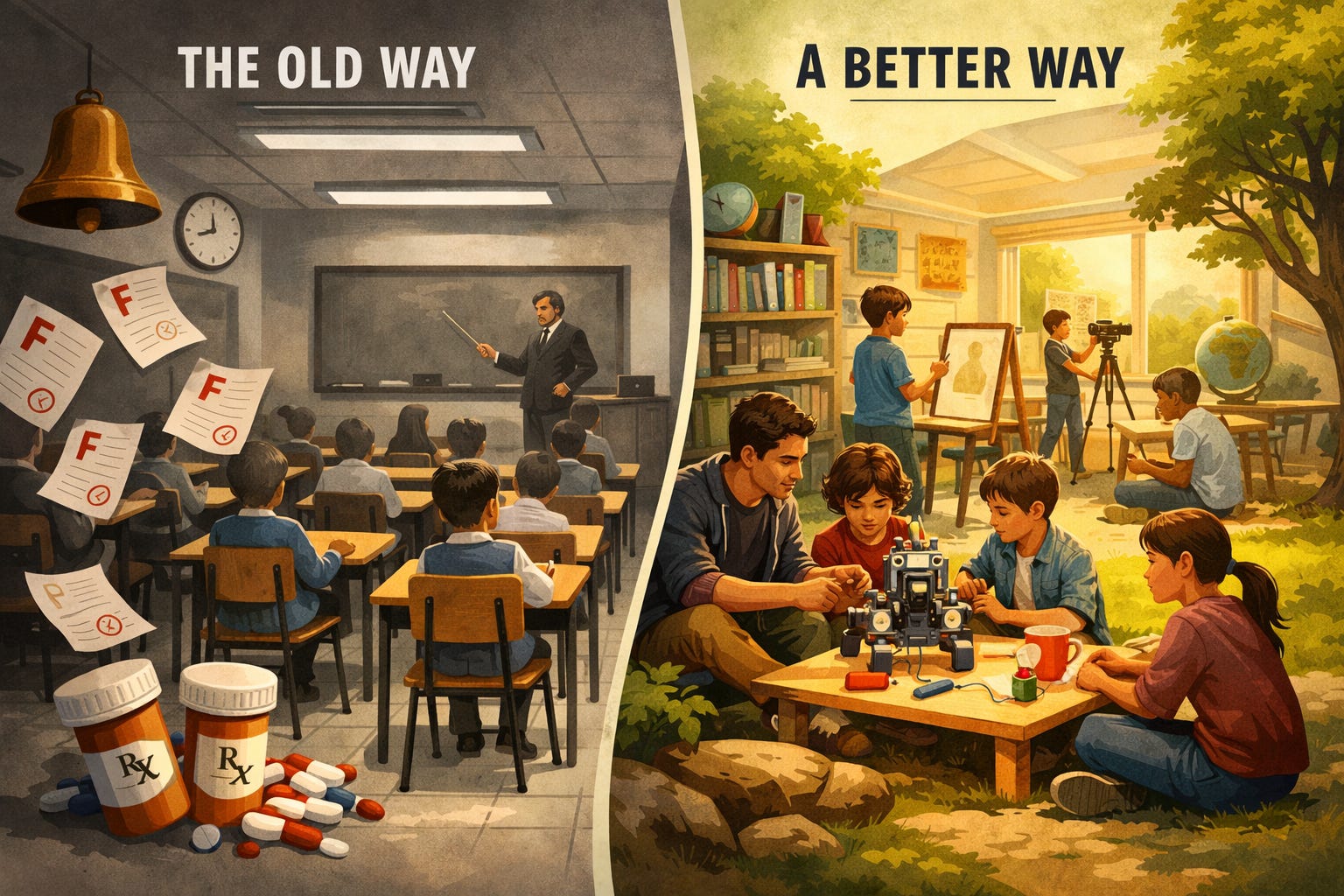
Stop romanticizing the past.
Learning wasn’t better “back then.”
It sucked.
Most kids were ignored.
Some were beaten.
Many were written off entirely.
If you didn’t fit, you disappeared.
So this isn’t about going backward.
It’s about finally going forward.
Public education matters.
A healthy society depends on it.
But the system we’re using now is still a dressed-up one-room schoolhouse with better lighting and worse outcomes.
Same age groups.
Same pacing.
Same boxes.
Same desks.
Same bells.
Same assumption that conformity equals learning.
And when kids don’t fit?
We label them.
Learning disability.
Behavior problem.
ADHD.
Not because they’re broken —
but because the system refuses to move.
ADHD isn’t bullshit because it doesn’t exist.
It’s bullshit because we turned a way of functioning into a disorder.
Show me some of the most effective, creative, adaptive people in the world and I’ll show you brains that don’t sit still, don’t wait their turn, and don’t learn in straight lines.
They didn’t succeed because they were “treated.”
They succeeded because someone stepped in and said,
“Fuck the system. This kid is better than that.”
Usually a parent.
Sometimes a teacher.
Sometimes a coach.
Someone who gave them tools.
Books.
Machines.
Space.
Permission.
And here’s the part no one wants to say out loud:
Kids with resources get their differences interpreted.
Kids without resources get their differences disciplined.
Same brain.
Different outcome.
That’s not neuroscience.
That’s class.
So stop pretending the answer is more testing, more medication, more compliance, and more buildings full of kids sitting still all day while everything we know about learning says it doesn’t work that way.
Learning doesn’t happen in boxes.
We just keep building them.
A better system wouldn’t be more expensive.
It would be cheaper.
Smaller learning hubs.
Mixed ages.
Mentorship over semesters instead of rotating strangers.
Project-based work.
Flexible pacing.
Narrative assessment instead of grades.
You eliminate massive admin layers.
Endless testing infrastructure.
Behavior management costs.
Burnout.
Dropouts.
Late-stage “interventions” that come decades too late.
Engaged learners are cheap.
Disengaged ones bankrupt societies.
We already have the teachers.
We already have the research.
We already know what works.
What we don’t have is the courage to trust people over systems.
This isn’t radical.
It’s practical.
We can build something better.
With better outcomes.
For less money.
The only thing standing in the way
is our addiction to control
and our fear of letting kids become who they actually are.