

Here’s the uncomfortable truth:
Education doesn’t need a fix.
It doesn’t need a reform.
It doesn’t need another patch, pilot project, or politician’s promise.
It needs to be burned down and rebuilt.
Not out of spite — out of necessity.
The system we’re using is doing exactly what it was designed to do. It just wasn’t designed for this world.
We’re still teaching as if knowledge is scarce, as if facts must be memorized and stored because you might not have access to them later. As if the biggest risk is not knowing enough details.
That world is gone.
Facts are everywhere now. Too many, in fact. There are more details than any one person could ever hope to hold. Too many specializations. Too much information. Too many moving parts.
So the goal can’t be “know everything.”
The goal has to be understand how things work well enough to decide what matters.
Right now, we do the opposite.
We teach people to memorize isolated facts without context. Dates without causes. Names without systems. Opinions without evidence. Subjects without connections.
We teach history like we’re watching a movie.
Heroes. Villains. Uniforms to glorify. Uniforms to despise. Sides to choose. Lines to cheer.
And then we act shocked when the real world doesn’t look like the script.
History doesn’t repeat as a remake.
It repeats as a pattern.
Same pressures.
Same incentives.
Same fears.
Different flags. Different rhetoric. Different technology.
When you train people to recognize costumes instead of conditions, they miss it every time it comes back wearing different clothes.
And it always comes back.
The same failure shows up everywhere else.
You can’t understand biology without chemistry.
You can’t understand psychology without philosophy.
You can’t understand thought without understanding the brain.
You can’t understand the brain without biology, chemistry, environment, and experience.
Nothing exists in a vacuum.
Economics touches psychology.
Psychology touches politics.
Politics touches media.
Media touches incentives.
Incentives shape behavior.
Behavior reshapes systems.
Everything touches everything else.
But instead of teaching people how systems interact, we hand them sealed boxes labeled “math,” “history,” “science,” and “social studies” — as if reality respects those borders.
It doesn’t.
That’s why people are drowning in information and starving for understanding.
That’s why a guy at the grocery store can look at the price of beef and immediately blame “the government,” as if one person, one party, or one election controls weather, supply chains, fuel costs, corporate consolidation, labor shortages, inflation, climate instability, and decades of policy inertia.
The person in charge is usually just the one holding the bag of shit when the bill comes due.
Policy doesn’t form overnight.
Outcomes lag.
Momentum matters.
A good economy or a bad one is usually inherited — built by administrations long gone, shaped by bureaucrats, corporations, and incentives wearing every color of stripe imaginable.
Blaming the person holding the microphone feels good, but it doesn’t give you power.
Understanding does.
Most people can’t see why they suffer. So they do the human thing: they look for a face to blame. Someone nearby. Someone loud. Someone visible.
But most of the people who caused today’s problems are retired, insulated, or dead.
So what do you do?
You educate people to see.
Not with more trivia. Not with louder opinions.
You teach mechanics.
You teach people how systems form, how incentives shape behavior, how feedback loops spiral, how small decisions compound over time, how power concentrates quietly, legally, bureaucratically.
You teach them how to tell the difference between:
facts and opinions
uncertainty and denial
metaphor and measurement
skepticism and contrarianism
Because an opinion is only valid when the facts are unclear.
It’s 2026. We have satellites, space stations, global communication, live data streams from orbit — and we still have flat earthers.
That isn’t a technology problem.
It’s an education problem.
We never taught people how knowledge is established. How evidence is weighed. How models improve. How certainty works. How metaphor teaches meaning without describing physics.
So people retreat into belief systems that feel stable — even when reality is sitting right at their feet.
And a society that can’t agree on how reality is determined can’t solve complex problems. It can’t govern itself. It can’t tell the difference between disagreement and delusion.
That confusion isn’t empowering. It’s exploitable.
Real education doesn’t eliminate disagreement.
It narrows it to where it actually belongs.
Before we point more fingers, before we blame the wrong people and the wrong systems, we need to build an education system that stops fixating on useless details divorced from the bigger picture.
Teach the full picture first.
Teach systems.
Teach patterns.
Teach incentives.
Teach context.
Then the details are forced to reveal themselves — because details only mean something once you understand what they’re part of.
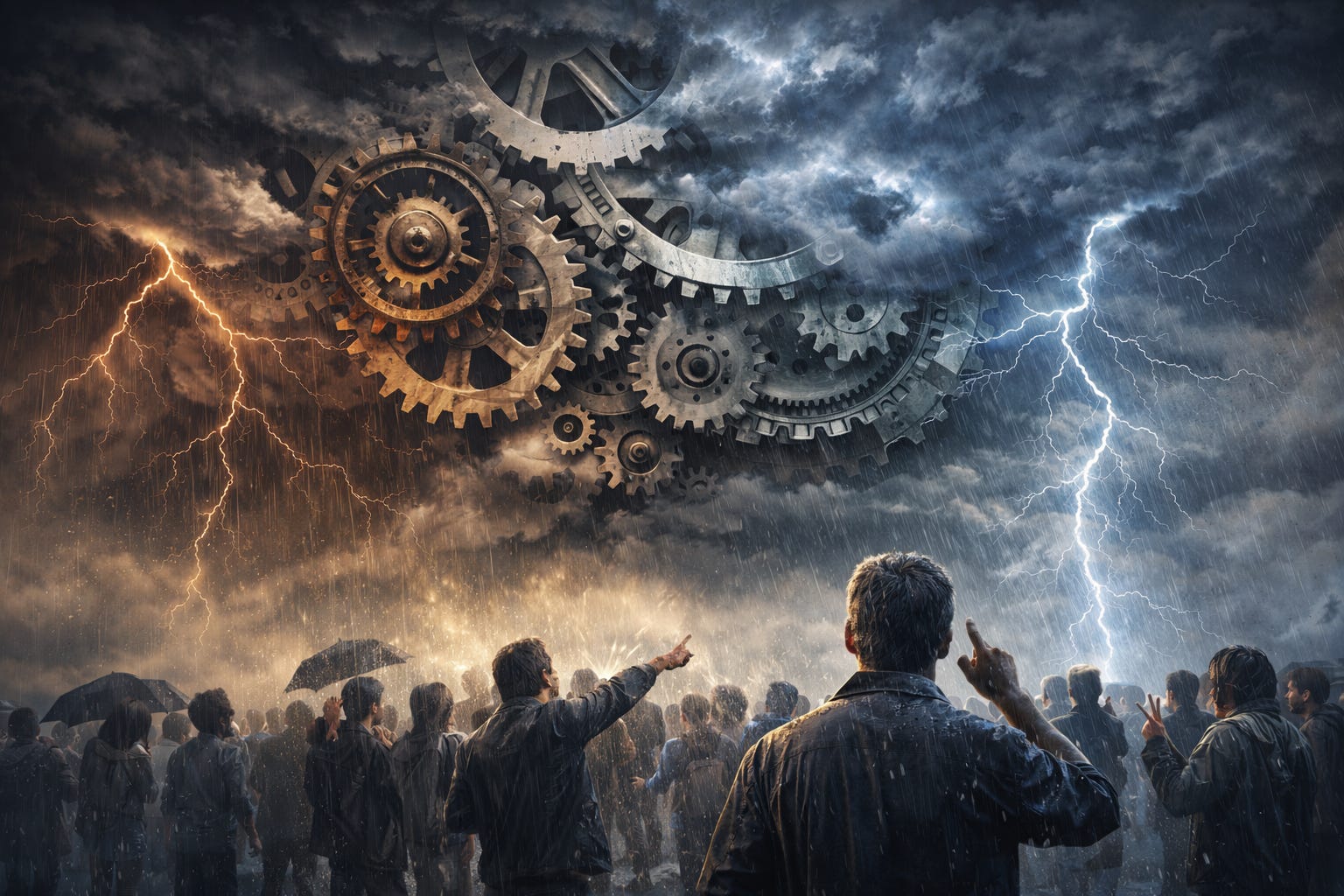
It’s hard to see where the storm is going, where it came from, and what it’s bringing…
when you’re standing inside it.
And that’s the real failure of modern education.
It keeps people inside the storm — reacting to the rain — without ever showing them the weather.
One big, fat, sweeping YUP