

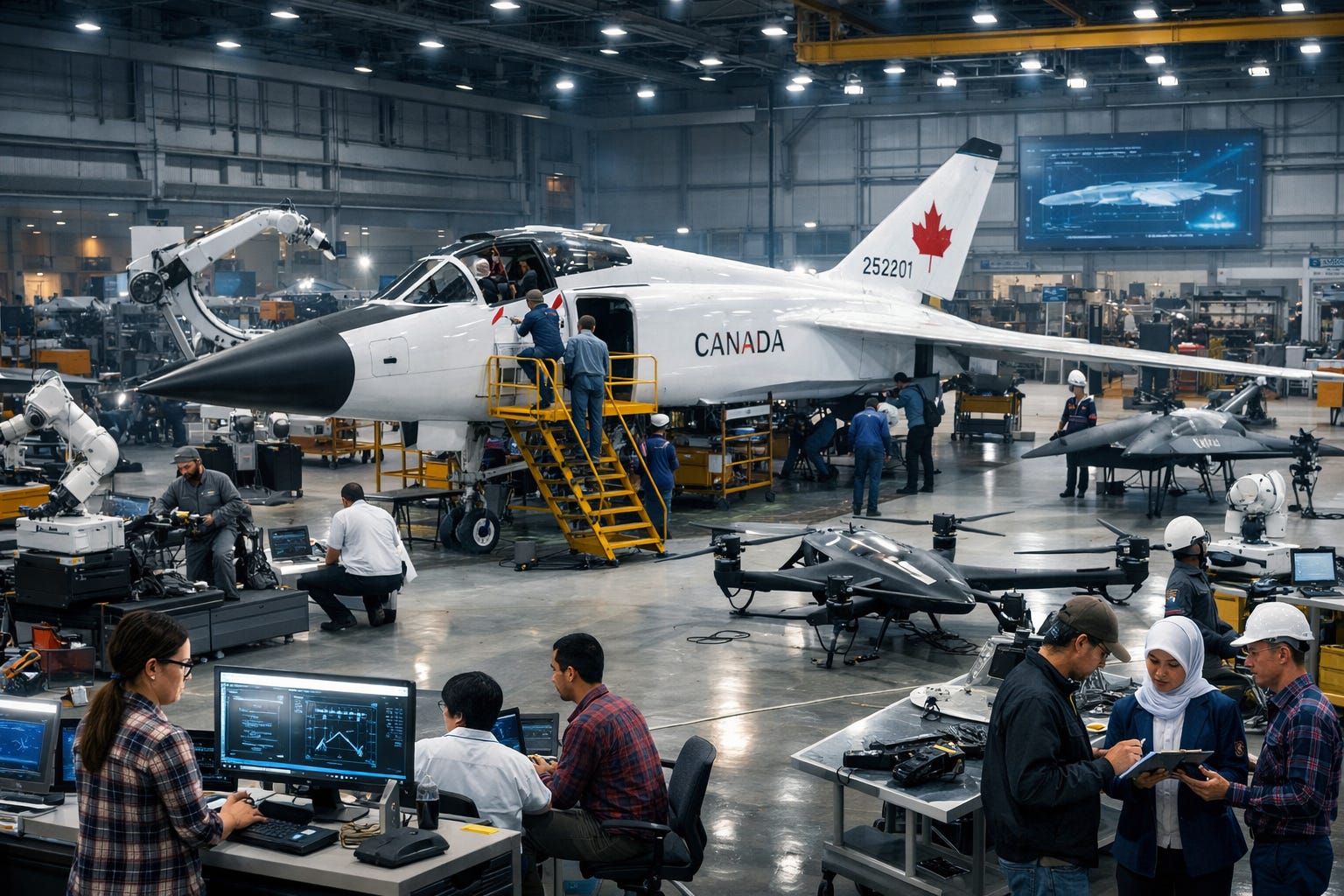
We were taught the Avro Arrow was a failure.
It wasn’t.
It was killed — not because it didn’t work, but because it worked too well.
For every dollar invested, it returned three.
It built talent inside our borders.
It gave Canadians meaningful work that mattered to the nation itself.
And when it was scrapped, it happened fast. Brutally fast.
Thousands of engineers, machinists, designers, and technicians lost their jobs almost overnight. They walked out of the building carrying cardboard boxes — family photos, desk nameplates, the small artifacts of a life suddenly cut loose.
And waiting for many of them was NASA.
They needed to get to the moon.
That moment marked the beginning of the Canadian brain drain — and here’s the truth no one wants to admit: it never ended. It just changed shape.
Today we educate Canadians in advanced fields, then offer them no serious domestic projects worthy of their skills. So they leave.
We invite international students, take their tuition, train them — and they leave too.
We don’t decide where they go.
We have nothing compelling enough to keep them.
We like to talk about education, but education without opportunity is just subsidized migration.
We are told Canada is opposed to war — and that’s true.
But defence isn’t about war. It’s about innovation under urgency.
Why do you think you have Wi-Fi?
Why do you think you carry a computer in your pocket?
Steve Jobs didn’t invent those technologies. He assembled them.
Most of what powers modern life — GPS, wireless networking, microprocessors — came out of defence and space programs funded by governments that understood one thing:
If you want the future, you have to pay for it before it makes sense.
Canada once understood that.
Then we got scared of our own ambition.
We cling to foreign auto manufacturing and pretend it’s industrial policy.
But make no mistake: there are no Canadian cars.
GM. Ford. Toyota.
Foreign companies. Foreign IP. Foreign decisions.
We assemble what others design.
We keep jobs only as long as spreadsheets elsewhere allow it.
The Arrow was different.
It was 100% Canadian — design, systems, ownership.
It didn’t just build aircraft.
It built towns.
Communities.
Hockey arenas.
Bakeries.
Schools.
Money flowed within our borders instead of leaking out to foreign shareholders.
That’s what sovereignty actually looks like — not flags, not slogans, but control.
Now look at the world.
Climate change has redrawn the map.
The Northwest Passage — once legend, once obsession — is opening.
For centuries, explorers chased it because they understood what it meant:
Trade routes. Power. Leverage.
Canada is no longer remote.
Canada is central.
And centrality comes with responsibility — and opportunity.
You cannot govern the Arctic with southern assumptions.
You cannot protect Arctic trade routes with equipment designed for deserts and aircraft carriers.
Yet we continue to buy military equipment from foreign governments that do not understand our geography, our distances, or our cold.
Half of the U.S. has never seen sustained Arctic winter.
They don’t design for −40.
They don’t design for silence, distance, and failure.
And still we pay their price tags.
We sell our resources the same way.
We think small:
“How many rural jobs does this mine create?”
So we sell our minerals.
Our oil.
Our forests.
Often to the lowest bidder.
Often with no long-term ownership.
Often with no downstream control.
So what should be ours belongs to others.
Why don’t we benefit from oil the way Norway does?
Because they built a sovereign wealth fund.
They asked how to turn resources into permanence.
We didn’t.
We apologized for our wealth instead of stewarding it.
And yet — despite all of this — Canada is rising.
We have:
Resources the world needs
An educated population
Stability that attracts people and capital
Institutions that bend but don’t break
External forces try to infiltrate us with fear, xenophobia, and grievance politics — but our shared identity holds.
In Canada, we don’t hate our system.
We just wish the people running it did a better job.
That matters.
It means we believe in governance.
In process.
In community.
Canadian patriotism isn’t about wealth or domination.
It isn’t about the ability to destroy another nation with the push of a button.
It’s built on something rarer:
Taking care of each other
Believing work should matter
Building systems that are fair, not flashy
Leading without threatening
We don’t need to be a superpower of force.
We can be something more dangerous to a broken world:
a superpower of example.
A country that shows you can be strong without being cruel.
Capable without being imperial.
Ambitious without losing your soul.
The Avro Arrow wasn’t nostalgia.
It was a glimpse of what Canada could be when it stopped thinking small.
And now — with the world changing, maps redrawn, old certainties gone — the question isn’t whether Canada can step up.
It’s whether we’re finally ready to own what we already are.
Powerful framing on education as subsidized migration. That single line cuts through decades of policy talk about talent retention. I worked with alot of Canadian engineers who ended up in Silicon Valley, and they all said the same thing: loved home, but the projects here weren't ambitious enough. When you train people for moonshots but only offer maintainence work, you shouldn't be suprised where they end up.