

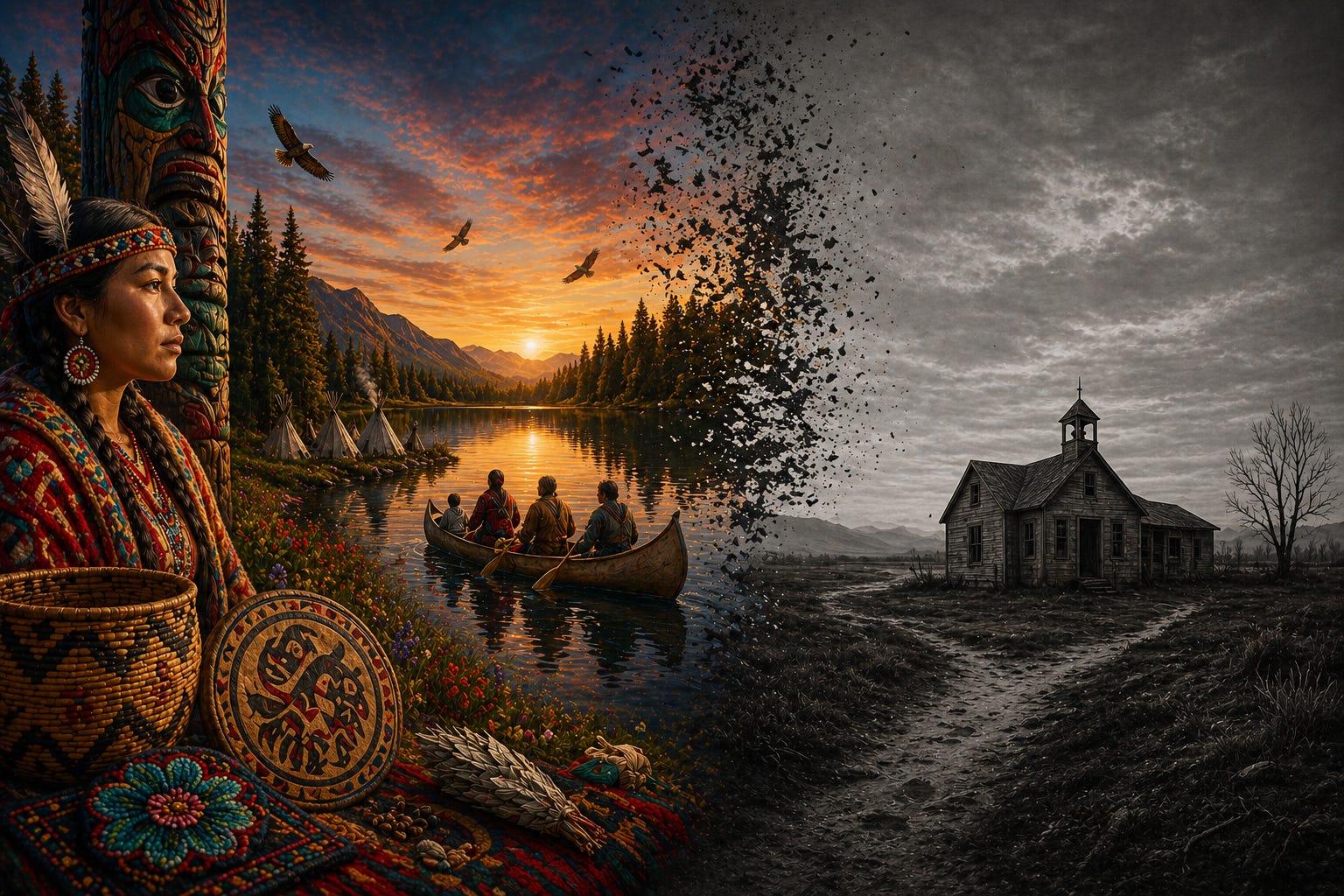
I’m sitting at the table with my kid — Grade 11 English.
He’s working through his Indigenous unit.
I ask what he’s learning.
He shrugs.
“Residential schools.”
That’s what stuck.
Thirteen years into the system, and that’s the takeaway.
Not who these people are. Not how they live today. Not where they fit in the country right now. Just the worst thing that ever happened to them.
And that’s when it hits you.
We don’t teach Indigenous people.
We teach Indigenous history.
Like it’s over.
And look — that history matters.
The Canadian Indian residential school system should be taught, understood, and taken seriously. It should make people uncomfortable.
But when everything is framed in the past, students don’t see a people. They see an event. Something that happened, and something that ended.
Because nowhere in that conversation is the simplest, most important truth:
They’re still here.
Indigenous peoples in Canada were never one group, and they aren’t one now.
The Haudenosaunee Confederacy didn’t live like the Mi’kmaq, and the Anishinaabe don’t share the same worldview as the Inuit.
That was true then. It’s still true now.
But you wouldn’t know that from how it’s taught.
What gets delivered is a simplified version that fits neatly into a unit.
And what my kid walks away with isn’t understanding — it’s distance.
Indigenous becomes something that happened to people a long time ago.
And then there’s the structure.
We don’t even give this its own space.
We tuck it inside an English course — a subject that’s supposed to open things up — and somehow manage to narrow both at the same time. English loses range, and Indigenous studies loses depth.
We’ve gone from ignoring Indigenous history to centering it almost entirely on trauma.
It feels like progress, but it still keeps Indigenous people at arm’s length — locked in the past, defined by what was done to them instead of recognized as part of what Canada is right now.
If this actually matters, then the framing has to change.
Not just what we teach — but how we position it.
Not as something that happened.
As something that continues.
Because there’s something else we’re missing.
When you look at the world right now — how we treat each other, how we treat the land — it’s hard to argue we’ve got it figured out.
There are ways of living that existed here long before Canada did. Ways that placed responsibility to the community ahead of the individual, and treated the land as something to be cared for, not used up. Not perfect, not the same everywhere, but grounded in a different set of priorities than the ones driving most of our decisions today.
And we barely touch it.
We keep searching for new systems to fix what’s broken — while ignoring the ones that were already here.
Because if the only thing my kid learns about Indigenous people is how they suffered…
he’s going to miss what they still have to offer.
That they’re still here.
And that we might actually need them more now than ever.