

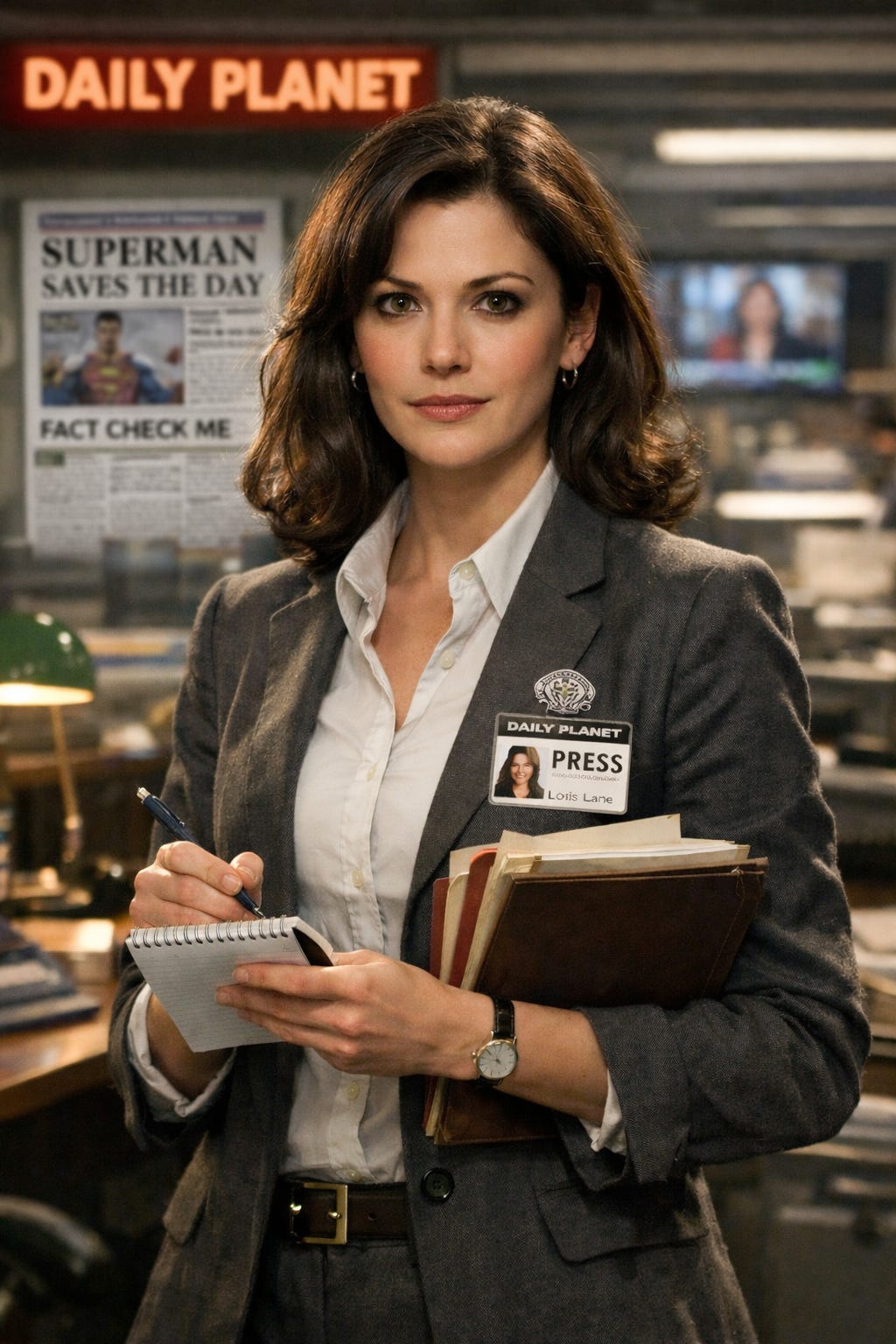
Lois Lane was exceptional.
That was the whole point.
She wasn’t brave because she ran toward danger — she was brave because she was allowed to. She had editors. She had time. She had protection. She had a newsroom whose job was to back her when the truth got uncomfortable.
Lois Lane didn’t just chase stories — she belonged to a system that understood roles. She investigated. Others verified. Someone else decided what led the broadcast. The audience trusted the process because the process had limits.
Now look at us.
We’re told the problem is “who controls the news.”
That’s not it.
The real problem is who’s expected to do what.
We’re expected to:
spot the story
find the angle
verify sources
cross-check claims
understand history
track geopolitics
follow the money
read opposing views
edit for bias
then somehow turn into a calm, charismatic TV personality who can explain it all in under 90 seconds
All while working a job, raising kids, paying rent, and staying sane.
I’m not Lois Lane.
Neither are you.
And pretending we’re supposed to be is breaking people.
The news used to be half an hour long. That wasn’t a limitation — it was a feature. It meant someone else had already done the work of deciding what mattered most today. You watched, you learned, and you went back to living.
Now the news never ends. Same four stories. Same panels. Same recycled outrage. Leave it on all day and you don’t learn more — you just absorb anxiety. Repetition masquerading as relevance.
And here’s the cruel irony:
The best reporting happening right now isn’t on TV.
It’s done by:
people with phones
spreadsheets
satellite images
shipping logs
flight trackers
publicly available data
We’ve got independent researchers — “weirdos,” hobbyists, obsessives — tracking troop movements, equipment losses, and battlefield realities with terrifying accuracy. Not because they’re paid. Not because they’re backed. Because they care, and because they’re free.
Reporting the news has become a hobby.
And watching the news has become a lifestyle.
That should horrify us.
Because money still carries authority. Production value still signals legitimacy. And the people with the backing are always tethered to the people doing the backing. Advertisers. Shareholders. Access. Brand safety. Legal teams.
Money gives you a megaphone.
The megaphone comes with a leash.
So we live in an upside-down world:
truth without authority
authority without freedom
and an audience trained to confuse polish with credibility
The signal is there. It’s free. It’s detailed. It’s documented.
And almost nobody’s looking — because it doesn’t feel official.
We didn’t lose journalism.
We lost role clarity.
Lois Lane worked because not everyone had to be Lois Lane.
Most people were allowed to trust that someone else was doing the digging — and doing it well.
Now we’ve collapsed the entire system onto the individual and called it “being informed.” That’s not empowerment. That’s abdication dressed up as responsibility.
So no — the solution isn’t “try harder.”
It isn’t “do your own research” like that’s a moral failing if you don’t.
The solution is rebuilding systems where:
fewer people dig deeper
those people are protected
synthesis is valued
attention is finite again
and ordinary people are allowed to live without carrying the weight of the entire world
Lois Lane wasn’t a fantasy because she was fearless.
She was a fantasy because the system around her still worked.
And until we fix that, we’re going to keep asking everyone to be a hero —
while quietly removing the conditions that ever made heroism possible.
The Capitalists Press will always serve Capitalism.
We can no longer expect veracity, vetted sources, integrity in reporting or sources, and certainly no end of questionable choices in hiring. The head of a major news organization could be replaced by a dozen writers I know on Substack who don't have a lot of followers but who have far more experience, intelligence, probity, and character than this individual, and many.of the others!