

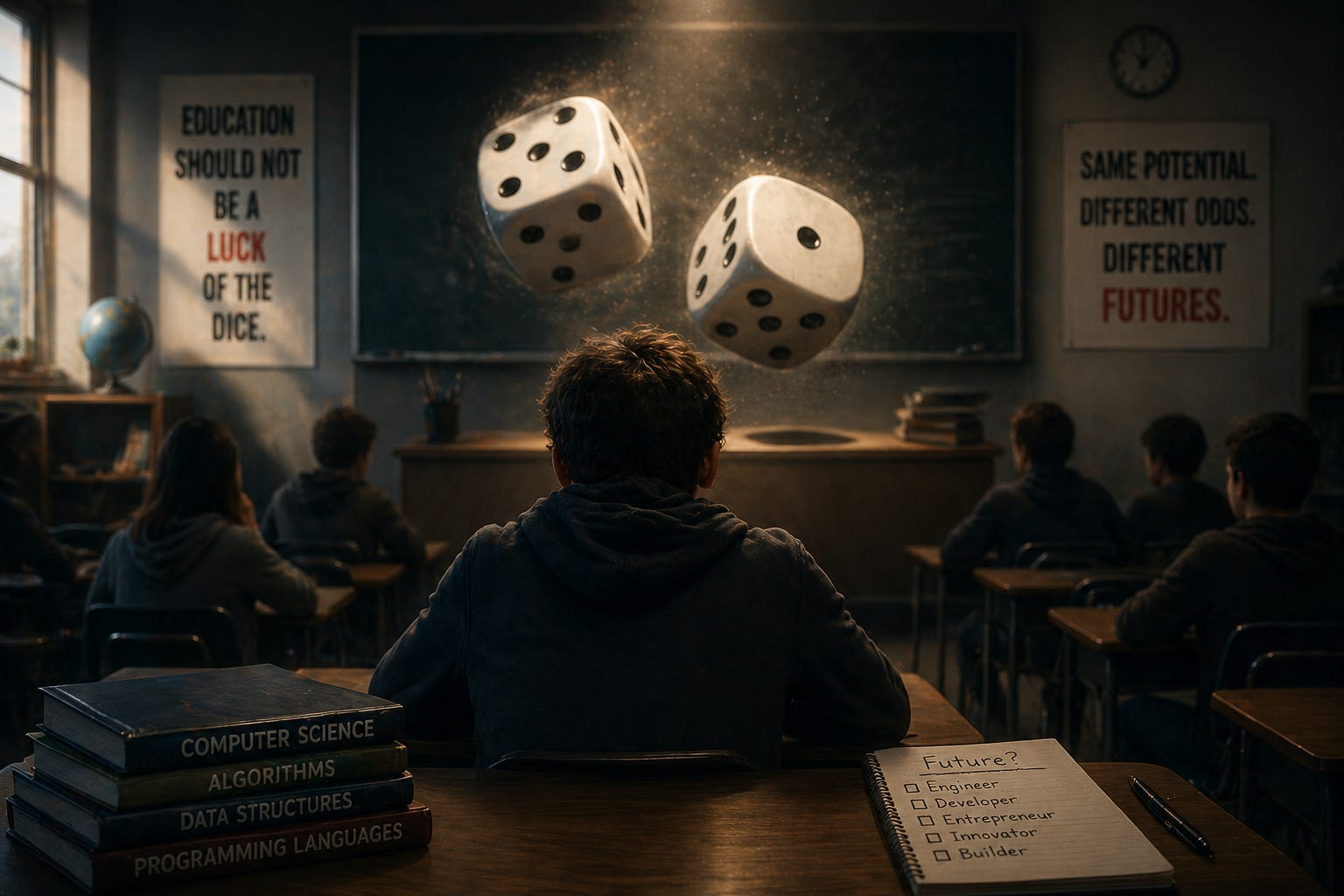
My son didn’t discover computer science because of the school system.
He discovered it in spite of it.
---
He’s always loved math.
Not because he liked getting the right answer—but because he liked the process. The steps. The logic. The idea that if you follow something properly, you get an outcome that makes sense.
Something objective.
Something you can trust.
Something you can build with.
You could see it when he was a kid.
His favourite toys were Legos and Power Rangers.
But he didn’t play with them the way most kids do.
There were no battles. No stories. No saving the world.
He built.
That’s all he did.
He’d take his Power Rangers and combine them in every possible configuration, over and over again, just to see how they fit together.
Same with Lego.
Instructions. Systems. Steps.
That’s where he lit up.
---
So when he got to high school and took computer science, something clicked.
It wasn’t just another class.
It was a language for how his brain already worked.
A way to take that “quirky” part of himself—the part that liked structure, logic, building—and turn it into something real.
Something useful.
Something he could actually *do* with his life.
---
But that didn’t happen because the system worked.
It happened because he got lucky.
---
His teacher wasn’t filling a gap.
He wasn’t a math teacher or a physics teacher assigned to computer science because the school needed someone in the room.
He was an actual computer scientist.
Someone who had spent years working in the field.
Someone who knew the tools.
Knew the languages.
Knew what mattered.
So my son wasn’t just learning computer science.
He was doing it.
Building.
Competing.
Exploring.
Seeing, for the first time, a real path forward.
---
Now imagine the exact same kid.
Same brain.
Same interests.
Same potential.
Different classroom.
---
Maybe that teacher is doing their best.
But they’re not a computer scientist.
They’re a math teacher.
Or a physics teacher.
Or someone handed a course they weren’t trained for.
So the tools are simpler.
The expectations lower.
The material outdated.
Same course code.
Same credit.
Same transcript.
Completely different education.
---
And that’s the problem.
We build school systems around geography and then pretend the outcomes are comparable.
We assign kids to classrooms based on where they live and act like a 90% means the same thing everywhere.
It doesn’t.
Not even close.
---
We say we have a teacher shortage.
But look at what we actually do.
We take people with real, in-demand expertise—developers, engineers, tradespeople—and we tell them:
Go back to school.
Get another degree.
Start at the bottom.
Wait ten years to earn what you’re worth.
---
We already know the job is worth $100,000.
That’s the top of the grid.
So why are we structuring the system so that anyone who already brings that level of value has to wait a decade to be recognized?
---
Take a skilled tradesperson.
An electrician.
A welder.
A machinist.
Someone who’s spent years mastering their craft.
They can earn a strong living right now.
Build something real.
Create something that matters.
And we ask them to walk away from that…
To teach shop class for $50,000 a year and hope it becomes something more.
Why would they ever say yes?
---
Same in tech.
A capable programmer can work remotely, build real products, stay current in a field that evolves constantly.
But if they want to teach?
We make them step out of that world, retrain, and enter a system that treats their experience like it barely exists.
---
And then we wonder why great teachers feel like exceptions.
Why strong programs depend on luck.
Why some kids discover a passion that changes their life…
…and others never even get the chance to see it.
---
My son didn’t find computer science because the system guided him there.
He found it because the right teacher happened to be in the right place at the right time.
That’s not a system.
That’s a gamble.
---
We don’t need to tear everything down.
But we do need to be honest about what’s happening.
This isn’t a shortage of teachers.
It’s a shortage of pathways for the people who actually have something to teach.
---
Because somewhere out there is another kid like mine.
Same brain.
Same curiosity.
Same potential.
And whether or not they ever discover it…
comes down to a roll of the dice.