

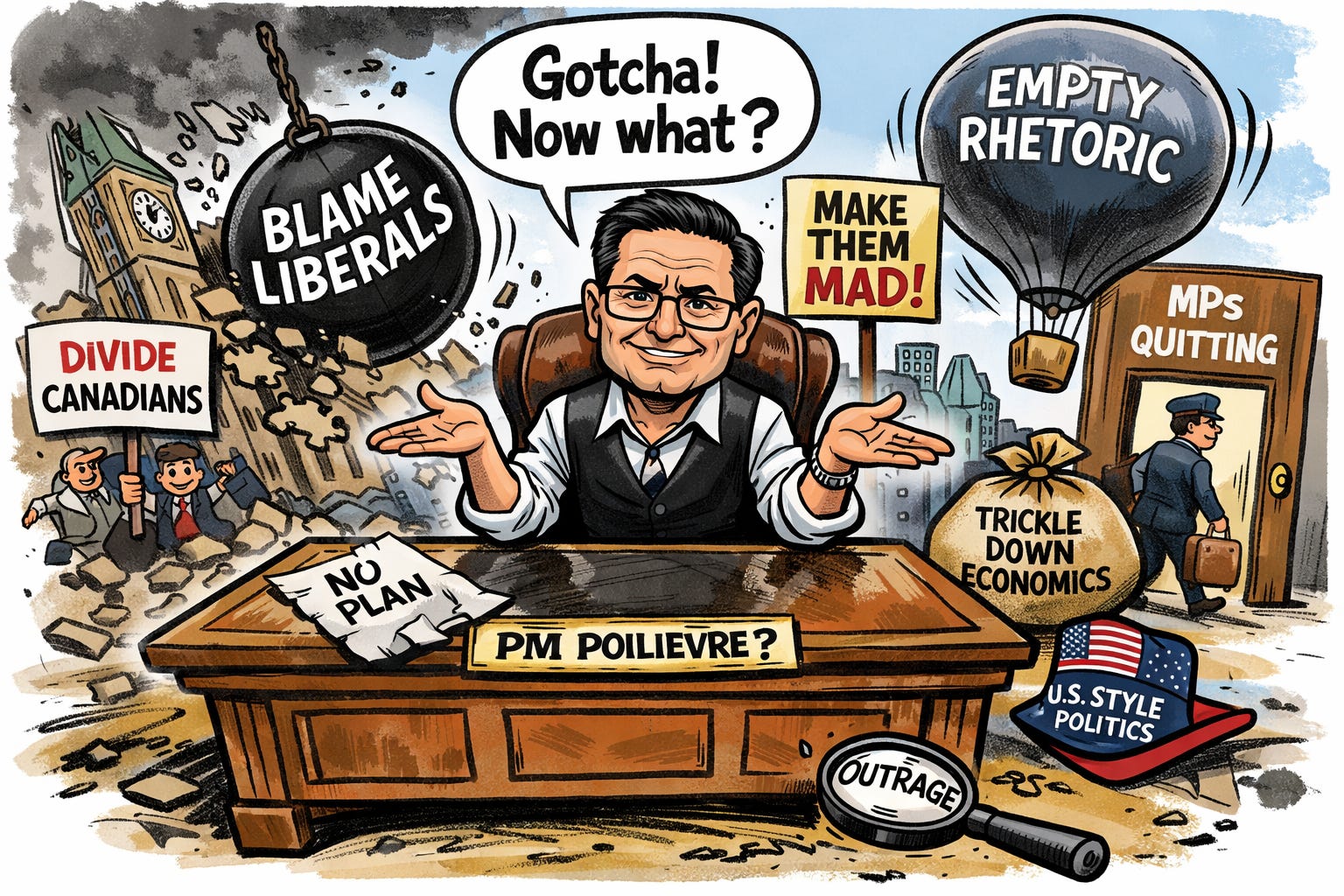
How is Pierre Poilievre still the leader of the Conservative Party?
Let me be clear: this isn’t about disagreeing with someone’s ideology. I can respect a political opponent who lays out a clear philosophy and defends it. I don’t have to like it. I don’t have to vote for it. But I can engage with it.
That’s not what this feels like.
With Pierre Poilievre, the only consistent position seems to be opposition itself. Opposition to the Liberals. Opposition to “gatekeepers.” Opposition to “the elites.” Opposition to carbon pricing. Opposition to spending. Opposition to whatever the government is doing that day.
Opposition is not a platform.
If you were Prime Minister tomorrow, what would you actually do?
Not what you’d undo. Not who you’d blame. Not which slogan you’d repeat.
What would you build?
Because running a country isn’t an extended Question Period clip. It’s not a viral 30-second dunk. It’s not repeating “common sense” until it sounds like policy.
Canada is dealing with affordability crises, housing shortages, strained healthcare systems, infrastructure gaps, climate pressures, and growing distrust in institutions. These aren’t solved by sarcasm. They aren’t solved by calling your opponents incompetent every day for four years.
Are you going to sit in the chair and continue campaigning? Or are you going to govern?
And here’s the deeper issue: it’s hard to even disagree with you meaningfully because you rarely articulate detailed, costed, long-term policy. You critique. You provoke. You simplify. You frame everything as corruption or betrayal. But governing requires complexity. It requires trade-offs. It requires saying, “Here is the plan, here is what it costs, here is who wins, here is who loses, and here is why we believe this is the right path.”
Where is that?
Instead, what comes through is a style of politics that leans heavily into division. Framing immigrants — including people who are here legally — as part of the problem. Suggesting institutions are broken beyond repair. Turning every disagreement into a moral failure of the other side.
Most Canadians don’t wake up wanting political warfare. They want their rent paid. Their groceries affordable. Their kids safe. Their taxes used responsibly. They want functional systems, not permanent outrage.
And yes — your own caucus instability raises questions. When MPs cross the floor or publicly fracture, that’s not just optics. That’s a signal. Leadership isn’t just about attacking opponents; it’s about holding a coalition together.
So what do you stand for beyond “not Liberal”?
Is it trickle-down economics? Is it American-style culture war politics? Is it deregulation at any cost? Is it shrinking government across the board, regardless of downstream effects?
Spell it out.
Because if your core message is simply that everything is broken and everyone else is to blame, then eventually you inherit that same broken system. And when you do, you can’t keep blaming the last guy.
You either govern — or you campaign forever.
Right now, it feels like campaigning forever.
And that’s not enough.
Fact check me.