

I had a long day.
I spent most of it on the road, and by the time I got home all I wanted was to eat my Tuesday taco and lie down in bed.
But Daisy hadn't had her evening constitutional.
Rather than start an argument about whose turn it was, I grabbed the leash and we set off.
My mind still firmly on the Old El Paso waiting for me at home, I decided to take the short route and cut through the park rather than walk around it.
The park was empty.
Well, almost.
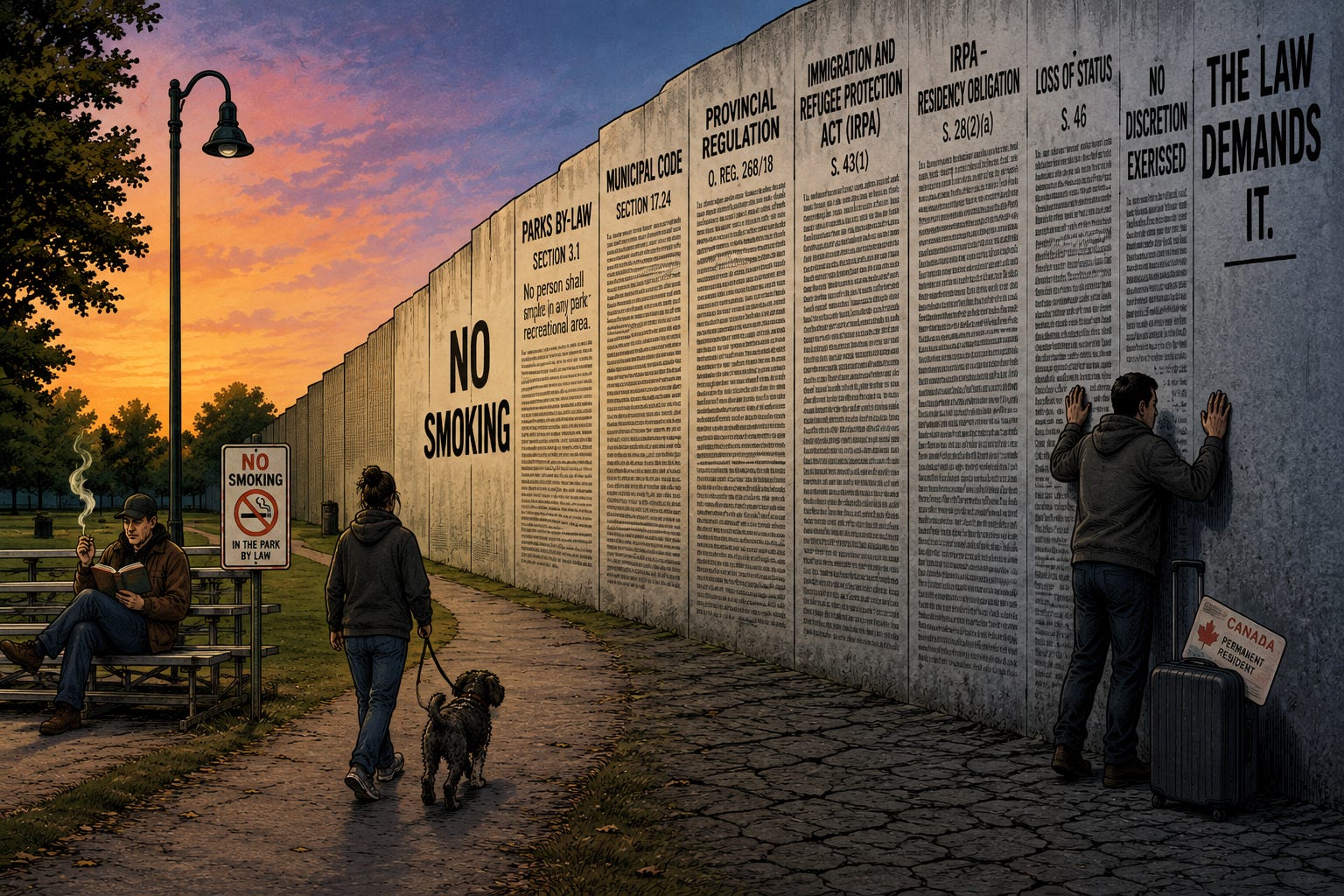
There was a guy sitting alone on the ball diamond bleachers, reading a book and smoking a cigarette.
It was the cigarette that caught me.
Partly because you just don't see that many people smoking anymore, but mostly because it has been illegal to smoke in our parks for years.
There was even a sign about five feet away from him.
So, naturally, I did what any responsible citizen would do.
Nothing.
I kept walking.
I could have pointed out the sign. I could have reminded him that smoking wasn't permitted. I suppose if I was really committed to civic responsibility I could have reported him.
But why?
There was nobody around.
He wasn't blowing smoke into a playground full of children. He wasn't bothering anyone. He was a guy sitting alone on some bleachers, reading a book and having a cigarette.
The rule existed.
He was breaking it.
And somehow society survived my decision not to enforce it.
Rules are important.
We need rules. They're part of how millions of strangers manage to live together without everything descending into chaos.
But knowing when rules need to be enforced is just as important as having them.
Because sometimes we become so concerned with making sure the rules are followed that we forget why the rules existed in the first place.
And this week I read a story that reminded me how dangerous that can become when the stakes are considerably higher than a cigarette in a park.
A man had lived in Canada for decades after coming here as a refugee. He had permanent resident status. At some point, he returned to the country he had fled to care for an ailing family member.
That decision eventually put his status in jeopardy.
Not because he had committed some heinous crime.
Because he had broken the rules.
What stayed with me most was the reasoning attributed to the judge. The outcome wasn't necessarily fair. It wasn't necessarily just.
It was what the law required.
And that's where I have a problem.
Law and justice aren't the same thing.
We should know this by now.
We've had plenty of perfectly legal injustices throughout history. Saying that's the law explains why something happened. It doesn't establish that what happened was right.
Judges can't simply ignore legislation whenever they dislike an outcome. Nor should they. A society in which every official gets to personally decide which laws count isn't much of a legal system either.
But if our laws produce outcomes that reasonable people—including the people tasked with applying them—recognize as unjust, then somebody needs the power to ask whether applying the rule actually serves the reason we created it.
And if nobody has that power?
Then perhaps the problem isn't the judge.
It's the law.
Rules are tools.
We create them to protect people, maintain order, resolve disputes and make society function.
They are not sacred objects demanding obedience for obedience's sake.
Sometimes justice requires enforcing the rule.
Sometimes justice requires making an exception.
And sometimes it requires looking at the guy sitting alone on the bleachers with his book and his cigarette, looking at the No Smoking sign five feet away...
and continuing your walk.
Fact check me.