

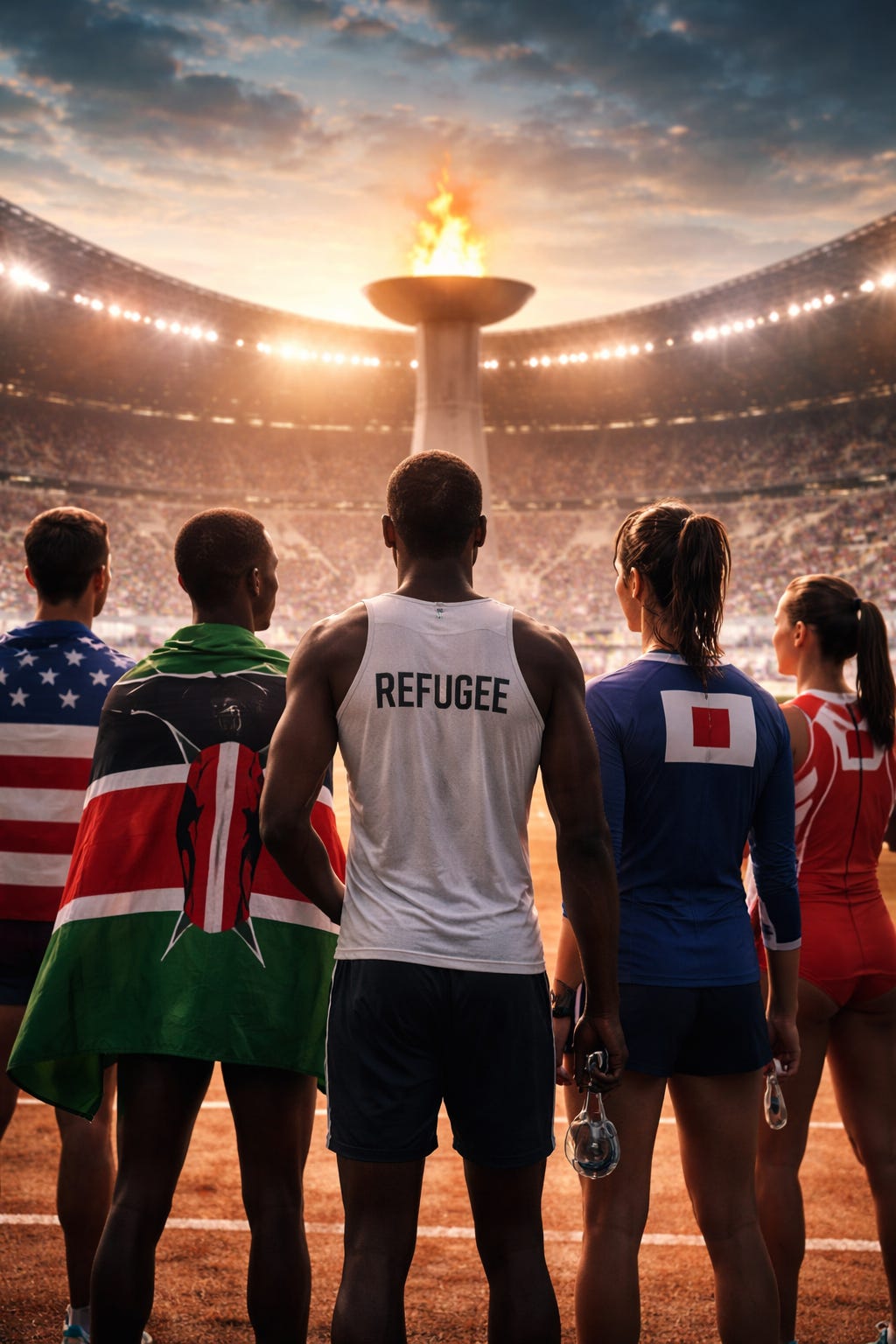
The Olympics are strange in the modern world.
Not because of the corruption or the politics—we can leave that alone—but because of how the Games function in a time when sport is otherwise hyper-commercialized, constantly streamed, and endlessly analyzed.
Every four years, the general public suddenly pays attention to sports that exist quietly the rest of the time. Disciplines athletes train for year after year, season after season, often in near anonymity. Sports most of us don’t understand very well, don’t follow, and couldn’t explain the rules of if asked.
And maybe that’s the best thing about the Olympics.
For a brief moment, excellence matters more than popularity. Mastery matters more than marketability. The spotlight shifts away from the handful of sports we argue about daily and lands on people who have dedicated their lives to something narrow, difficult, and often invisible.
The Olympics remind us that greatness exists far beyond what is profitable.
The Games bring nations together—not to posture or dominate, but to celebrate.
We cheer our athletes because they’re ours. We wrap ourselves in flags, accents, shared history. For a moment, the abstract idea of a nation becomes human. Pride becomes personal.
And just as importantly, the Olympics let us see others.
Stories that feel impossible—like a Jamaican bobsled team—suddenly make sense. Not because they win, but because they exist. Because someone loved something enough to ignore climate, culture, money, and probability just to be there.
For most Olympic athletes, participation is the dream.
Very few will ever be paid well. Fewer still will become famous. A microscopic number will turn their discipline into long-term security. We know a handful of names—but we couldn’t tell you who currently dominates discus, or biathlon, or fencing, even while asking the question.
And that’s not an insult.
That’s the point.
The Olympics aren’t about sustained attention. They’re about recognition. A brief acknowledgment that these people exist, that what they do matters, and that devotion itself is worthy of respect—even if it never translates into fame.
Who wins a medal only feels surprising to us because we tune in once every four years.
We don’t really know how gymnastics or figure skating is scored. We argue about difficulty, artistry, execution—without understanding the system well enough to explain it five minutes later. But for a moment, at least, we watch.
The athletes aren’t surprised.
They already know who’s in contention. They know whose technique is cleanest, whose routine is peaking, who’s injured, who’s inconsistent. They compete against the same people, in the same venues, year after year.
World championships happen annually.
Rankings are tracked.
Margins are measured relentlessly.
By the time the Olympics arrive, the story is mostly written.
What we’re seeing isn’t chaos—it’s the visible tip of a long, quiet process. Years of repetition and refinement suddenly made public for people who normally wouldn’t notice at all.
And that’s okay.
The Olympics aren’t for athletes to learn who’s best.
They already know.
They’re for the rest of us—to briefly step into a world that never stopped moving just because we weren’t watching.
As spectators, we like to believe we’re watching a level playing field.
We’re not.
Different nations, disciplines, and athletes operate with wildly different resources. Some governments pour enormous amounts of money into sport for prestige and national identity. Others rely on corporate sponsorships. Others still scrape together whatever they can.
Money buys advantages most viewers can’t imagine:
Full-time coaching.
Nutritionists.
Physiotherapists.
Sports psychologists.
Recovery technology.
Custom equipment.
Purpose-built facilities.
For some athletes, sport is their job—engineered, optimized, supported.
For others, it’s something they squeeze into the cracks of their lives.
Some athletes sacrifice everything.
They pay their own way.
Work jobs.
Train at night.
Burn vacation days just to make competitions—then quit jobs entirely when the calendar stops forgiving them.
They learn technique by obsessively watching YouTube.
Build their own training programs.
Train in sub-par facilities.
Struggle to find anyone good enough to push them.
They beg for funding.
Crowdsource airfare.
Borrow gear.
Sleep on couches.
They know there is no glory waiting for them.
No endorsements.
No safety net.
They’re not naïve.
They sacrifice everything for something far more precise: the chance to stand near excellence. To test themselves honestly. To know—without illusion—exactly where they stand.
For them, the Olympics aren’t a stepping stone.
They’re a destination.
And some athletes come from places where sport isn’t just sacrifice—but escape.
War-torn regions. Occupied cities. Refugee camps. Places where facilities don’t exist, safety isn’t guaranteed, and tomorrow itself is uncertain.
For them, the Games aren’t about medals.
They’re about being seen.
Sometimes the Olympics are a way out.
Sometimes they’re the only passport available.
Sometimes they’re simply a microphone—however small—to say: we’re still here.
They know a podium won’t end a conflict. But visibility matters. A name on a screen travels farther than statistics ever will.
They aren’t chasing glory.
They’re carrying witness.
So when you watch the Games, don’t just tune in to see your people compete.
Don’t be there to selfishly claim their success as your own.
Look at the athletes themselves.
Who they are.
Where they come from.
What it took to get there.
Because the one who finishes last—the one you quietly wonder how they even belong—may have sacrificed more to stand on that line than the one who came in first ever had to.
The rules of sport may treat competitors equally once the whistle blows.
The systems that support them absolutely do not.
So watch with curiosity, not ownership.
With respect, not entitlement.
With humility.
Because the Olympics aren’t just a showcase of who is fastest or strongest.
They’re a rare glimpse into what people are willing to give up—
just for the chance to stand next to greatness,
even if only for a moment.
And that’s what the Games are really showing us.
The Olympics like Fifa are wildly corrupt. There is no doubt about that. But that is a topic for another piece. What I'm talking about here is the people at the bottom of it. The athletes themselves the sport at it's core. And the stories we should care about. The people the system should be serving.
I’m having a really tough time finding hope in something like the Olympics. I’m left wondering how immigrants & the non-fascists felt during the 1936 Olympics where multiple fascist countries were allowed to compete while they actively were in the middle of harming & killing ppl. I think of all the buckets of money being spent for these “games” & reminded of the Gladiator events in Rome where the people were starving & barely surviving and were given a “circus” to take their minds off their hungry bellies & abject suffering. This current Olympics cost approx $4.2 billion. That’s JUST the cost for Italy. Not each country sending athletes over. What can 4.2 billion do? Well it could build 42,000 homes at $100,000 each. We could be helping 42,000 families have their first homes ever. Instead, we waste it on circuses, ballrooms, secret police abductions of our neighbors, & making the rich MORE rich. So, yea. I’m not feeling the Olympics this yr bc I’m finally seeing how we continue to allow the rich to pull the wool over our eyes while we can’t even afford the wool & have to put our own blinders on credit.