

One thing I heard my entire life whenever people talked about the NDP was:
“We can’t afford them.”
That was always the line.
Because they wanted to spend more.
Build more.
Provide more.
Expand services.
Invest in people.
And working-class people — already struggling to get by — were trained to fear it.
Irresponsible.
Reckless.
Naive.
Because they were taught to think about government budgets the same way they think about their kitchen table.
I can still hear politicians in my head talking about “tightening belts” and “living within our means.”
George Bush Sr. still rings in my ears when I think about it.
Governments spent decades teaching ordinary people to compare national economies to household budgets because it feels intuitive.
If your family overspends, you go broke.
So if the government overspends, the country goes broke.
Simple.
Clean.
Easy to repeat.
Except governments are not households.
A family cannot:
issue currency,
build national infrastructure,
stimulate economic growth,
invest across generations,
or absorb debt strategically to expand productivity.
Governments can.
That doesn’t mean deficits never matter.
Of course they matter.
Waste matters.
Corruption matters.
Inflation matters.
But “we can’t afford it” only seems to appear when ordinary people need something.
Healthcare?
“We can’t afford it.”
Affordable housing?
“We can’t afford it.”
Education?
Transit?
Dental care?
Childcare?
Suddenly everyone becomes an accountant.
But somehow there’s always money for:
corporate subsidies,
bank bailouts,
military expansion,
tax cuts for the wealthy,
emergency protections for financial markets.
Apparently we’re only broke when ordinary people need something.
One of the greatest political tricks ever pulled
was convincing working people
that public services are charity.
That they’re handouts.
Entitlements.
Something dirty.
Something other people are taking from you.
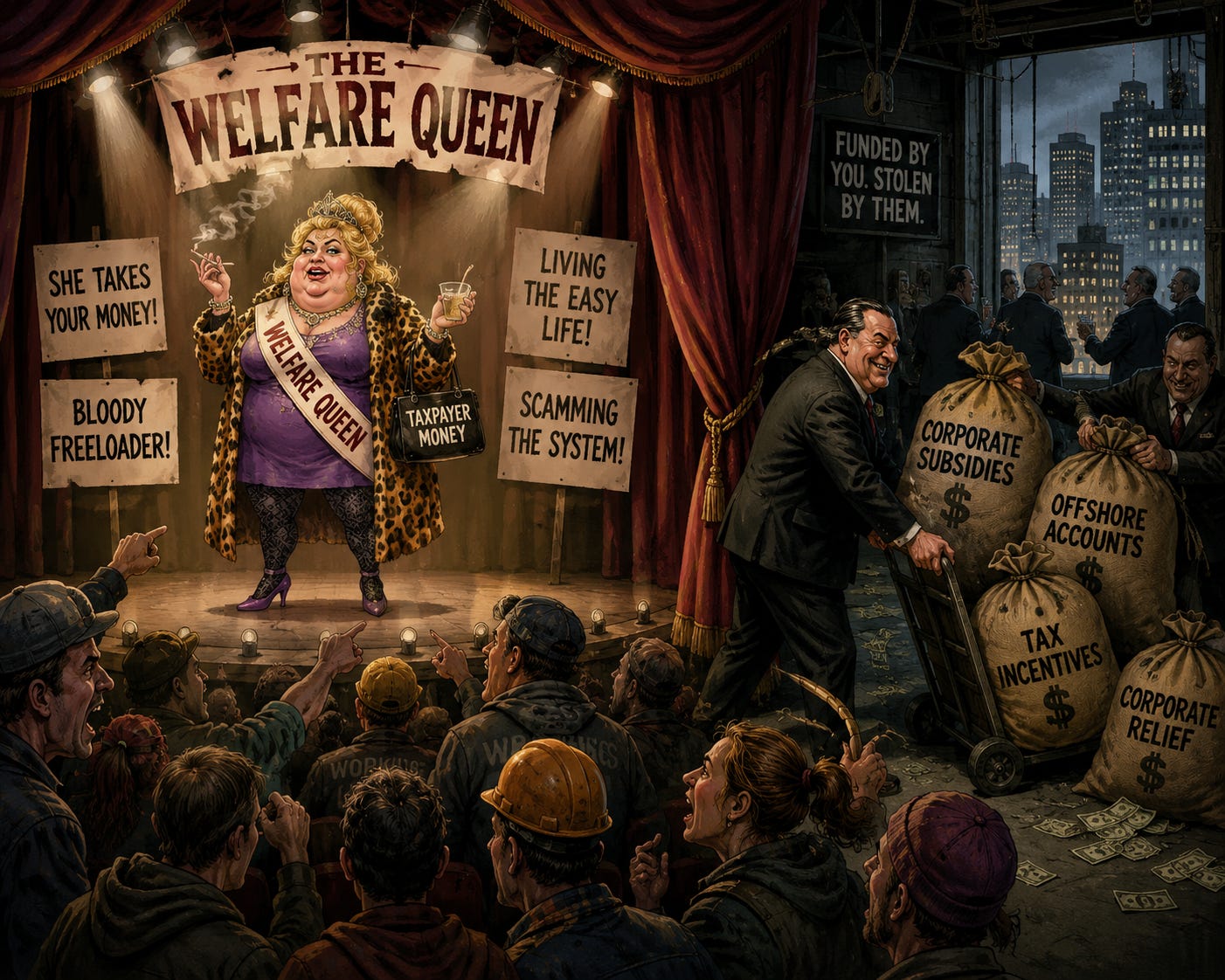
The “welfare queen.”
The freeloader.
The scammer gaming the system.
It was political theater.
A villain created to make working-class people resent each other
instead of questioning where their money was actually going.
Because if people start believing public services are shameful,
they stop defending them.
And once that happens,
you can dismantle them piece by piece while calling it responsibility.
You still see it today.
Doug Ford cuts OSAP while talking about fraud and abuse,
even though reports showed the actual fraud levels were tiny relative to the size of the program.
But politically, that hardly matters.
Because once people believe a public service is being “gamed,”
they stop seeing students trying to build a future.
They start seeing scammers.
And the moment that shift happens,
cuts become easier to sell.
But here’s the thing:
We do not “earn” government services.
They are not gifts from politicians.
Not acts of charity.
Not rewards for obedience.
We already paid for them.
Every paycheck.
Every deduction.
Every property tax bill.
Every purchase.
Over and over and over again.
That’s what taxes are for.
We fund the roads.
The schools.
The hospitals.
The transit systems.
The fire departments.
The infrastructure that allows society itself to function.
So why are ordinary people constantly made to feel guilty
for wanting access to the things they already finance?
And here’s the irony.
The same kinds of politicians people were told would bankrupt society —
social democrats,
democratic socialists,
the “tax and spend” crowd —
sometimes end up exposing the myth entirely.
Zohran Mamdani was painted as the scary socialist boogeyman in New York politics.
The guy supposedly promising everyone everything.
The kind of politician we’ve been told all our lives would destroy the economy.
And yet suddenly people are forced to confront an uncomfortable possibility:
Maybe the problem was never that we “couldn’t afford nice things.”
Maybe the problem was priorities.
Because a productive society is not one where everyone fights like hell just to survive.
That’s not productivity.
That’s exhaustion.
A productive society is one where people are stable enough to:
raise children,
recover from illness,
start businesses,
take risks,
get educated,
innovate,
and fully participate in society.
The worker with childcare works more.
The student without crushing debt creates more.
The sick person who receives treatment contributes again.
The family with stable housing becomes economically productive instead of permanently trapped in survival mode.
That’s not charity.
That’s investment.
That’s infrastructure.
That’s how functioning societies are built.
The biggest lie wasn’t “we can’t afford it.”
The biggest lie
was convincing ordinary people
they don’t deserve the things they already bought.
So next time someone says,
“We can’t afford it,”
slap them with this Fact Check Me.