

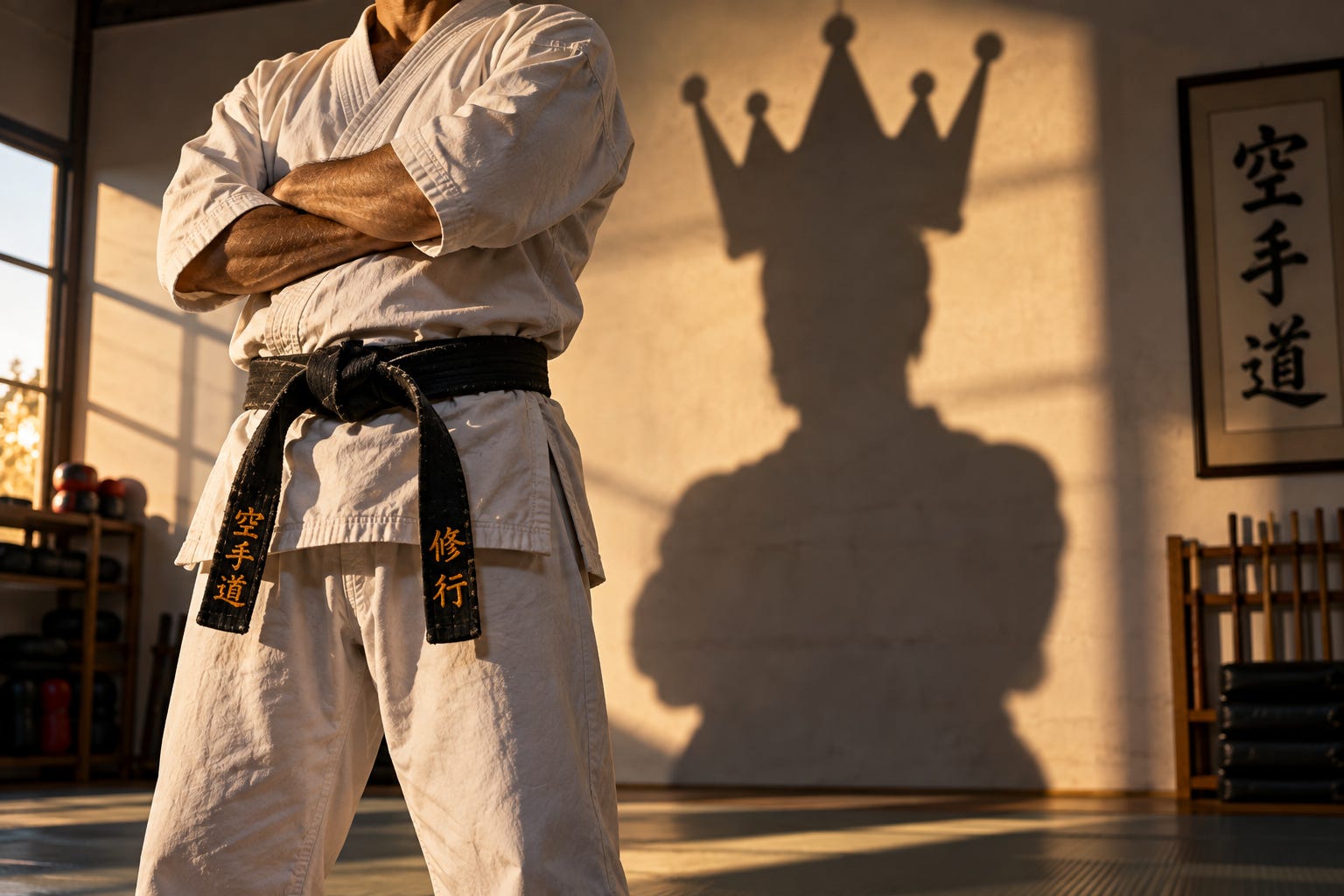
I've loved martial arts for most of my life. They've been an integral part of who I am, which is probably why I've become increasingly suspicious of the mythology we build around the people who teach them.
Because sometimes a guy in pyjamas who has spent forty years punching and kicking his friends is just a guy in pyjamas who has become exceptionally good at punching and kicking his friends.
And that's okay.
Mastering a martial art is an accomplishment. So is mastering yoga, tai chi, Pilates, dance or any number of other mind-body disciplines. They require years of practice, patience, sacrifice and repetition.
But mastery deserves respect. It doesn't demand deference.
Somewhere along the way, we have a tendency to make a strange leap.
This person knows something I don't.
Therefore, this person understands something I don't.
Therefore, this person understands life better than I do.
Why?
Your karate instructor might have read a shelf full of Buddhist philosophy, watched every kung-fu movie ever made and made pilgrimages to Japan Okinawa, China or whatever far off land. He may have spent decades contemplating discipline, fear, ego and violence.
There may be real wisdom in what he's learned.
But he's not a therapist.
He's not a psychologist.
He's not a doctor.
And the black belt around his waist doesn't make him any of those things.
Even the spirituality associated with martial arts deserves some perspective. The philosophical traditions surrounding the martial arts developed within particular cultures and historical circumstances. Warriors wrestled with questions of violence, death, duty, fear and impermanence. Modern budō later incorporated ideas of education and character development.
There's value there.
But why would we assume this is somehow the path to spiritual enlightenment? Particularly, in today's modern age.
The problem becomes more serious when you consider how loosely regulated much of the mind-body world is.
There are organizations, federations and certification systems, but there is no universal authority deciding who gets to call themselves Sensei, Master or Guru. There is certainly no universal body deciding whether someone who claims moral or spiritual authority actually deserves it.
So legitimacy can become remarkably circular.
Why should I listen to him?
Because thousands of people listen to him.
Why do thousands of people listen to him?
Because he's someone worth listening to.
Followers aren't evidence of legitimacy.
They're evidence that you can attract followers.
And these environments can create a dangerous progression:
Expertise becomes title.
Title becomes hierarchy.
Hierarchy becomes deference.
Deference becomes personal authority.
Eventually, the person who once corrected your stance is telling you how to live your life.
Worse, questioning the teacher can itself become evidence that the student is wrong.
You don't understand.
You're not ready.
Your ego is getting in the way.
You need to learn respect.
It's a beautifully closed system. The teacher's authority proves the teacher's authority, while questioning that authority proves why you still need the teacher.
And there's another problem with an unchecked hierarchy: there's nobody above you to tell you when it's time to step aside.
So the reign of the guru too often ends one of two ways: death or disgrace.
Meanwhile, an entire generation of talent can be left standing in the cold, waiting for its turn.
You can tell someone a million times that they're the future. Eventually, though, the future has to arrive.
When that promising young student or instructor starts pushing fifty and they're still being told to wait their turn, the promise starts ringing a little hollow. At some point their potential begins drying up right alongside the promise that someday they'll finally be allowed to use it.
The twenty-year practitioner will always have less experience than the forty-year practitioner. The student will always have fewer years than the master. But experience doesn't automatically remain relevant simply because you keep accumulating it.
The world changes.
Teaching changes.
Students change.
Knowledge changes.
Sometimes the person with twenty years of experience has the better idea.
But in a hierarchy built around seniority and deference, they may never get the opportunity to prove it. The people underneath the master aren't being prepared to surpass him. They're being taught to remain underneath him.
That's not mentorship.
That's preservation.
And when the person at the top finally disappears, everyone suddenly discovers the problem: instead of spending decades developing successors, the organization spent decades developing followers.
Is it really surprising that the worlds of martial arts, yoga and other guru-centred communities periodically produce stories about revered teachers abusing the people who trusted them?
It's something I consciously tried to resist throughout my own career.
Let's train together.
Let's build a community.
I'm in charge because my name is on the lease, not because I've elevated to another plane of existence.
Ask me questions.
Let me say, "I don't know."
Let me ask you for advice.
I'll fix your kata.
But Victor over there is actually a doctor. Maybe talk to him about your sore back.
That's what I think we sometimes forget about expertise: it has boundaries.
Knowing more than me about karate means I should probably listen when you correct my karate.
It doesn't mean I should let you choose my career, repair my marriage, diagnose my depression, raise my children or explain the mysteries of the universe.
And none of this means we shouldn't have teachers.
We need teachers.
We should respect people who dedicate their lives to mastering something. We should listen when experience has given someone something valuable to teach us. Sometimes our teachers will profoundly change our lives.
But a good teacher doesn't need you to believe he's something more than human.
He can be wrong.
He can learn from you.
He can tell you when somebody else knows more than he does.
And perhaps most importantly, he can eventually watch you walk out the door without needing you to spend the rest of your life believing you still need him.
Find great teachers.
Just be very fucking careful about finding gurus.
At Burger King?