

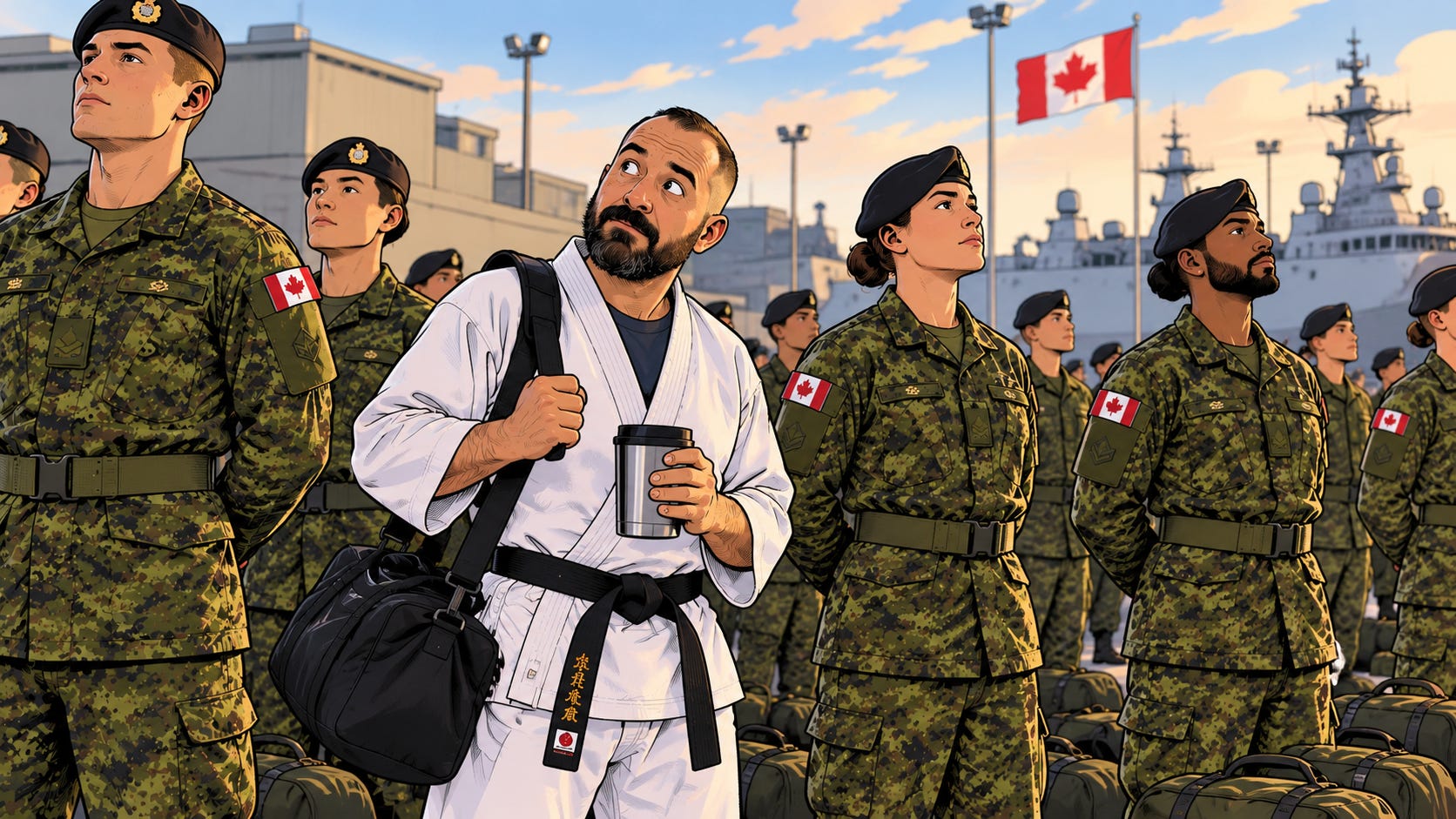
Growing up in a big city like Toronto, most of us don’t give the military too much thought. Why would we? The city is full of opportunities, things to do, and a liberal hippie mindset that certainly has its own opinions about the military-industrial complex.
Not to mention, I was the son of not just a soldier, but one who, without getting into it, certainly wouldn’t have wanted his sons following the path he took.
A few months ago, a job posting came up on Indeed.
I was, and still am, in a bit of a midlife transition. My son is getting ready to leave the nest, he can and does drive himself anywhere he needs to go, and my wife loves me, sure, but could probably use a little solitude.
The posting was for an overseas Fitness, Sports and Recreation Coordinator.
They were looking for fitness professionals willing to take on a six-month deployment, most likely in Latvia or aboard a Canadian naval ship, keeping Canadian Armed Forces members and supporting staff fit while supporting morale through sports and recreation.
Wow. What an adventure that could be.
For a guy who had spent most of his adult life keeping his head down, grinding through school, building a business, and raising a family, the prospect of doing something completely different was, at the very least, intriguing.
So, despite not technically meeting all the qualifications, I dusted off the old résumé, wrote the best cover letter I could, and sent it off into the ether, not knowing what would come of it.
Let’s be clear about something.
The role was with Canadian Forces Morale and Welfare Services (CFMWS), a civilian organization whose mission is pretty clearly stated in its name. So don’t picture your guy army-crawling under a net while being yelled at by a drill sergeant.
In fact, the physical requirements were that you could walk. A lot. And lift fifty pounds.
I figured I could manage that.
Eventually, I made it through a few rounds of selection, some online competency tests, and finally an interview with two managers who, let’s just say, hadn’t seen quite as many sunsets as yours truly.
But I’ve always been an advocate for young people, so this didn’t bother me.
And that brings me to something important.
What I began to discover about CFMWS was an organization that appeared to value hard work, competence, and a genuine desire to serve over titles and seniority. After spending much of my life in an environment where seniority was everything, and there was always someone who outranked you, this was a refreshing change.
By the time I’d made it through the interviews and assessments, I started thinking I might actually have a shot at this thing.
I began researching CFMWS, learning more about its mission, and even identifying areas where I thought my experience could make a meaningful contribution. Somewhere along the way, something changed. I wasn’t just interested in the adventure anymore.
I started hoping I’d found something I’d been craving for a long time. Something to belong to that was bigger than myself. A place where contributions, dedication, and hard work were valued and respected.
So when the rejection letter landed in my inbox, I was more than a little disappointed.
But I’d been getting used to rejection lately, so I moved on and redirected my attention toward other opportunities. I would not be heading to Halifax for the October training and selection course. I would not be joining the deployment pool. And I certainly wouldn’t be heading to Eastern Europe anytime soon.
Or so I thought.
I’d pretty much put CFMWS out of my mind and started exploring where my teaching degree might take me when, one afternoon, I was sitting in the kitchen and an email arrived.
The sender?
CFMWS.
A spot had opened up, and I was at the top of the list. All I had to do was click a link and accept.
After picking my jaw up off the floor, and with the missus urging me to go for it, I wasted little time accepting.
Four weeks later, I was on a plane to Halifax.
I’d been warned that the training and selection course would be gruelling and demanding, and that I shouldn’t expect much spare time. The objective wasn’t simply to train and evaluate us. It was also to give us a taste of what life on deployment might look like.
Long days. Demanding schedules. Potentially seven days a week.
I wondered whether I still had it in me. Having worked evenings for most of my adult life, I’d rarely had a reason to get out of bed before seven or eight in the morning, let alone be told where to be and when for practically every waking moment.
When I arrived in Halifax and began mingling with the other candidates, I was relieved to discover I wasn’t the oldest person there.
There were candidates for all sorts of roles: travel coordinators, retail coordinators, recreation coordinators, and even accounting coordinators.
Okay, I wasn’t sure whether the accounting people were actually called coordinators, but it seemed like everyone else was.
Later, when I met the other Fitness, Sports and Recreation candidates, I discovered that out of fourteen of us, I was only the fourth oldest.
Practically a spring chicken.
There were originally 4,500 applicants for the various positions. With approximately 125 candidates making it to Halifax for training and selection, that meant fewer than 3% of applicants had made it this far.
Not bad for a guy who wasn’t technically qualified in the first place.
And while we’re on the subject of getting selected, I should probably thank Isaac.
You see, throughout the week, there was a name that kept appearing on every Fitness, Sports and Recreation roster.
Isaac.
Except Isaac never showed up.
I have no idea who Isaac is, where he went, or why he wasn’t there. But given that I received my invitation after a spot unexpectedly opened up, I have a sneaking suspicion I owe the guy a beer.
So, Isaac, wherever you are, thanks for not showing up.
After arriving on base, receiving our room assignments, and figuring out where we were supposed to be, the training got underway.
I won’t bore you with the details of every PowerPoint presentation.
The point was to ensure that all 125 or so candidates understood the mission, the importance of every role, the exceptionally high standards we would be held to, and the difference we could make.
Throughout the week, four core values were displayed on banners at the front of the lecture hall.
Integrity. We Care. One Team. Creative.
They weren’t just decorations. The instructors referred to them often.
Now, I’ve spent most of my life in an environment that preached mutual respect but often fell short when it came to actually practising it.
CFMWS felt different.
The instructors demanded that we show up on time. Actually, early. On time was considered late. But they were equally respectful of our time.
When a session was scheduled to end, it ended. They understood that we needed time to get to the mess hall, eat, and return for the next class or activity.
It sounds like a small thing, but it wasn’t.
Respect wasn’t something that flowed exclusively from the bottom up. It went both ways.
In the outside world, we’re often taught to be grateful for the jobs we have. We’re supposed to appreciate the opportunity, work hard, and remember that someone else would happily take our place.
At CFMWS, the roles we were preparing for were presented differently.
They were a form of service.
We would be giving up many of the freedoms and comforts we enjoyed at home. We’d be away from our families, working long hours in unfamiliar environments, supporting the men and women serving our country.
But that sacrifice wasn’t taken for granted. We were being asked to become valuable members of a team whose mission was to serve those who serve.
And there was something profoundly refreshing about that.
Another thing I discovered was that perfection wasn’t the goal.
We often associate military precision with strict discipline and an environment where nothing is allowed to go wrong. What I learned was almost the opposite.
Military precision isn’t necessarily about making sure nothing goes wrong. It’s about being prepared for when things inevitably do.
A bus might arrive late. Or early. The catering might not arrive at all. An entire class might spend thirty minutes sitting in the wrong room waiting for an instructor who is patiently waiting for them somewhere else.
Things happen.
What mattered was how people responded. Nobody seemed particularly interested in finding someone to blame. The focus was on identifying the problem, finding a solution, and moving forward.
And I discovered something about myself.
I was quite at ease in this environment.
I’ve struggled with the constant demands of perfection for much of my life. The problem with perfection is that it’s the enemy of good. If you refuse to do anything until you can do it perfectly, there’s a pretty good chance you won’t end up doing much of anything.
Here was an environment with exceptionally high standards that also seemed to recognize that things weren’t always going to go according to plan.
It valued problem-solving, troubleshooting, adaptability, and the ability to keep moving when circumstances changed. It didn’t particularly matter whether everything went off without a hitch.
What mattered was that, at the end of the day, the job got done and the mission moved forward.
That distinction resonated with me.
As the week progressed, the pace began taking its toll.
Some candidates struggled with the demands. A few decided the experience wasn’t for them. Others, from what I understood, were asked to leave.
But something struck me about how those departures were handled.
No example was made of them.
There were no public lectures about the people who couldn’t keep up. No attempts to embarrass anyone or use their departure as a warning to the rest of us. In fact, there was very little mention of those who didn’t complete the training.
They simply weren’t there anymore.
I don’t know what conversations took place privately, and I won’t pretend to. But what I observed was an organization that could maintain exceptionally high standards without publicly diminishing the people who couldn’t meet them.
Not everyone was going to make it through. That didn’t mean they were lesser people. It simply meant that, for whatever reason, this particular environment wasn’t the right fit.
And the training continued.
There were also candidates who approached the week as a competition.
And to be fair, in some ways it was.
We were all being evaluated for positions, and naturally, people wanted to distinguish themselves. Some made a point of speaking more than others, offering insights from their previous military or civilian roles, demonstrating their knowledge, and making sure their experience was recognized.
I hold nothing against them for that. Everyone had their own reasons for being there, and everyone wanted to succeed.
But I kept finding myself looking toward those banners at the front of the room.
Integrity.
We Care.
One Team.
Creative.
And of all those values, the one that resonated most deeply with me was One Team.
I’d spent decades building a business, teaching students, managing employees, and being the person responsible for making decisions. I’d spent much of my adult life in leadership positions, where people looked to me for answers.
But I wasn’t in Halifax because I wanted another opportunity to be in charge. I wasn’t particularly interested in proving I was more knowledgeable, more experienced, or more deserving than anyone else.
I wanted to contribute. I wanted to be useful.
I wanted to be part of a team where people were valued not simply for what they could accomplish individually, but for what they could contribute to the success of everyone around them.
And perhaps that’s what I’d been looking for all along.
Not another title. Not another position of authority. Not another opportunity to prove myself.
Just the opportunity to be part of something where what I brought to the table mattered, where I could support the people around me, and where we were all working toward something bigger than ourselves.
One Team.
Two words on a banner at the front of a lecture hall.
And somehow, after nearly fifty years, they were beginning to mean an awful lot to me.
Turns out, when you have a mission and a purpose, having your feet hit the floor at 5:00 a.m. so you can help lead a 5:30 PT session alongside people working toward the same goal is easier than you might think.
And then there were the people.
I’ve met people from all over the world, but for the first time in my life, I was meeting people from all over Canada.
That was an entirely new experience for me.
So many of the candidates had connections to the military. Some were retired CAF members, others were military spouses, and some were what I learned are affectionately called base brats, kids who grew up in military families.
What I came to understand was that in communities across this country, the military plays a central role in the lives of countless people and their families.
For someone who grew up in Toronto, where military life was something I rarely encountered, it was an eye-opening experience.
I came away with a much deeper appreciation for the people who serve and the communities that support them.
And while I would love to live in a world where we didn’t have to ask anyone to make the sacrifices that members of the Canadian Armed Forces choose to make, the reality is that we don’t live in that world.
Heaven knows I was never going to do it.
But having the opportunity to support those who do?
I can find purpose in that.
By the end of the week, I’d bonded with a group of strangers over a shared purpose. Many of them were people whose names I hadn’t even had the chance to learn, but whom I’d be honoured to have the opportunity to serve alongside.
Whether I get called up for deployment or not, I’ll be forever changed by the experience.
And if I’m being honest, returning to my normal life has left me feeling a little deflated.
For one week, I had somewhere to be, something meaningful to contribute, and people around me who shared a common purpose. I was part of something bigger than myself, and I hadn’t realized just how much I’d been missing that.
So, fingers crossed that sometime in the near future I’ll get the opportunity to teach karate for my country.
Alongside about fifty other things.
I can't imagine joining the actual forces at that age. He must be a bad ass. Honestly, I was so impressed with the whole environment.
The new model that CFMWS provides is more about helping provide wellness and recreation. Think personal trainer, group fitness classes, sports and recreation coordinator.
They're well liked these days from my understanding.