

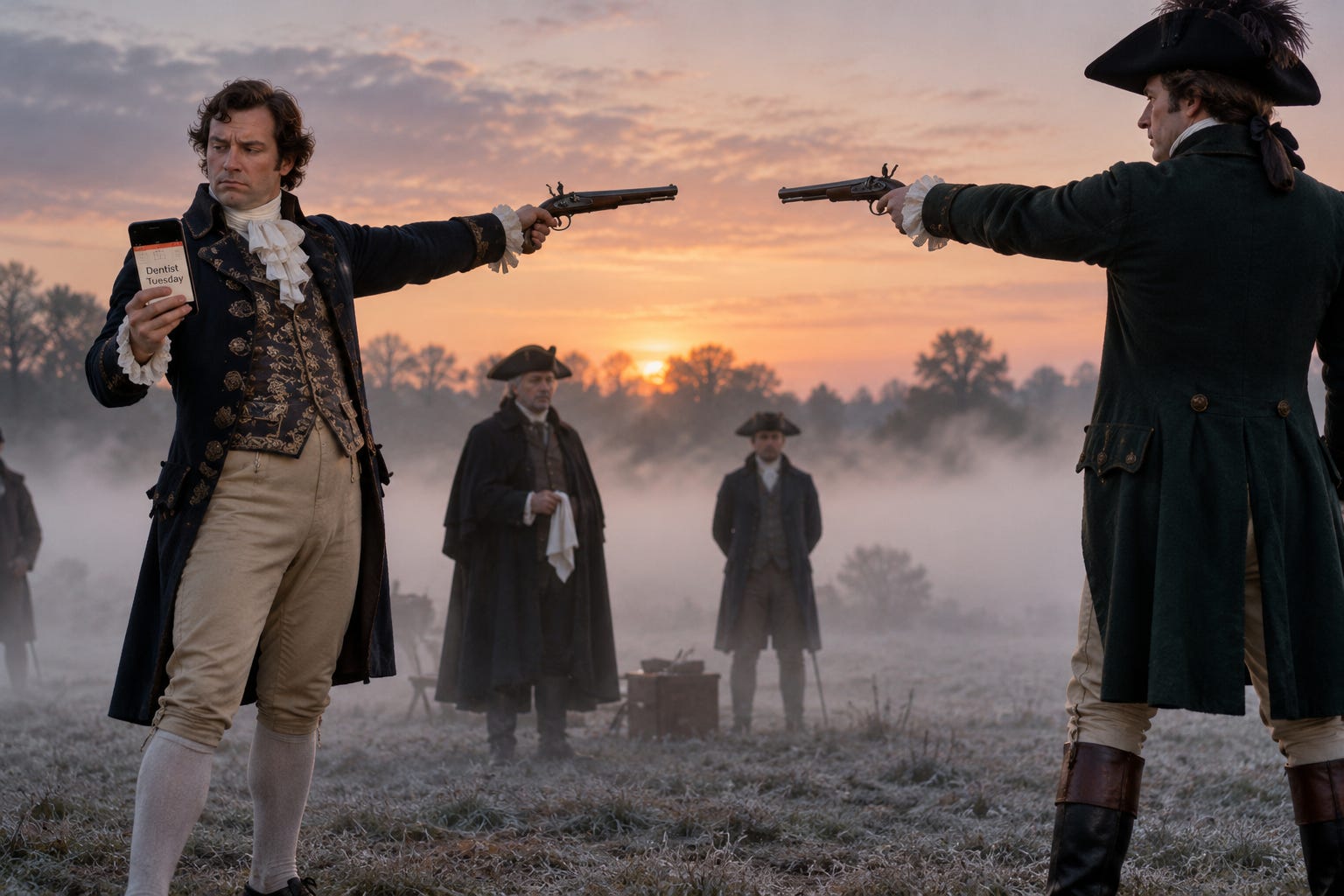
I’ve always thought duelling was a weird custom.
I can’t imagine having my feelings hurt so badly, or my honour disgraced to such an extent, that I’d feel the urge to pull off my glove, slap my offender across the face with it, throw it dramatically on the ground and make my way over to my second to choose between foils or pistols.
I mean, even the ancients had lawyers.
And yet, for centuries, otherwise intelligent men decided that the appropriate response to being called a liar or a coward was to meet in a field at dawn and try to kill each other.
We romanticize this stuff now.
There’s something almost elegant about the duel. The early morning mist. The frock coats. The seconds standing solemnly nearby. Ten paces, turn and fire.
Very civilized.
Except, of course, for the part where someone gets a lead ball fired through his liver because another guy questioned his integrity over brandy the night before.
But maybe duelling tells us something about the past that we tend to forget.
Life was pretty shitty.
We have a habit of imagining the past as though we would be living our present lives with nicer architecture.
We picture the manor house and the horse-drawn carriage. Candles burning in the windows. Dinner served on silver.
We don’t imagine the toothache, the infected cut on our thumb, the freezing bedroom, or contaminated drinking water.
Even if you were wealthy, you didn’t have antibiotics, modern anesthesia, or most vaccines. Surgery was extraordinarily dangerous, assuming there was even a surgery capable of fixing what was wrong with you.
And for much of human history, if you became seriously ill, the arrival of the doctor wasn’t necessarily good news.
There was a reasonable chance his plan involved removing some of your blood. Let those demons out.
So maybe people had a different relationship with death because death had a much closer relationship with them.
Disease, infection, childbirth, accidents and violence were constant companions in ways that are difficult for most of us to appreciate.
Maybe that changes the calculation.
If death is something you see constantly, perhaps risking your life doesn’t seem quite as outrageous.
And if your reputation determines your career, social standing, your family’s position and how people will remember you after you’re gone, maybe honour becomes more valuable precisely because life is less secure.
It sounds ridiculous to us:
My honour is worth more than my life.
But perhaps what they were really saying was:
My life is temporary. My honour survives me.
Which brings me, naturally, to Denis Leary.
In No Cure for Cancer, Leary does a bit defending his proudly unhealthy lifestyle by pointing out that all these healthy habits supposedly add years to your life, but the years they’re adding are the ones at the end.
And really, who wants those?
It’s a joke, obviously.
But there’s an interesting idea buried underneath it.
We don’t just want to live.
We expect to.
We have become so good at postponing death that longevity has become our default assumption.
When I turned 35, I remember telling someone that I had officially reached middle age.
They laughed at me.
Really?
Half of 70 is 35.
If that’s not at least the beginning of middle age, you have some pretty high expectations.
If you live to 80, the middle was 40.
If you live to 90, congratulations. You can push it all the way to 45.
The uncomfortable part is that none of us knows the number we’re dividing by two.
You only discover where the middle was after you’ve passed it.
Maybe that’s one of the biggest differences between us and the people standing in those fields at dawn.
We assume tomorrow.
We schedule retirement. We contribute to pensions. We buy 25-year mortgages. We worry about what our cholesterol might do to us twenty years from now.
We have built an entire civilization around the expectation that, barring some terrible misfortune, there should be decades ahead of us.
So of course duelling seems insane.
Someone calls me a coward today and I’m supposed to risk the next forty years proving him wrong?
Fuck that.
I have a dentist appointment Tuesday.
Maybe people in the past weren’t unusually cavalier about death.
Maybe we’re unusually insulated from it.
And perhaps one of the strangest accomplishments of modern civilization isn’t simply that we made life longer.
It’s that we made tomorrow feel guaranteed.
Good article.