

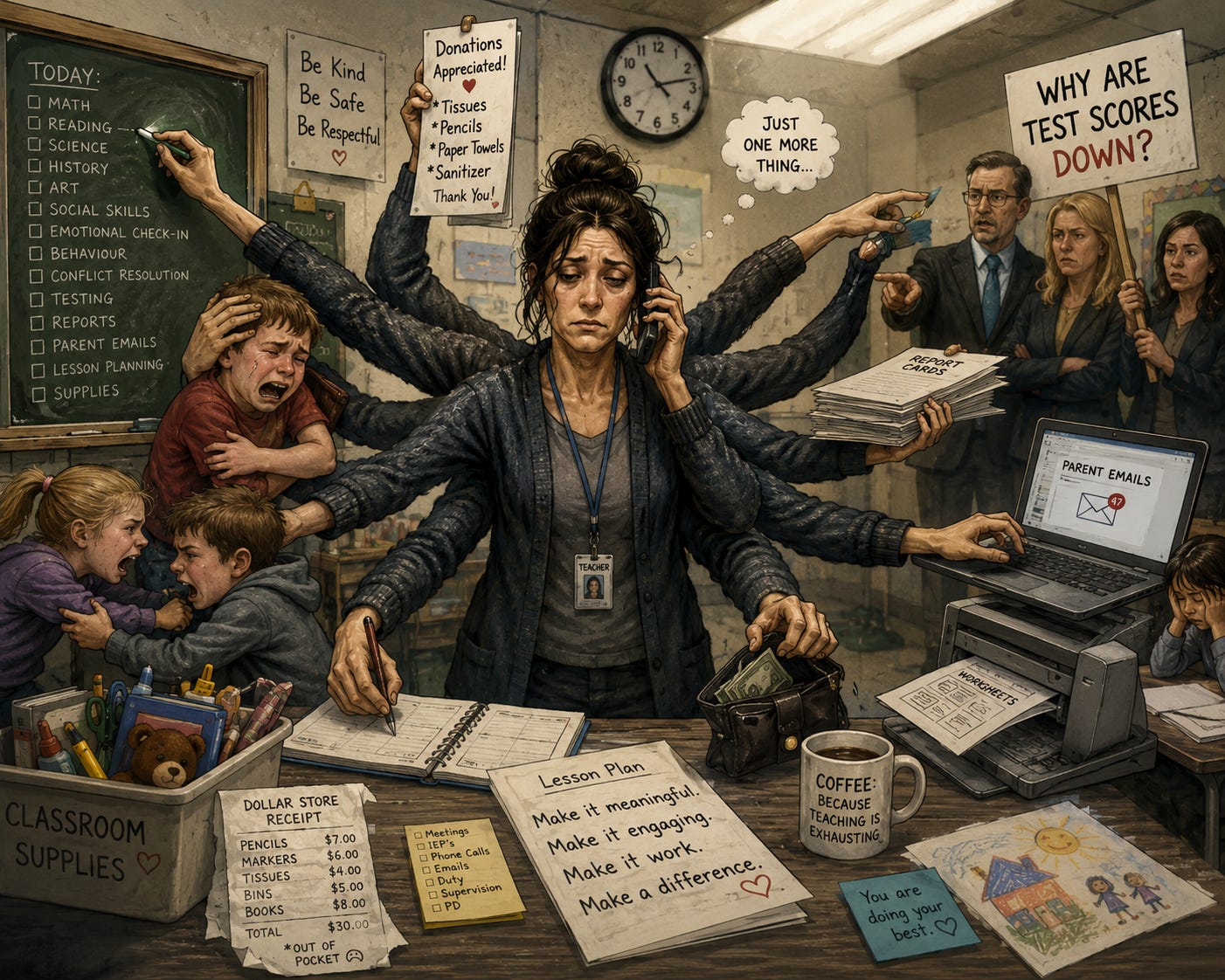
Stop Asking Teachers to Be the Whole School
We ask teachers to be everything, and then we wonder why they don’t measure up.
In Ontario, a teacher doesn’t just “deliver education.”
And let’s be real for one second — delivering a lesson is already a specialized skill.
It requires knowledge. Performance. Timing. Presence. The ability to read a room. To hold attention. To pivot when something isn’t landing. To improvise. To follow a different path than the one you started with because the kids in front of you need something different than the lesson plan imagined.
That alone is hard.
If all we asked teachers to do was deliver strong lessons, I’m confident we would have some outstanding people in classrooms across the province.
But that’s not all teaching is.
Teaching is also planning those lessons. Building them from the ground up. Making sure subjects connect. Finding themes. Weaving together science, English, history, art, social studies, and whatever else the curriculum demands that week.
In Ontario, teachers aren’t handed full lesson plans.
They’re handed a checklist.
Here are the things you need to cover.
Now go build the machine yourself.
And somehow we act like that makes sense.
You wouldn’t ask an actor to write the script, build the set, direct the show, manage the audience, counsel the cast, clean the theatre, and buy the props — then blame them when the performance isn’t perfect.
But that’s exactly what we do to teachers.
They have to write the lesson.
Build the lesson.
Deliver the lesson.
Assess the lesson.
Modify the lesson.
Document the lesson.
Defend the lesson.
Then they have to build the classroom itself.
Not just physically, either — although yes, somehow they also have to become interior designers. They have to make the room warm, organized, colourful, inviting, functional, accessible, and inspiring.
Often with supplies they bought themselves.
Old books from garage sales.
Bins from dollar stores.
Toys from their own basements.
Pencils, markers, paper, tissues, paper towels.
A public education system where teachers are quietly expected to fund the atmosphere out of their own pockets.
That should embarrass us.
And then there’s the emotional architecture of the classroom.
Because when you have children in a room for six hours a day, you are not just delivering information.
You are managing time.
Energy.
Conflict.
Friendships.
Feelings.
Anxiety.
Attention.
Behaviour.
Self-esteem.
Group dynamics.
You are building routines.
Creating behaviour systems.
Teaching kids how to transition, how to listen, how to share space, how to recover from frustration, how to function around other human beings.
That isn’t “extra.”
That is the classroom.
And then, because apparently that still isn’t enough, teachers are also expected to be therapists, conflict-resolution experts, social workers, motivational speakers, crisis managers, and emotional translators.
Most people will never be asked to carry that many roles in one job.
But teachers are.
Every day.
And here’s my biggest beef: the two biggest parts of teaching — building lessons and delivering lessons — are not even necessarily the same skill.
Some people are brilliant creators. They can design incredible lessons, beautiful resources, thoughtful progressions, deep connections between subjects.
But put them in front of thirty kids and they freeze.
Other people are incredible in the room. They can command attention, explain clearly, read faces, shift gears, make students feel alive and engaged.
But ask them to build a full curriculum from scratch every week and they drown.
Those are different gifts.
Different temperaments.
Different brains.
Often, they belong to different people.
But our system pretends every teacher should be both.
Why?
And why all the redundancy?
Why does every Grade 2 teacher in every classroom in every school across the province need to build the same lesson plan over and over again?
Can’t we do it once?
Can’t we create strong, beautiful, tested, high-quality lesson frameworks and say:
Here.
Start with this.
Now go teach.
Teachers should still adapt.
They should still bring themselves into the room.
They should still respond to their students, their community, their class culture.
But they shouldn’t have to reinvent public education every Sunday night at their kitchen table.
Because that’s what’s happening.
A tired teacher, after marking and emails and behaviour notes and parent communication and meetings and planning and actual teaching, is sitting there trying to find one more worksheet online because tomorrow still has to happen.
And then we wonder why the system feels inconsistent.
Of course it’s inconsistent.
We’ve made every classroom its own little island.
Some teachers have the time.
Some have the talent.
Some have the energy.
Some have the experience.
Some have none of those things yet because they’re new and barely surviving.
And the kids get whatever version of the system that one exhausted person can build.
That’s not fair to students.
And it’s not fair to teachers.
If we want consistency, build consistency.
If we want creativity, give teachers room to be creative.
If we want better lessons, stop making every teacher start from zero.
Give them the script.
Give them the set.
Give them the props.
Give them the supplies.
Then let them perform.
Let them teach.
Because the magic of a great teacher is not that they can do every job in the building.
The magic is what happens when they are finally allowed to do the job they were trained to do.
Stand in front of students.
Connect.
Explain.
Encourage.
Challenge.
Adapt.
Inspire.
Teach.
That should be enough.
And if it isn’t, then the problem isn’t the teacher.
It’s the system we built around them.
This made me cry.
Thank you for writing this.
It feel nice to be seen.
Honestly this explained the problem so well.
I worked as a cleaner in a secondary school here in the UK for 17 years, so I got to know the teaching staff really well and saw so much of this firsthand.
Most teachers genuinely just want to teach. But somewhere along the line the role became teaching, administration, emotional support, behavior management, crisis management, resource hunting, paperwork, and everything in between.
And the sad part is, a lot of genuinely brilliant teachers are burning out not because they can’t teach, but because they’re being asked to carry an impossible system on their backs 😮💨