

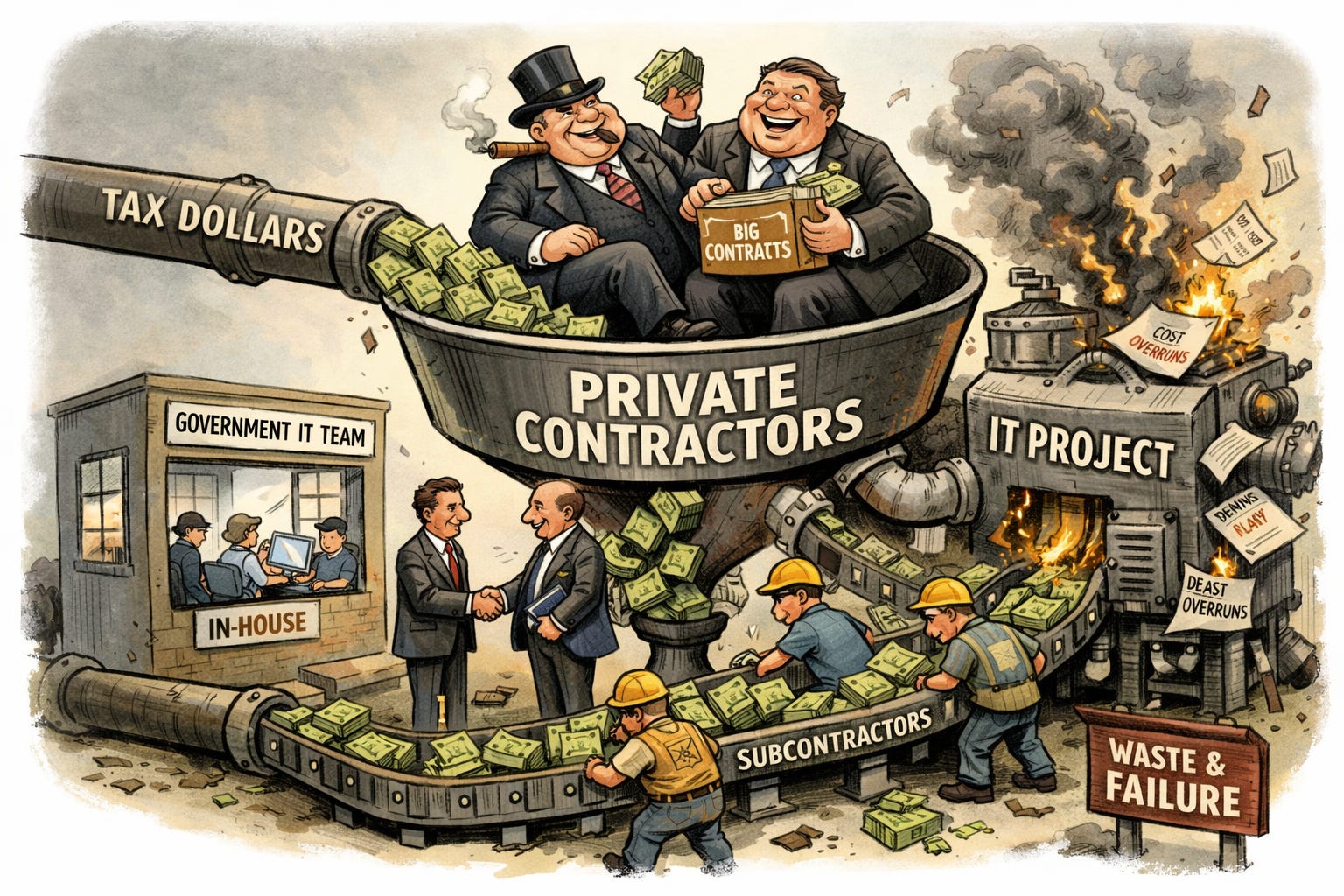
I can never understand why the default solution for public services is to start calling private contractors.
In Ontario, we already lived through the eHealth disaster.
Over a billion dollars spent.
Private contractors everywhere.
And in the end? Nothing but a scandal.
So now it’s time to try again—and what’s the strategy?
Bring in private bids.
We already saw this movie.
It was terrible.
Why are we getting a sequel?
---
And here’s the thing—I’m not pretending to be some expert systems architect.
I don’t know exactly how to build a province-wide health records system.
But I do know what it is at its core:
It’s a database.
A place to store, organize, and access patient information.
That’s it.
And yeah—at scale, it’s complicated. Security, access, integration. Fine.
But let’s not pretend we’re building a spaceship.
---
I took a computer class in high school decades ago and built a garbage database in whatever version of Microsoft Office they gave me a C in.
Today?
I personally know people—real people—who build systems like this for a living.
My father-in-law built systems managing inmate data in Georgia.
I could name ten others making solid six-figure salaries doing this kind of work.
So why are we acting like this requires a hundred-million-dollar contract with a corporation full of people we’ll never meet?
Why can’t we just build a team?
Hire developers.
Pay them well.
Put them in a government office.
Let them build the thing.
---
Instead, we go the same route every time.
We open the door to massive private firms.
They bid low to get in.
Then the scope expands.
The timelines stretch.
The costs explode.
And suddenly we’re not talking millions—we’re talking hundreds of millions.
Or more.
And when it fails?
No one is responsible.
Because the system is too complex.
Too many contractors.
Too many layers.
Too many “partners.”
It’s failure by design.
---
And we’ve all bought into this idea that government can’t do anything efficiently.
That public employees are overpaid.
That the private sector is leaner, smarter, better.
But look where the money actually goes.
It’s not the developers.
It’s not the people doing the work.
It’s the layers above them.
Executives.
Consultants.
Subcontractors hiring subcontractors.
Everyone taking a cut.
That’s where your tax dollars disappear.
---
I’d rather spend that money on the people actually building the system.
Give them stable jobs.
Give them ownership.
Give them a reason to give a shit.
Let them take pride in building something that serves all of us.
Instead, we funnel that money upward into a machine that’s never satisfied.
A system that always needs more funding.
That never stays on budget.
That can’t be held accountable because no one can even fully explain how it works anymore.
---
Maybe what we really need isn’t fewer government workers.
Maybe we need fewer corporations inside our government.
Maybe the problem isn’t that public systems are inefficient.
Maybe it’s that we’ve built them to depend on people who profit when they are.