

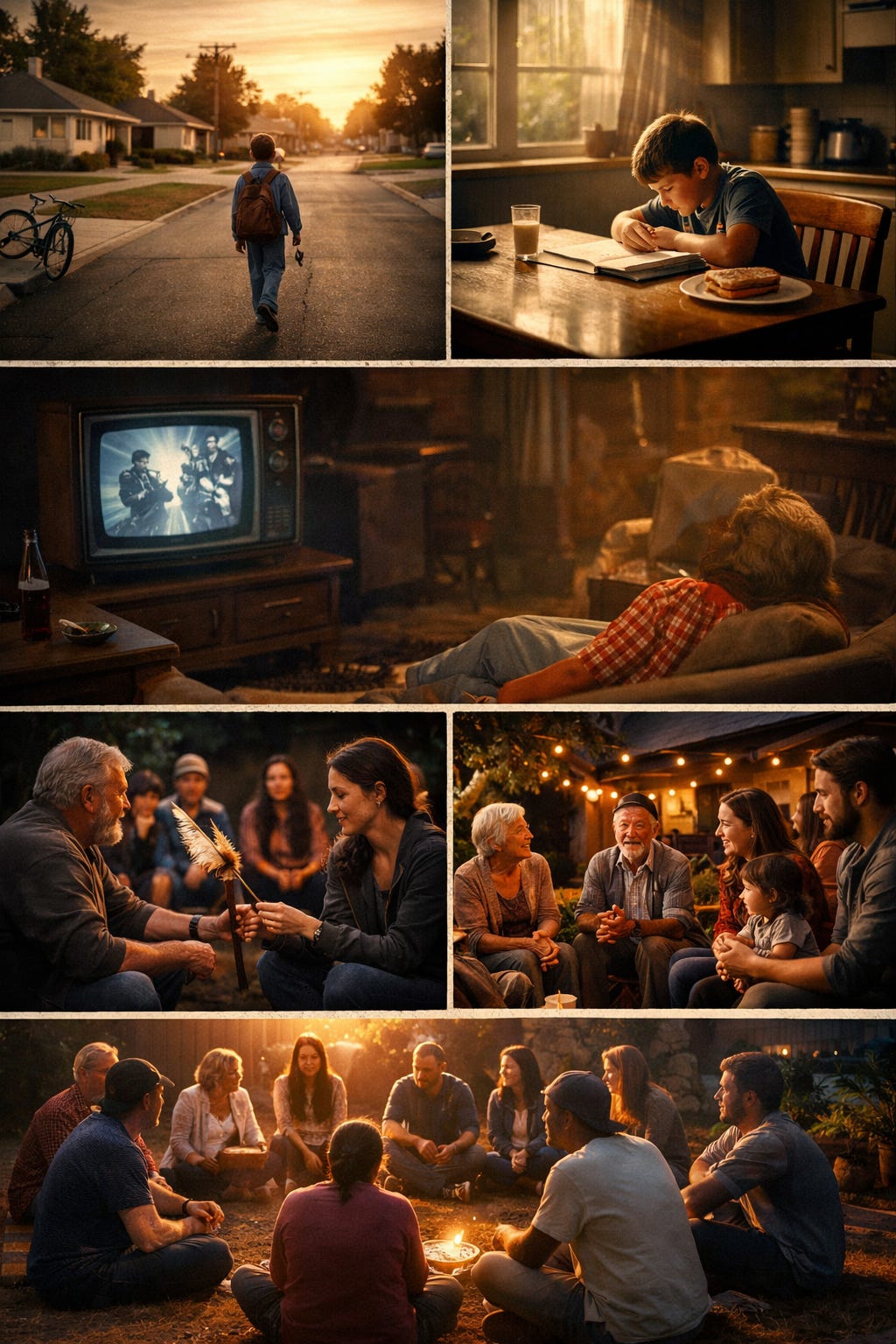
It all started with latchkey kids.
They were always there, of course. In every city, in every era, whenever the world sped up faster than families could keep pace. But this time was different. This time was the sixties.
For the first time, on a massive scale, children were being left alone not because of tragedy or war—but because of progress. Two incomes. Longer commutes. Nuclear homes stripped of grandparents, neighbors, and the quiet web of adults who used to say, that kid is one of mine too.
Nobody was watching.
No guardians. No elders. No one looking out a window and recognizing a child as part of the neighborhood instead of just part of a household. Kids raised themselves in the hours between school and dinner, absorbing whatever filled the silence.
And something leaked in.
At first it was subtle. Then it accelerated. Whatever message reached those kids—about freedom, consumption, rebellion, desire—spread fast. Faster than parents noticed. Faster than institutions could respond.
It bled into media.
Into commercials.
Into songs.
Adults didn’t teach it. They discovered it already everywhere.
A generation raised unsupervised didn’t just grow up differently—it rewrote the culture in real time. And once the signal escaped the house, it never went back in.
And the children of those generations cried.
They cried then, and many of them are still crying now—not loudly, not always visibly, but persistently. A low ache for something unnamed. For care they never received. For attention that was supposed to be ordinary, not earned, not negotiated.
They weren’t abandoned dramatically.
They were abandoned logistically.
Fed. Clothed. Scheduled.
But not held by a tribe.
So they fractured. Into us and them. Into generational blame. Parents blamed children. Children blamed parents. Everyone yelling sideways instead of together. We called it culture wars, or politics, or identity—but underneath it was grief. Grief with nowhere to land.
And the thing is—we didn’t need this to happen.
Generations didn’t need to turn around and scream fuck you at the past. We’re still doing it. I do it too.
But can we stop this shit already?
We don’t need some pious intervention. No saviors. No gurus. No one pretending they’ve got clean hands or moral high ground—because you don’t. None of us do. You’re just as messed up as the rest of us, so maybe sit down for a second before we lose our cool again.
We don’t need a stage.
We don’t need a crowd.
We don’t need to win.
We can take turns holding the feather—or the Elmo doll, if that’s what it takes to feel safe enough to speak. We show up. We say what we actually mean. Slowly. Logically. Without turning it into a performance or a festival or a point-scoring exercise.
And here’s the hard part:
we let other people ask questions—real ones—without assuming bad faith, without dogpiling, without trying to embarrass them into silence.
No outrage economy.
No culture war cosplay.
No Bonnaroo bullshit.
Just people—finally—talking like adults.
And here’s where the hope is:
The waves are getting smoother.
More of us are recognizing the pattern. More of us are hearing the same signal beneath the noise. The message is finally landing: humans don’t raise humans alone. They never have. They were never meant to.
The tribe is coming back—not perfectly, not nostalgically, but intentionally. In chosen families. In communities. In people deciding to show up for kids that aren’t biologically theirs. In men learning how to nurture. In women refusing to carry it all alone. In elders being invited back into relevance.
We’re remembering something ancient.
So let’s stop asking what makes us feel smartest.
Let’s stop asking who’s most wrong.
Let’s ask one question instead:
What helps the most people?
That’s it.
That’s the bar.
And then—this is the radical part—we do that.