

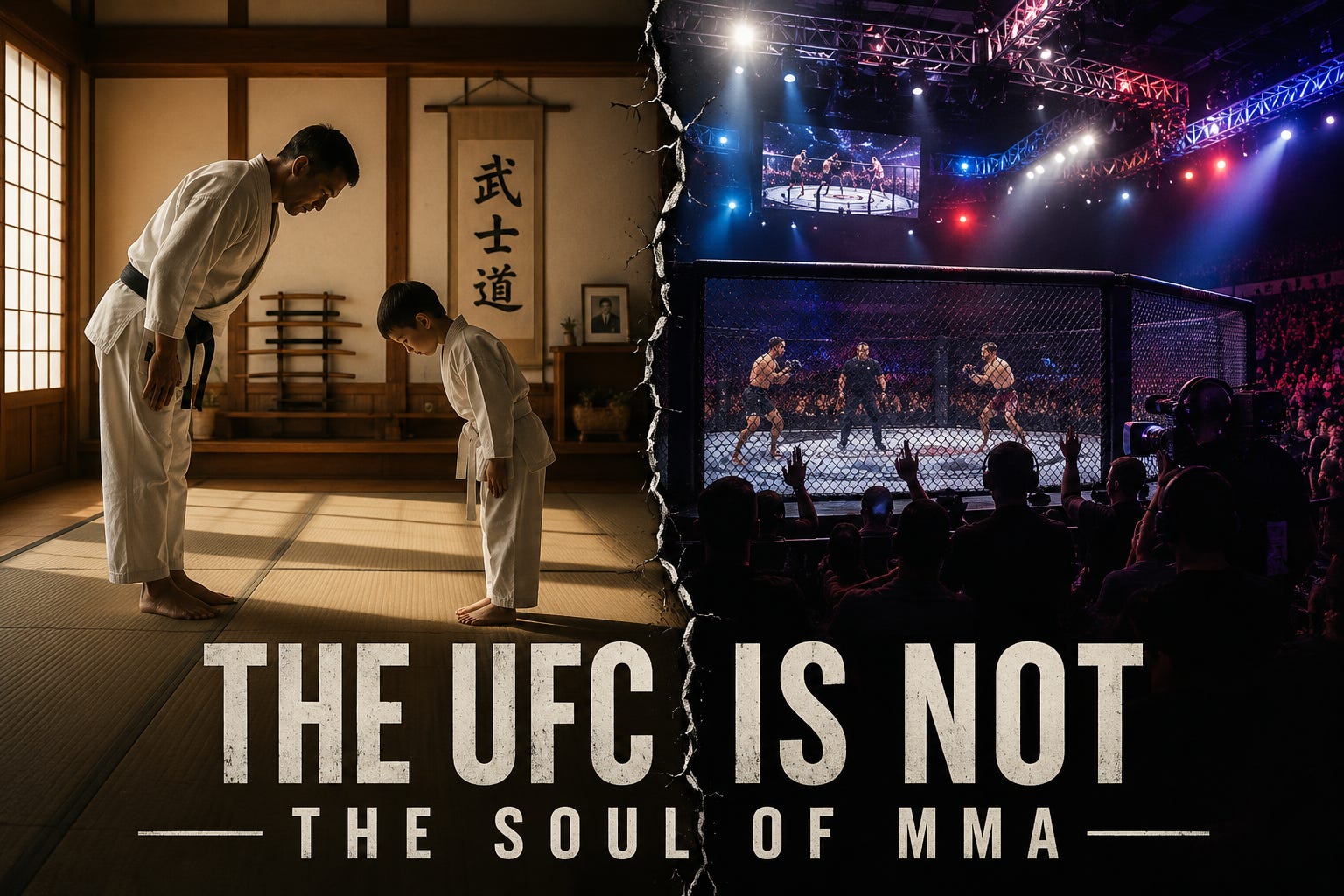
Every day, in dojos and gyms, warehouses, strip malls, and community centres, well-meaning instructors try to make people better.
They teach children how to lose with grace. They teach adults how to control their tempers. They teach that the point of learning to fight is so you don't have to. The kicks and punches are almost secondary to the lesson underneath: discipline, humility, respect.
They don't always live up to those ideals themselves. They're human. They make mistakes.
But they believe the world would be a better place if more people trained.
Then there's the UFC.
I remember when being an MMA fan meant being part of a niche community. We passed around grainy VHS tapes of pay-per-views that nobody can honestly remember paying for. We'd watch them over and over, pausing exchanges to study a guard pass, a foot sweep, a combination we'd never seen before. We weren't chasing chaos. We were chasing understanding.
Maybe that's nostalgia.
But maybe it isn't.
Somewhere along the way, the UFC stopped simply promoting mixed martial arts and started defining it. It discovered that technical mastery doesn't trend the way outrage does. Humility doesn't generate clicks like ego. Respect doesn't sell pay-per-views like tribalism.
The organization didn't invent martial arts fandom—it inherited it. But it made choices about what to amplify. Every promotion does. The UFC chose spectacle as often as substance, personality as often as principle.
To be clear, this isn't an attack on UFC fans. Millions tune in because they appreciate extraordinary athletes performing at the highest level. Many are lifelong martial artists themselves.
The criticism is aimed at the institution.
I'm watching the World Cup as I write this. Football has its own catalogue of corruption, political compromise, and ethical contradictions. I don't believe in moral purity tests. If we boycotted every flawed organization, there would be very little left to enjoy.
But not all flaws are created equal.
In football, the game is bigger than its administrators. You can still lose yourself in the players, the clubs, the tactics, the history, and the supporters. The bureaucracy fades into the background.
The UFC is different. Its leadership is part of the product. Its executives, commentators, and public personalities are inseparable from its identity. Their worldview becomes intertwined with the brand itself. Separating the sport from the institution becomes increasingly difficult when the institution insists on being the face of the sport.
And that's a shame because mixed martial arts deserves better.
MMA is one of humanity's great collaborative achievements. It is karate borrowing from wrestling, judo learning from boxing, jiu-jitsu adapting to Muay Thai, and every style discovering that it has something to teach and something to learn. It is proof that traditions can compete fiercely without losing respect for one another.
The greatest tragedy isn't that the UFC changed mixed martial arts.
It's that, for millions of people, it became mixed martial arts.
That confusion has consequences. Children walk into local dojos believing martial arts is about trash talk and intimidation. Parents see only blood and bravado instead of discipline and self-control. The quiet values that built these arts are drowned out by the loudest microphone in the room.
Traditional martial arts were never about creating the toughest person in the building. They were about creating the person least likely to need to prove it.
I don't expect perfection from the organizations I watch. I don't even expect them to share my politics. But I do expect them to recognize the responsibility that comes with representing something larger than themselves.
Because the soul of martial arts was never found under bright lights or in a pay-per-view main event.
It's found in the instructor who stays after class to help a struggling student.
It's found in the black belt who bows to a beginner.
It's found in the competitor who wins with humility and loses with dignity.
The UFC may own the biggest stage in combat sports.
But it does not own the soul of mixed martial arts.