

We’re trying to keep AI out of the classroom, and I think that might be a huge mistake.
I understand why.
AI has been framed as a cheating machine because it can do the work for a student without the student learning anything.
Take a picture of a page of long division and it can solve the whole thing in seconds. Five-hundred-word book report? It doesn’t even break a sweat.
Assuming it could sweat.
That obviously needs to be addressed.
But as I prepare to return to teaching academics after nearly three decades out of school, I’ve been using AI to brush up on some long-forgotten skills.
Long division. Fractions. Parts of speech.
The other day I created a prompt to drill me on identifying adverbs.
AI gives me a sentence. I identify the adverbs. It scores my answer, corrects my mistakes, explains what I got wrong and gives me another.
And it adjusts.
When I’m flying, it increases the difficulty. Before long I’m feeling pretty smart and wandering into grammatical territory that starts looking more like professional linguistics than an elementary school refresher.
Other times I’m hungry, tired and just not getting it.
So it slows down.
It brings me back to my operating level and starts building again.
That got the teacher in me thinking.
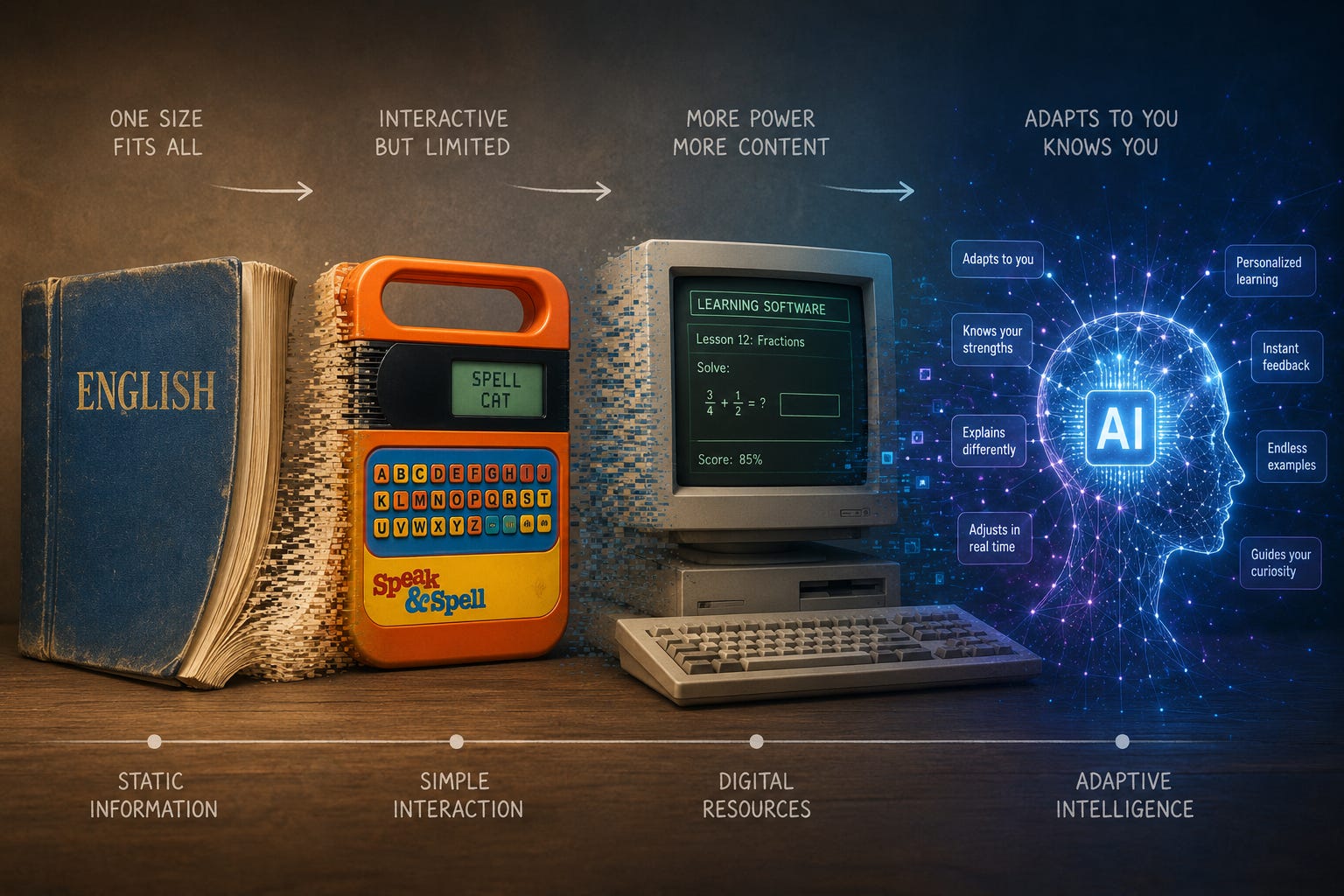
I had a Speak & Spell when I was a kid. At the time, it seemed like magic. It gave me words, I spelled them and it told me whether I was right.
But that’s all it could do.
AI can notice that a child keeps struggling with a particular type of word. It can isolate the problem, explain it differently, create new examples and drill that specific skill. With the right prompt written by the right teacher, it can make the whole thing feel like a game.
My Speak & Spell could play a game someone had programmed into it.
AI can build the game around the kid playing it.
And I was one of those kids who could have used that.
I wanted to learn. I wanted to pay attention.
But my mind wandered.
When you’re a kid sitting in a classroom and you stop understanding what’s being taught, eventually the teacher starts sounding like an adult in Charlie Brown.
Wah wah wah wah wah.
I’d be following along with fractions, my mind would wander somewhere around reciprocals, and by the time I tuned back in we’d somehow moved on to Indigenous migration patterns.
I wasn’t refusing to learn.
I’d just lost the thread.
And in a classroom full of other kids, the lesson can’t always stop and wait for you to find it again.
AI can.
I lost you.
It can go back.
No, before that.
Back again.
It can keep working backwards until it finds where understanding stopped and start rebuilding from there.
We’ve talked about individualized learning forever. The problem is there might be thirty individuals sitting in the room and only one teacher.
AI changes that arithmetic.
The student who needs more time can take more time. The student who already understands can move ahead. The kid who needs to work at a lower grade level, gets to sit in the same class as their peers, without shame or stigma. A kid fascinated by some tangent can chase the rabbit hole and then be guided back to the core knowledge they need.
For a mind that doesn’t always travel in straight lines, AI can be an engine and a compass.
None of this means handing every kid ChatGPT and getting the teacher out of the way.
The teacher decides what needs to be learned. The teacher designs the exercise. The teacher recognizes when the AI is wrong. And the teacher decides when the tool needs to be put away.
If I’m assessing whether a student understands long division, having AI solve the problem defeats the purpose.
Put it away.
But after the student tries, could AI identify where they went wrong, explain the mistake and generate another problem targeting it?
Pick it up.
If I’m assessing whether a student can construct an argument, having AI write the essay tells me nothing.
Put it away.
But could AI challenge the argument the student wrote, ask questions and force them to defend their reasoning?
Pick it up.
Maybe that’s the distinction we’ve been missing.
Use AI when it expands the thinking. Put it aside when it replaces the thinking.
We don’t need classrooms without AI.
We need teachers and students who understand when to use it and when not to.
Because the most interesting thing I’ve discovered while relearning adverbs isn’t that AI can give me the answer.
It’s that the worksheet can finally notice the student.
Have you ever wondered if it's giving you incorrect answers?