

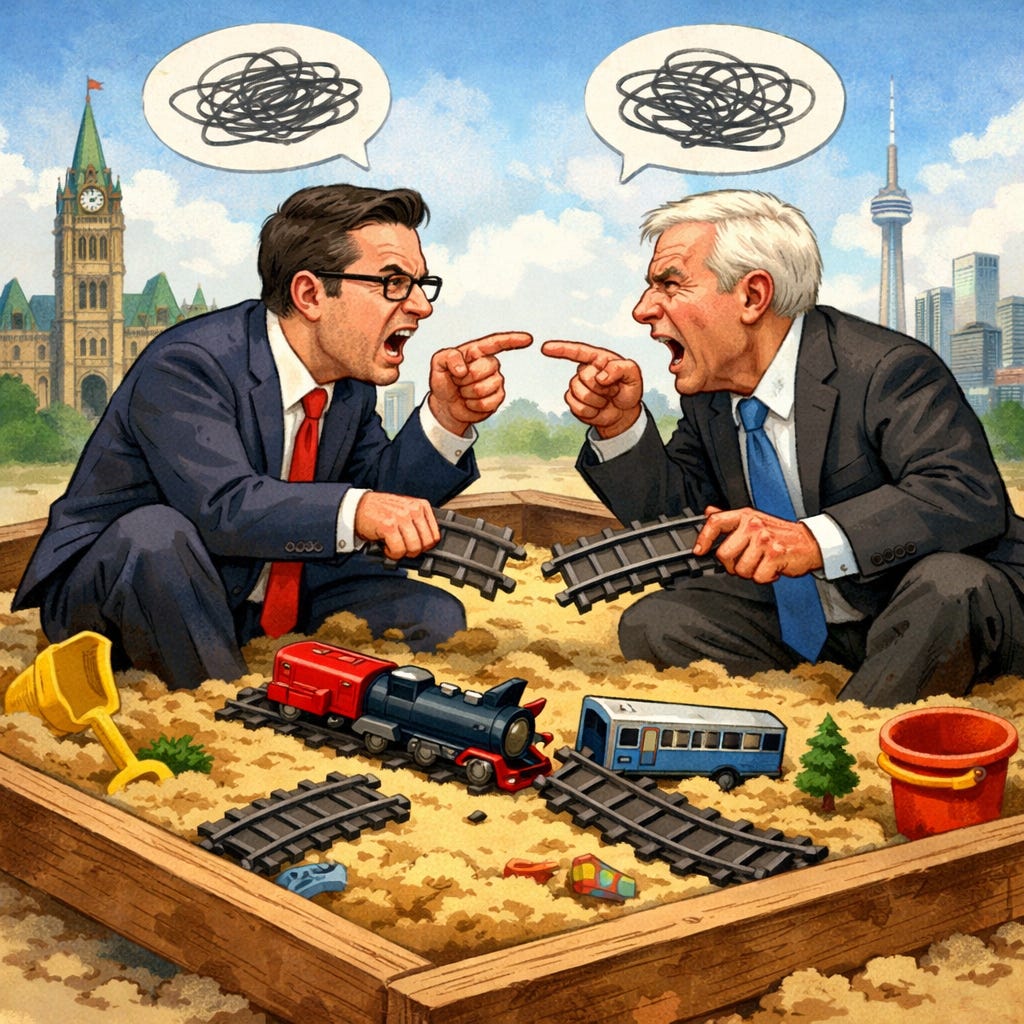
Pierre Poilievre is out attacking the proposed rail line linking Toronto to Montréal and beyond, as though passenger rail in this corridor is some brand-new Liberal fever dream.
It isn’t.
Canada has been talking about better rail in this corridor for years. Governments have studied it, committees have reviewed it, and politicians of all stripes have understood the same basic reality: the Toronto–Québec City corridor is the most populated stretch of the country, and our passenger rail service is embarrassingly slow for a modern economy.
And here’s the part that makes this whole performance so transparent.
Conservatives didn’t suddenly discover problems with this corridor.
Under Andrew Scheer, they supported expanding passenger rail in this exact Toronto–Québec City corridor. Party members backed it. The idea passed internally with strong support.
The difference isn’t the corridor.
It isn’t the need.
It isn’t even the concept.
The difference is who’s proposing it — and how ambitious the version is.
What was once framed as high-frequency rail — faster, more reliable service — has now evolved into a high-speed proposal. Fine. That’s what progress looks like. Ideas grow. Plans improve. Technology advances.
But now that the Liberals are the ones pushing it forward, Pierre Poilievre is acting like the entire concept is absurd.
That’s not leadership.
That’s reflex.
Because the job of opposition is not to play tug-of-war with the government like a contrarian child. It’s not to say left when they say right, down when they say up, no when they say yes.
The job of opposition is to hold government to account.
To challenge waste.
To expose incompetence.
To improve ideas.
To push projects to be done better, faster, and more responsibly.
A serious opposition leader wouldn’t be pretending the rail corridor itself is the problem.
He’d be asking:
Why did it take this long?
Why are we still talking about planning when we should be building?
Why have Canadians spent years hearing about rail modernization without seeing steel in the ground and passengers on trains?
That would be leadership.
Because if Poilievre actually wanted to govern, he could have taken the more intelligent line: yes, build the corridor — but stop dithering, stop delaying, stop announcing and re-announcing the same dream while nothing gets done.
He could have positioned himself as the guy forcing the government to move.
The guy demanding timelines.
The guy saying Canada should already be riding the thing by now.
Instead, he chose the cheaper instinct: oppose it because the Liberals touched it.
That’s the tell.
Poilievre’s problem isn’t that he disagrees with bad government. His problem is that he seems incapable of recognizing a good idea once the wrong team says it out loud.
Even when that idea is exactly the kind of nation-building infrastructure politicians are supposed to champion.
And while Canada keeps debating, countries we’re told to fear are building.
China’s high-speed rail network hit roughly 35,000 kilometres years ago.
They didn’t build that because they’re magically smarter.
They built it because they decided infrastructure matters.
Meanwhile, in Canada, we still argue like building useful things is some kind of ideological trap.
That’s the real embarrassment.
Conservatives are often the first to warn about falling behind global competitors — to talk about productivity, trade, economic growth, and national strength.
Fine.
Then act like it.
Because you do not keep pace with the future by whining about infrastructure.
You do not compete by romanticizing stagnation.
And you do not become a serious country by treating every major project as a partisan football.
If Poilievre thinks he should be prime minister, then he should start acting like someone interested in governing rather than someone obsessed with winning the title.
He’s been elected for two decades.
He has held office.
He has had every opportunity to be more than a critic.
But this is the problem with career politicians.
Eventually, they stop seeing public office as a place to build things and start seeing it as a stage for permanent campaign mode.
Everything becomes performance.
Everything becomes grievance.
Everything becomes someone else’s fault.
A rail line that could connect cities, move people more efficiently, ease pressure on existing networks, and help drag Canada a little closer to the century it already lives in should not be controversial because one party announced it.
The nuanced conservative response would be simple:
Build it.
Do it faster.
Do it responsibly.
And stop making Canada wait.
Instead, we get a man who sounds less like a prime minister in waiting and more like a whiny kid furious that somebody else picked up the shovel.
That’s Pierre Poilievre in a sentence:
more interested in having the job than doing it.
The rail - in so many ways - is such a massive challenge and conversation that needs to happen throughout North America.
I'm so happy you called out one of the many challenges in discussing this issue!
Infrastructure is a massive issue throughout this entire continent, and the rail is one of them! It always has been.
I appreciate that you write about Canada, but I can't tell you how much of your work is a discussion about continental high-level issues!
Keep going! I absolutely love reading!