

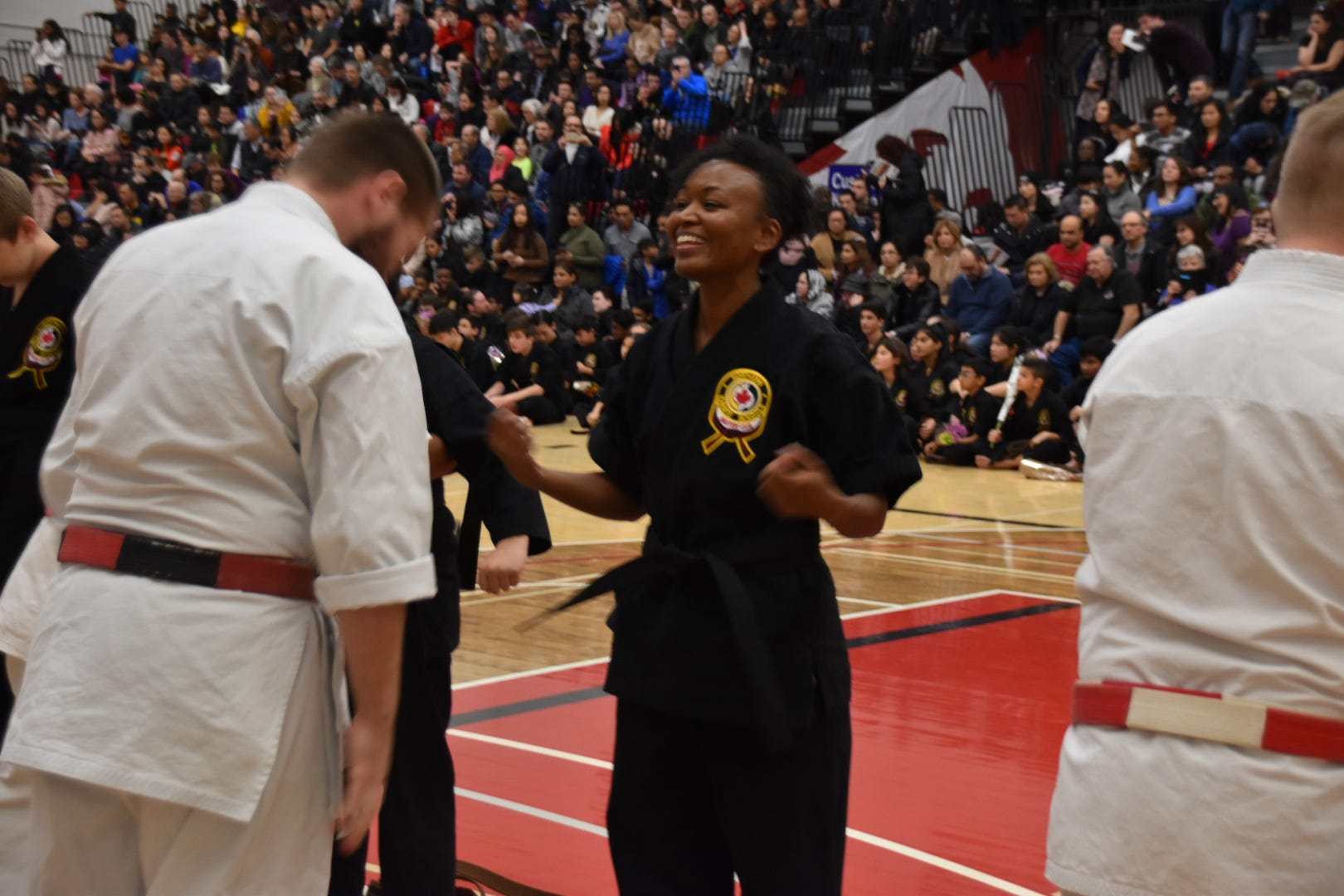
Let me explain belts and ranks in martial arts — in a way even martial artists can understand.
Two people in the same dojo can hold the same rank for completely different reasons.
Martial arts ranks are not universal.
Hell, two PhDs from the same program aren’t equal either — but they both get to walk around calling themselves “Doctor.”
Martial arts are no different.
In my dojo, the average time to reach black belt is about five years.
But “average” doesn’t mean anything once you start looking at real people.
Take one of my students — a young teenager who earned her black belt in three.
She’s gifted. Trains every day. Practices on her own.
As far as martial arts goes, she’s special.
Now look at the kid standing beside her wearing the same belt.
Not as skillful. Not even close.
Maybe they only trained twice a week.
Maybe their parents dragged them in for the first couple years.
Maybe they were half-in, half-out because of other activities.
Maybe karate just isn’t their favourite thing.
But does it have to be their favourite thing?
Or do they just have to want to do it?
That second kid took seven years to earn what the prodigy earned in three.
They failed their test three times.
They needed extra help, extra reps, extra eyes on them.
But they stuck around.
They kept showing up.
They learned how to try hard — maybe for the first time in their lives.
So tell me — are they not allowed to feel proud of their accomplishment?
Should we not celebrate the fact that they refused to quit?
I’ve seen completely average students fail their first dan test multiple times…
and then pass their second dan on the first try.
People peak at different times.
We don’t all grow at the same speed.
And that’s the entire point:
The belt around your waist says nothing about the journey you took to earn it.
Frankly, part of me wishes we could get rid of belts altogether.
No hierarchy. No comparing.
Just people training — learning, sweating, helping, sharing this weird, beautiful thing we do.
But belts, when done properly, aren’t trophies.
They’re markers of effort, achievement, growth, and the simple, stubborn fact that you kept putting on your gi and stepping onto the floor.
When done poorly, belts become barriers.
When done correctly, they become stories.
And every story is different.
---
And here’s the part nobody in martial arts wants to admit:
Martial artists argue constantly about the “value” of a belt.
Whose system is harder.
Whose teacher is tougher.
Whose art is purer.
Whose black belt “means more.”
And you BJJ guys — relax.
We know it takes ten years.
Congratulations.
But I was around back when BJJ was still called Judo, and you know what?
Everybody got along back then.
Everybody understood it was just a different expression of the same roots.
The truth is this:
A belt has nothing to do with the art, the school, or the system.
The belt someone wears does not represent:
the quality of their dojo
the skill of their teachers
the difficulty of the curriculum
or the reputation of the style
A belt is not branding.
A belt is a story.
It represents one thing and one thing only:
That individual student’s personal journey.
That’s it.
Two black belts in the same art, same school, same instructor — and their belts can mean two completely different things.
Because they’re two completely different people.
---
And let’s be honest — we all say “belts don’t mean anything,” right?
So why don’t we start acting like it?
Why can’t a mom of three — running around like the proverbial chicken with its head cut off, squeezing in a few hours of kata for herself — be celebrated for her accomplishments too?
Why measure her against the 20-year-old who woke up hungover, stumbled into the dojo, and kicked everyone’s ass?
Let’s not pretend that doesn’t happen.
More than belts, I’d love to get rid of the gatekeepers who put too much value on ranks.
Who treat belts like sacred objects.
Who wrap martial arts in ego, dogma, and weird pseudo-religion.
Because while karate is my religion, I’m still an atheist at heart.
I don’t need something to worship.
I don’t need something to envelop me.
I put karate down all the time.
I go hours without thinking about it — and it’s still the biggest thing in my life.
But what am I supposed to do?
Not have other interests?
Not pick up my guitar and play badly?
Not sing Bob Seger with my son while he drives us around in his ’67 Impala?
What kind of father would I be?
More importantly, what kind of sensei would I be if I didn’t understand that my students have entire lives outside the dojo?
If martial arts is your whole life — if you think about it morning and night, read about it, eat for it, train through family dinners, and ache to get back on the floor — good for you.
You have something you love completely.
I envy your singular focus.
But you can’t measure the rest of us by your standards.
They’re too high.
Too narrow.
Too suffocating for the normals — the humans — who need balance, who love karate deeply but not exclusively.
Most people aren’t trying to be perfect.
They’re just trying to be better.
And that deserves a belt too.