

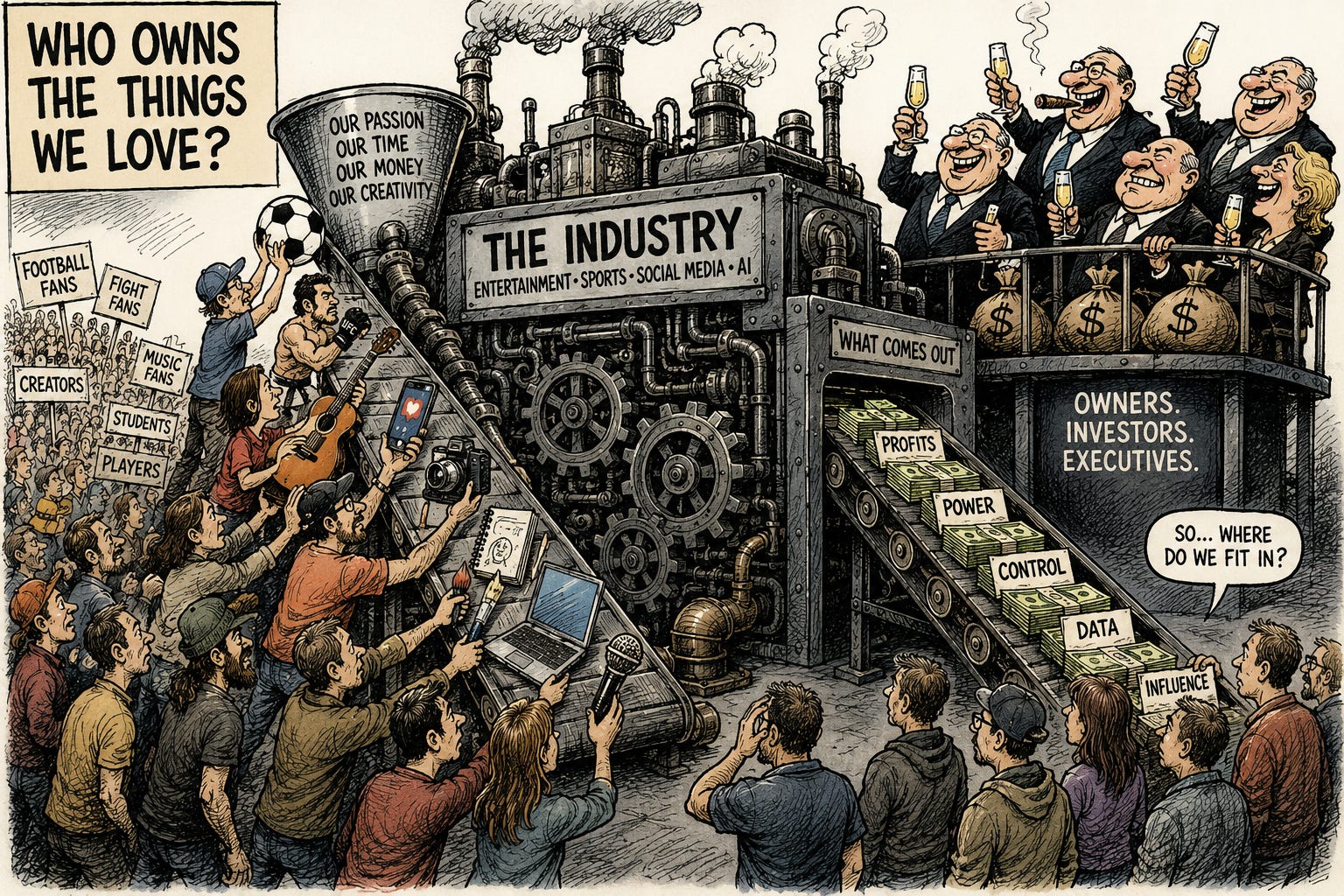
Most of the things we love are owned by people we'd never invite over for dinner.
Football fans love football. Most don't love FIFA.
Fight fans love fighting. Most don't love the UFC's executives.
Musicians love music. Most don't love record labels.
People love talking to each other. I'm not convinced anyone actually loves social media companies.
And yet somehow we've accepted a strange arrangement:
The people who create the culture rarely own it.
The people who own it rarely create it.
Think about football.
Millions of people wake up early on weekends. They spend thousands on tickets, jerseys, travel, subscriptions, and pints at the pub.
Children kick balls in parks. Parents drive them to practices. Volunteers coach local clubs. Players dedicate their lives to the game.
Without them, football doesn't exist.
But somehow FIFA ended up owning the keys to the kingdom.
The same thing happens everywhere.
The fighters take the punches. The fans buy the pay-per-views. The coaches spend decades developing athletes.
Yet a handful of executives end up controlling the sport.
Social media takes it even further.
At least FIFA didn't invent football.
Facebook didn't invent friendship. Instagram didn't invent photography. TikTok didn't invent creativity.
The users create everything.
The posts. The videos. The comments. The communities. The trends.
The companies provide the infrastructure.
That's important work.
But let's be honest about the arrangement.
We build the city. They own the roads.
And before anyone screams socialism, let's remember we've seen this story before.
Electricity became important enough that we regulated it.
Water became important enough that we regulated it.
Banking became important enough that we regulated it.
Telecommunications became important enough that we regulated it.
Not because governments are perfect.
Not because public ownership magically fixes everything.
But because at some point society recognized that certain things become too important to leave entirely to whoever happens to own them.
The internet crossed that line years ago.
Social media crossed it too.
AI is standing on the edge of it right now.
Bernie Sanders recently suggested that AI should have some form of public ownership.
Whether he's right or wrong isn't actually the interesting question.
The interesting question is why so many people immediately dismissed the idea as radical.
If AI becomes the infrastructure for education, communication, research, entertainment, customer service, healthcare, and knowledge work, why shouldn't the public have some say in how it operates?
If Facebook can influence elections, shape public discourse, and determine what billions of people see every day, why shouldn't it face the same scrutiny as other critical infrastructure?
If a platform affects society, shouldn't society have a voice?
The answer isn't necessarily government ownership.
Government can be inefficient. Corporations can be corrupt.
Neither deserves blind trust.
But there has to be something between complete corporate control and complete public ownership.
Some form of accountability.
Some recognition that once a thing becomes woven into the fabric of society, ownership alone shouldn't grant absolute authority.
We're constantly told:
"That's just how it works."
But that's what people said about monopolies. About child labour. About company towns. About banks. About railroads.
History is full of systems that seemed permanent until enough people asked why.
And maybe that's the real question.
Not who owns Facebook. Not who owns FIFA. Not who owns the UFC.
Who owns the culture?
Because last time I checked, it wasn't the executives filling the stadiums.
It wasn't the shareholders creating the content.
It wasn't the board members teaching the classes, coaching the teams, writing the songs, filming the videos, or buying the tickets.
It was us.
The people who show up.
The people who care.
The people who make the thing worth owning in the first place.
So here's the question:
If we create the value, build the culture, and keep the whole machine running...
why are we always the last ones asked what should happen to it?
Fact check me.