

As summer winds down and my family gets ready to send the kid off for his last year of high school, we can't help but start considering what comes next.
And since this kid is so much smarter than his old man, he has some lofty goals.
I've realized he's not going to get there on his own.
So I'm sitting here with a laptop, researching university admission requirements and figuring out a strategy to give him the best chance of success.
Because with everything he's already got going on—making the grades, working the summer business he started, engaging in extracurricular activities—he can't possibly be expected to have the bandwidth to strategize his admission plan too.
I had supportive parents. They wanted me to succeed. But they were completely ignorant when it came to the workings of university admissions.
I went through it on a whim and a prayer.
I want my kid to have the leg up I never had.
And there's good reason for me to put in the effort, because all those kids at the top, snagging the best spots?
They're not doing it on their own either.
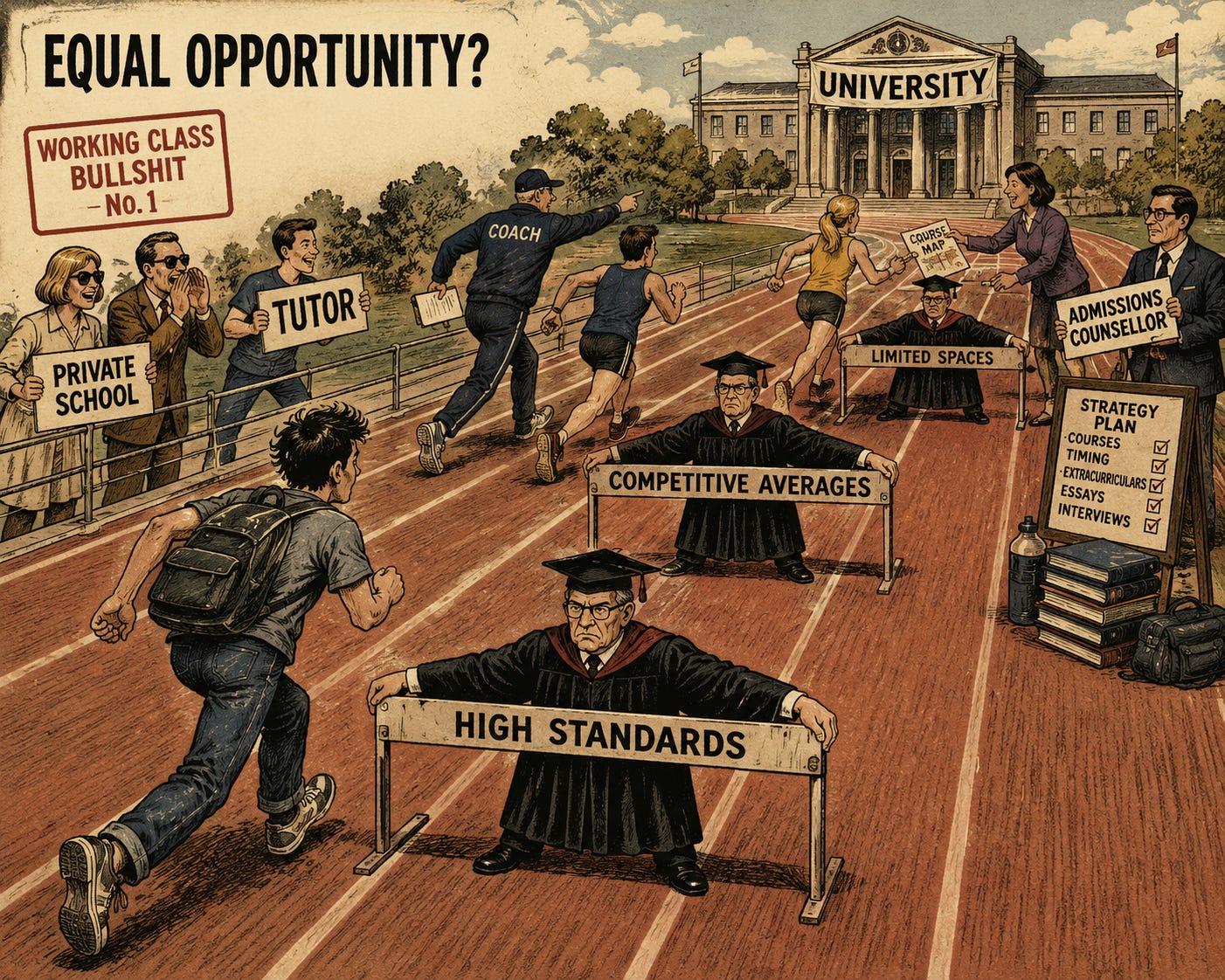
Private schools. Extra tutoring. Professional admissions advisors. Parents who already understand the system.
The idea that a kid should bear all the responsibility for his own success and stand entirely on his own two feet is some working-class bullshit.
What surprised me was how much strategy there actually is.
Which courses should you take? When should you take them? Which marks count? When are offers made? What does one university value that another doesn't? What can you do now to put yourself in a better position a year from now?
None of this is secret.
That's what makes it interesting.
The information is available to everyone.
And we have somehow confused access to the system with equal opportunity within the system.
The elites don't have to put up walls anymore and tell the rest of us we're not welcome.
Everyone can apply.
There's the website.
There's the application.
Good luck.
But we're not running the same race.
One kid arrives knowing the course. His parents have run it before. Someone has helped him train. Maybe his school has been preparing him for this since Grade 9. Maybe his parents hired someone whose entire profession is understanding university admissions.
The other kid just knows he needs good grades and should probably apply somewhere.
Nobody cheated.
Nobody bribed an admissions officer.
Nobody bought a building and put their name on it.
One kid simply knew how the system worked.
That's privilege too.
And it starts long before the application.
Do we really think a kid in an underfunded public school with an overwhelmed guidance department gets the same university preparation as a kid at an elite private school whose reputation depends partly on getting graduates into elite universities?
Of course not.
The private-school kid isn't doing anything wrong. Neither are his parents.
If I could give my kid every one of those advantages, I would.
That's why I'm sitting here learning the system.
The problem isn't that some parents help their kids navigate it.
The problem is that a child's opportunity depends so heavily on whether someone in his life knows that there's a system to navigate.
We like to look at the results afterward and call them merit.
And maybe the kid who got the spot worked his ass off.
Privilege doesn't erase effort.
But effort doesn't erase privilege either.
My parents loved me. They supported me. They would have done anything they knew how to do to help me.
They just didn't know how this world worked.
Neither did I.
So I went through it on a whim and a prayer.
My kid won't.
Because opening the starting line to everyone doesn't make the race equal.
Not when some kids showed up with a coach and the rest of us never got the rulebook.