

Today my son was telling me about a debate he had in his Classical Civilizations class.
It was his job to defend Athena for turning Arachne into a spider for criticizing the gods. Apparently, some of his classmates may have taken offence to his argument.
His defence was pretty simple.
Arachne committed what today we might call blasphemy. She challenged the gods, insulted them and was punished for it. Athena turning her into a spider might seem a little excessive, but divine punishment for blasphemy isn’t exactly something the ancient Greeks had a monopoly on.
And that led him to something else.
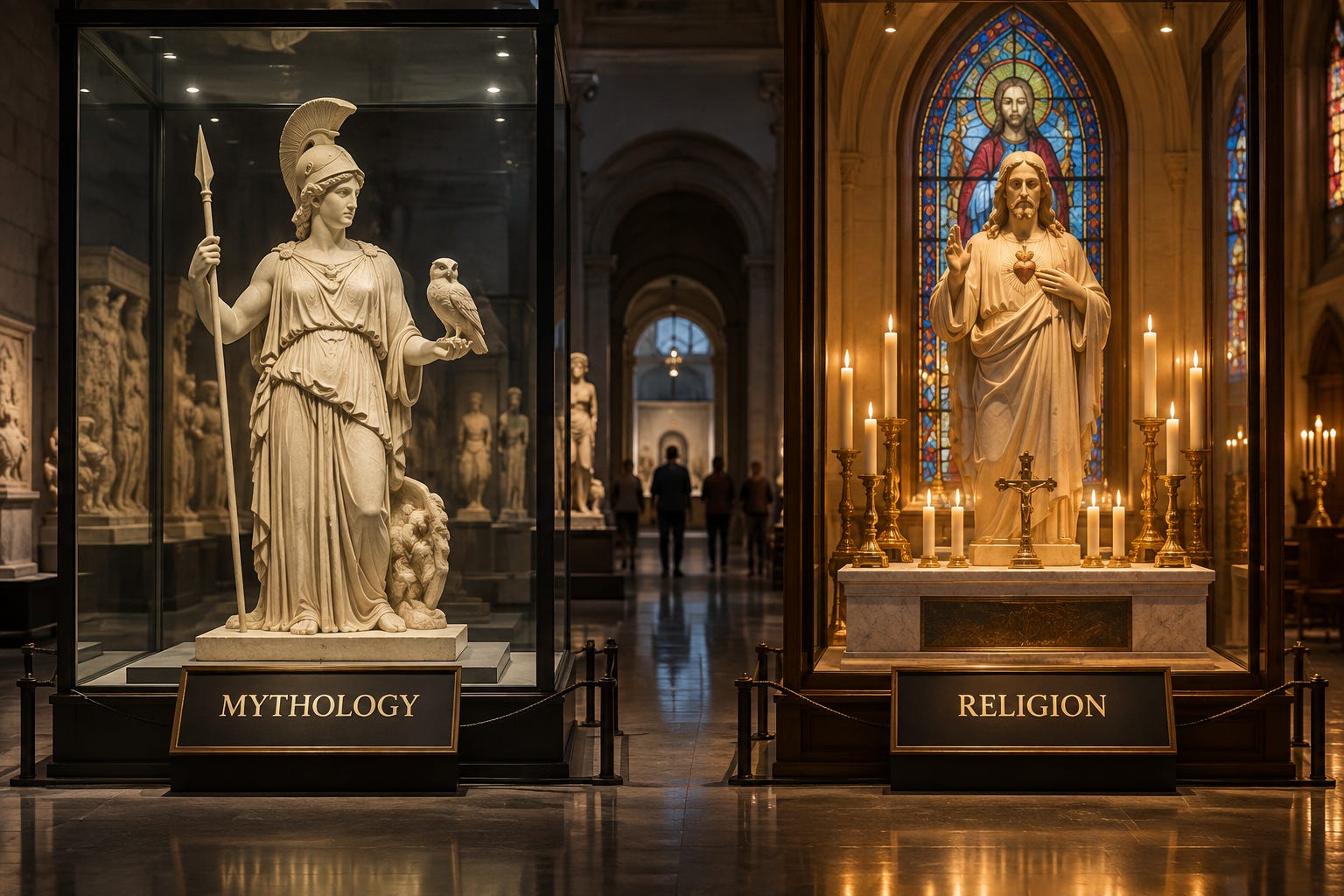
All religion qualifies, at least in one academic sense of the word, as myth.
Which shouldn’t actually be controversial.
Myth doesn’t necessarily mean a stupid thing people used to believe that we now know isn’t true. It can simply mean a traditional story through which a culture explains gods, creation, morality and humanity’s place in the universe.
Today’s mythology was once somebody’s religion.
The Greeks didn’t go to the temple and say, “Gather round, everybody. It’s mythology time.”
They believed this shit.
And this is where our conversation took a different turn.
My son has been raised in a household that we’ll politely call less than religious. So he was genuinely baffled by the idea that people could believe the supernatural stories contained within religions actually happened.
Not believe in their meaning.
Not value their lessons.
Believe they happened.
We live in a world where we know considerably more about physics, biology, astronomy and the natural world than the people who first told these stories. We haven’t explained everything about the universe. Not even close.
But seas parting, people rising from the dead, gods speaking from burning bushes and prophets travelling supernaturally to heaven aren’t exactly the kinds of explanations we’d accept for an unexplained event today.
If somebody walked into an emergency room tomorrow and announced that a dead man had risen after three days, I suspect the first call wouldn’t be to the Vatican.
Which got me thinking.
Why does it matter?
Does Jesus need to have actually been the son of God for “love your neighbour” to be good advice?
Does Muhammad’s Night Journey need to have literally happened for his teachings to contain wisdom?
Does Moses need to have received commandments directly from God for “don’t murder people” to remain a pretty solid foundation for civilization?
Why does wisdom need supernatural authentication?
We don’t demand this anywhere else.
Nobody needs proof that Aesop’s animals actually talked before accepting the moral of a fable. Nobody investigates whether Icarus really strapped wings to himself before discussing hubris. Fairy tales have been teaching children lessons for centuries without anyone demanding forensic evidence that a wolf once impersonated somebody’s grandmother.
The story isn’t less valuable because it isn’t history.
Of course, for many religious people, whether these things actually happened matters enormously. Christianity isn’t simply a collection of nice things Jesus said. Islam isn’t simply a collection of useful teachings attributed to Muhammad.
Fair enough.
But that only makes the question more interesting.
Why?
Why does compassion become less meaningful if the person teaching it wasn’t divine?
Why does mercy require a miracle?
What exactly disappears if we stop demanding that the story be factual?
You could still have Christmas, Eid, Passover, Diwali and Easter. You could keep the rituals, meals, music, community, family traditions and cultural identity we’ve built around religion.
You could pray if prayer gives you peace.
You could read scripture and find wisdom in it.
You could teach your children the stories.
You could even believe in God.
If we’re taught that God is within us, maybe that’s real enough.
What might disappear is the need for everyone else’s story to be wrong.
Because once my supernatural claim has to be literally true, your contradictory supernatural claim becomes a problem.
My God said this.
Your God said that.
My book is revelation.
Your book is mythology.
My prophet spoke to God.
Yours was mistaken.
And somehow, conveniently, the religion I happened to inherit from the family and culture into which I was born tends to have gotten the universe exactly right.
Funny how often that happens.
I’m not naive enough to think removing religious literalism would bring world peace. Human beings have demonstrated an extraordinary ability to find reasons to hate each other. We’d manage.
But we’d have one fewer reason to believe God wanted us to.
Maybe mythology isn’t an insult.
Maybe that’s where religions eventually go when enough time passes and nobody is left who needs the stories to be facts.
Athena turns Arachne into a spider and we call it mythology.
A god performs a miracle and we call it religion.
Maybe the difference isn’t the story.
Maybe it’s whether anyone is still around insisting it really happened.